

Psomagen has successfully transformed its business fundamentals through financial structure improvements driven by operational efficiency and a return to profitability. The company aims to continue growing its performance by enhancing its competitiveness in the U.S. genomics analysis market.
In particular, it expects to benefit from spillover effects if the National Defense Authorization Act (NDAA), which includes the Biosecurity Act, is enacted in the United States next year.
Psomagen said Friday that it is strengthening its revenue base locally based on genomics analysis supply contracts with major clients, including the U.S. National Institutes of Health (NIH), Moderna, and the Michael J. Fox Foundation.
The company also emphasized that it has proactively adopted the latest sequencing platform, "UG100," from global genomics analysis firm Ultima Genomics, and is expanding its business scope into various clinical service areas.
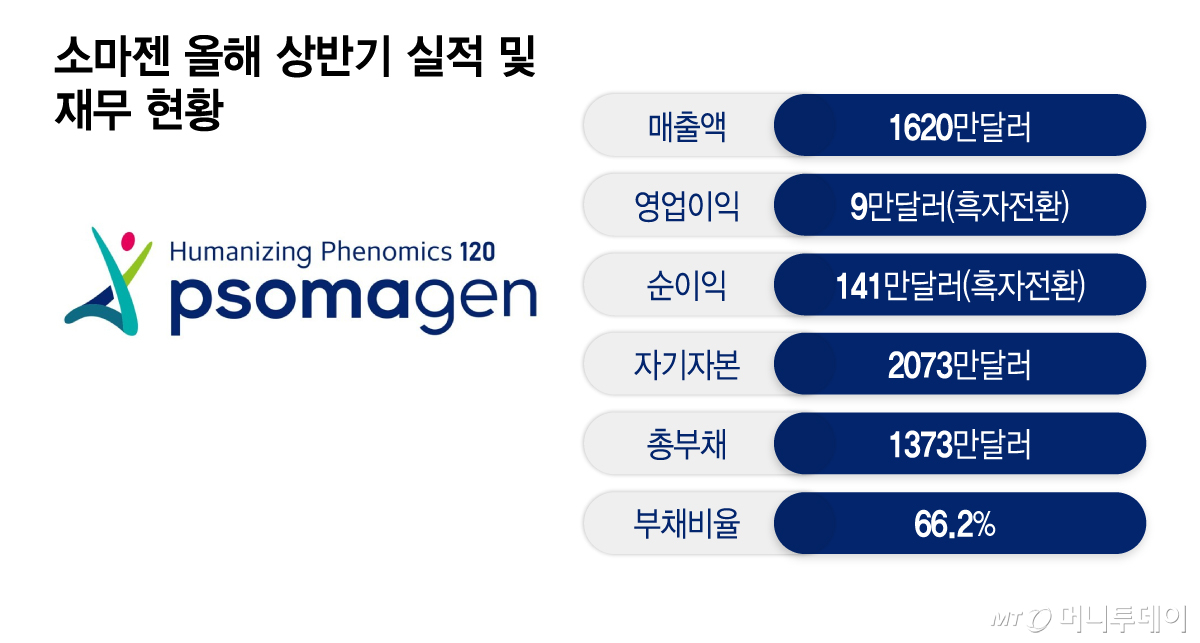
Psomagen is a U.S.-based genomics analysis company listed on the KOSDAQ market in July 2020. In the first half of this year, it recorded revenue of $16.2 million (approximately 21.6 billion won) and an operating profit of $90,000 (approximately 120 million won), marking a return to profitability. Analysts attribute this primarily to cost-efficiency strategies, such as cost reduction, aimed at improving profitability.
In the first half of this year, Psomagen sold a portion of its shares in its subsidiary KEAN Health and offset its accumulated deficit with excess capital from stock issuance.
Through these measures, it eliminated all of its accumulated deficit, which stood at $66.24 million (approximately 88.4 billion won) as of the end of last year, converting it into retained earnings of $14.5 million (approximately 19.3 billion won). By maintaining a debt-free management policy to minimize financial costs, the company has established a structure that allows it to focus on its core business of genomics analysis services.
Psomagen's strategy is to continue renewing contracts for single-cell analysis services with major clients while expanding new businesses, including direct-to-consumer (DTC) home genetic testing, proteomics analysis, clinical genomic analysis, and microbiome analysis.
Changes in the U.S. genomics analysis market environment are also noteworthy. This is because Psomagen could benefit from sanctions on Chinese biotech companies that would begin if the National Defense Authorization Act, including the Biosecurity Act, is enacted in the United States next year.
The bill aims to block transactions with "concerned biotech companies" that may pose a threat to U.S. national security, and it includes Chinese genomics analysis firms on the "Chinese Military Companies List" (1260H) designated by the U.S. Ministry of National Defense. Consequently, it is expected that movements to switch suppliers to U.S. genomics analysis companies, including Psomagen, will gain momentum locally.
A company official said, "While many domestic and international genomics analysis companies are struggling due to declining revenue and other factors, Psomagen continues to secure additional orders based on a stable client network established in the U.S."
The official added, "With the enactment of the U.S. National Defense Authorization Act next year, we can also expect structural spillover benefits." Furthermore, the official noted, "Following our return to profitability this year, we will accelerate the pace of performance growth starting next year."

 in THEBIO
