

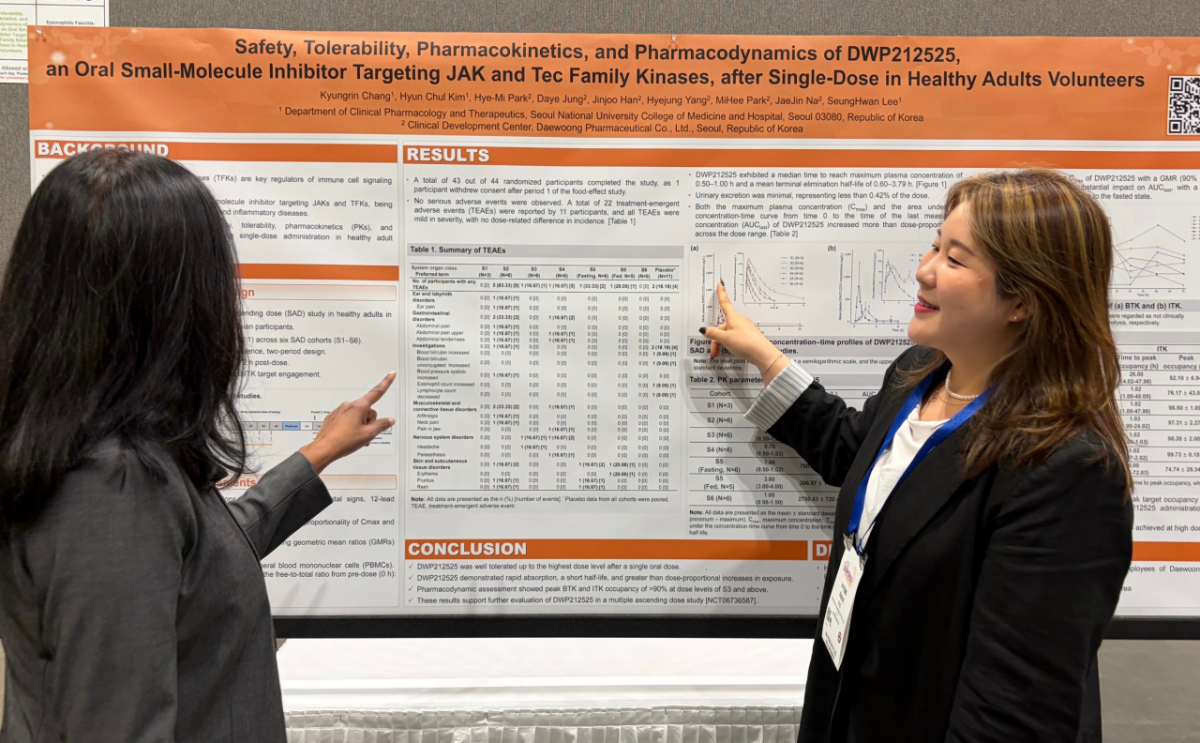
Daewoong Pharmaceutical confirmed a maximum target occupancy rate of over 90% for key target proteins in the Phase 1 clinical trial of its autoimmune disease drug candidate, 'flodicitinib.' No serious adverse events were observed in a single-dose study conducted on healthy adults, securing initial pharmacokinetic and safety data for subsequent clinical development.
Daewoong Pharmaceutical announced on the 17th that it presented interim Phase 1 results for flodicitinib (DWP212525) at 'ACR Convergence 2026,' the annual academic conference of the American College of Rheumatology, held in Orlando, Florida, U.S.
Flodicitinib is an oral drug candidate being developed to treat autoimmune and inflammatory diseases. Its mechanism involves selectively inhibiting three proteins: JAK3, which regulates immune cell activity and function, and ITK and BTK, which are involved in T-cell and B-cell activation.
Daewoong Pharmaceutical is considering the development potential for various autoimmune diseases, including rheumatoid arthritis, systemic lupus erythematosus, and Sjögren's syndrome, given its ability to modulate immune responses involving both T-cells and B-cells.
The results disclosed were obtained from a single ascending dose (SAD) study within the first-in-human Phase 1 clinical trial conducted on 44 healthy adults. Analysis showed that the maximum target occupancy rates for the key targets, BTK and ITK, were each over 90%.
Target occupancy is an indicator of the extent to which a drug binds to its target protein. These results provide initial pharmacokinetic evidence that flodicitinib binds to target proteins in humans; however, therapeutic efficacy in actual autoimmune disease patients must be confirmed through subsequent clinical trials.
In pharmacokinetic evaluations, it was observed that drug exposure in the body increased as the administered dose increased. In safety evaluations, no serious adverse events occurred during the study period, and all adverse events occurring after treatment were mild. No significant difference in the incidence of adverse events was observed with increasing doses. Daewoong Pharmaceutical has completed the single ascending dose study and is currently conducting a multiple ascending dose (MAD) study. The goal is to complete Phase 1 clinical trials by Q1 next year.
Lee Seung-hwan, Professor in the Department of Clinical Pharmacology at Seoul National University Hospital, who is leading this clinical trial, stated, "No significant safety issues, such as serious adverse events, were found in the single ascending dose study conducted on healthy adults." He added, "Considering the safety results observed in the single ascending dose study, we expect good tolerability to be shown in the multiple ascending dose study as well."
Park Seong-su, CEO of Daewoong Pharmaceutical, stated, "The observation of high target occupancy for key targets in this single ascending dose study is a meaningful initial result for continuing subsequent clinical development." He added, "We will continue to secure clinical data through the ongoing multiple ascending dose study and expand the development potential of flodicitinib and global development opportunities across various autoimmune diseases in the future."

 in THEBIO
