

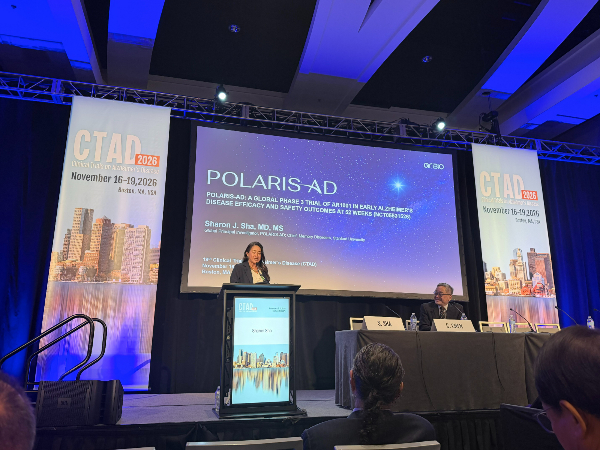
Aribio announced on the 17th that it achieved its primary efficacy endpoint in the global Phase 3 clinical trial (POLARIS-AD) of 'AR1001' (generic name: mirodenafil), an oral candidate drug for Alzheimer's disease. In the pre-specified monotherapy group, AR1001 delayed clinical deterioration by 31% compared to placebo at the 52nd-week time point, demonstrating a statistically significant difference.
Aribio announced the top-line (key metrics) results of the AR1001 Phase 3 trial at 6:05 a.m. (Korean time) on the same day at the 'International Conference on Alzheimer's Disease Clinical Trials' (CTAD 2026) held in Boston, U.S. Professor Sharon Sha, head of the Memory Disorders Division at Stanford University and overall principal investigator of the AR1001 global clinical trial, delivered the presentation.
Aribio's AR1001 is a once-daily oral treatment pipeline for Alzheimer's disease. It is a substance that works by inhibiting 'phosphodiesterase-5' (PDE-5), an enzyme that breaks down signaling molecules. The current Alzheimer's disease treatment market is centered on injectable drugs. Assessments suggest that if AR1001 succeeds in commercialization, it will possess market competitiveness by leveraging its ease of administration.
The global Phase 3 trial of AR1001 was conducted on 1,535 patients with early-stage Alzheimer's disease at approximately 230 clinical sites across 13 countries. Participating patients took one pill daily of either 30 milligrams (mg) of AR1001 or placebo for 52 weeks and underwent regular clinical evaluations.
The trial was designed to evaluate two pre-specified primary analysis populations, the Overall population and the Monotherapy population, following consultations with regulatory agencies such as the U.S. Food and Drug Administration (FDA) and the European Medicines Agency (EMA). The results for both populations were analyzed according to a pre-defined multiplicity adjustment procedure. The structure is such that if a statistically significant difference compared to placebo is observed in one of the populations, the primary endpoint is considered achieved.
The Phase 3 monotherapy group of AR1001 consisted of participants who were not taking either the existing symptomatic treatments 'acetylcholinesterase' inhibitors or 'memantine' at the baseline time point. This population was designated as the primary analysis target due to the continuity of efficacy in cognitive function and biomarkers observed in the monotherapy group in the previous Phase 2 trial. Based on this, Aribio pre-specified the monotherapy group as the primary analysis population during the design phase of the larger-scale Phase 3 trial.
The primary endpoint of the AR1001 Phase 3 trial was the change from baseline to Week 52 in the 'Clinical Dementia Rating Sum of Boxes' (CDR-SB). Analysis results showed that in the monotherapy group (604 patients), the AR1001 treatment group had a CDR-SB score deterioration that was 0.44 points less than the placebo group. The rate of clinical deterioration progression was delayed by 31%, showing a statistically significant difference (between-group difference -0.44 points, p=0.0266). In the overall population (1,535 patients), AR1001 showed a numerically favorable trend, but the difference between the treatment group and placebo was -0.11 points, which did not reach statistical significance (p=0.4015).
Secondary endpoints related to cognitive function and activities of daily living in the AR1001 Phase 3 trial showed a trend of improvement with AR1001 in both the monotherapy group and the overall population group. The effect was particularly larger in the monotherapy group. In the 13th-item Alzheimer's Disease Assessment Scale-Cognitive Subscale (ADAS-Cog13), the monotherapy group showed a difference of -1.16 points compared to placebo (p=0.0798). In the Mini-Mental State Examination (MMSE), it showed a significant difference of 0.7 points compared to placebo (p=0.0232).
Cerebrospinal fluid (CSF) biomarker analysis conducted alongside clinical evaluations confirmed results consistent with AR1001's mechanism of action. At Week 52, AR1001 significantly increased the levels of 'cGMP' (a substance involved in intracellular signaling in nerve cells) in the cerebrospinal fluid compared to placebo in both the overall population and the monotherapy group (p<0.0001 and p=0.0058, respectively). This result supports AR1001's mechanism of target engagement within the central nervous system.
Cerebrospinal fluid 'p-tau217' also showed results where AR1001 improved in both populations. The difference compared to placebo was -3.52 pg/mL (p=0.1784) in the overall population and -5.34 pg/mL (p=0.0402) in the monotherapy group. No statistically significant difference was observed in the cerebrospinal fluid 'Aβ42/40' ratio.
In safety evaluations, AR1001 showed generally relatively good tolerability during the 52nd-week dosing period. Adverse reactions occurring after administration were reported in 69.0% of the AR1001 group and 66.4% of the placebo group. Most were mild or moderate. The incidence of serious adverse reactions was similar at 10.0% and 9.8%, respectively.
The most common adverse reactions in the AR1001 group were diarrhea (7.7%, placebo group 4.4%), falls (7.3%, placebo group 5.9%), and dizziness (6.1%, placebo group 3.1%). The discontinuation rate of the investigational drug due to adverse reactions was 5.2% in the AR1001 group and 1.7% in the placebo group. Adverse reactions leading to discontinuation were diarrhea (0.7%, placebo group 0%) and vomiting (0.4%, placebo group 0%).
Aribio plans to actively proceed with additional analyses and consultations with global regulatory agencies based on the efficacy results of the monotherapy group confirmed in the AR1001 global Phase 3 trial. The goal is to verify the durability and safety of the therapeutic effect through a long-term extension trial and to focus resources on subsequent development so that the potential of an oral Alzheimer's disease treatment can be realized in actual clinical practice.
Professor Sharon Sha stated, "The CDR-SB results and safety profile of the pre-specified monotherapy group are encouraging," adding, "The AR1001 Phase 3 trial is another advancement toward addressing the unmet medical need for early Alzheimer's disease, where patients require more diverse treatment options."
James Rock, Chief Clinical Officer at Aribio, stated, "Sustained dedication from each participant and caregiver is required to participate in the 52nd-week dosing period and the ongoing extension trial," adding, "We deeply appreciate the unwavering support and dedication provided by the clinical trial sites, participants, and caregivers for the AR1001 clinical trials."
Jung Jae-jun, CEO of Aribio, stated, "We began the development of AR1001 with the goal of creating an oral treatment that slows the progression of Alzheimer's disease and can be conveniently used by patients and caregivers over the long term," adding, "The 31% delay in clinical deterioration confirmed at the one-year time point in the monotherapy group supports Aribio's hypothesis."
He also stated, "Aribio's vision is to provide patients and families with broader treatment options through a once-daily oral medication," adding, "Based on the global clinical trial results, we will quickly proceed to file for FDA approval."

 in THEBIO
