

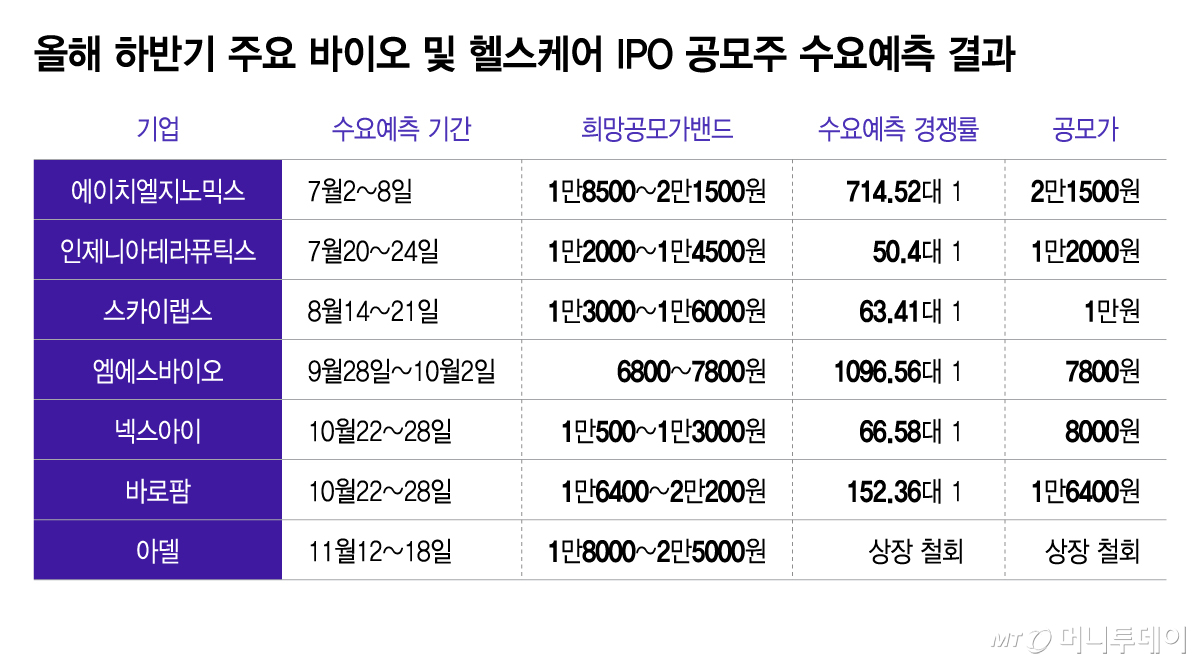
Adel has ultimately withdrawn its initial public offering (IPO). This month, Nexa's stock price plummeted after its new listing. As two major bio IPO stocks have both tasted disappointment, concerns are growing among biotech and healthcare companies preparing for their own IPOs.
On the 23rd, Adel announced that it is reviewing its IPO strategy while monitoring the stock market environment together with its lead underwriters. Previously, after conducting demand indications targeting institutional investors from the 12th to the 18th, the company submitted a withdrawal application on the 20th, canceling the remaining offering schedule.
Adel is understood to have failed to secure satisfactory investment demand during the demand indication process. This is interpreted as being influenced by the recent severe deterioration in investor sentiment across the domestic stock market as a whole.
During its IPO process, Adel attracted attention in the offering market as a major biotech company with global technology export experience. In December last year, it transferred its representative pipeline, an Alzheimer's treatment 'AEDL-Y01', to multinational big pharma Sanofi. The total contract size is $1.04 billion (approximately 1.4 trillion won).
Based on this technology transfer achievement, Adel set a corporate valuation of up to 566.5 billion won. It also emphasized the potential for technology transfers of subsequent pipelines, such as another Alzheimer's treatment 'ADEL-Y04'. However, it failed to overcome the adverse factor of the recent stock market plunge.
Since Adel passed the Korea Exchange's pre-listing review last month, it can reinitiate the offering process on the condition that it completes its listing by April next year. If it decides to retry, it must resubmit its securities registration statement by late January or early February next year at the latest, taking into account schedules such as designated audits.
Nexa, a major biotech company that launched its IPO before Adel, is also continuing a trajectory that has fallen short of shareholder and investor expectations. Nexa transferred its representative pipeline 'NXI-101' to ONO Pharmaceutical, a Japanese leader in immunotherapy drugs. Its subsequent pipeline 'NXI-201' received Investigational New Drug (IND) approvals in South Korea and the United States.
Based on these achievements, Nexa set a corporate valuation of up to 600.5 billion won. However, it failed to attract strong interest in last month's demand indication, with a competition ratio of 66.58 to 1. The offering price was set at 8,000 won, below the lower end of the desired offering price band (10,500 to 13,000 won). After its new listing on the 12th, the stock price fell further. It is currently trading in the 3,000-won range in the stock market.
The consecutive failures of two major biotech IPOs have heightened tension among biotech and healthcare companies preparing for their own IPOs. This is because two companies with global technology transfer achievements have consecutively failed to receive positive evaluations, confirming the low investment demand in the offering market for biotech stocks.
Currently, InnoVative Therapeutics and Mothers Pharmaceutical have passed pre-listing reviews and are awaiting demand indications. NovaCell Technologies, Vertis, and Briz Bio are undergoing listing reviews by the Korea Exchange. Many pharmaceutical, biotech, and healthcare companies preparing for IPOs also inevitably face significant deliberation regarding when to file for pre-listing review.
An Adel official said, "We are prioritizing a retry of the IPO through resubmission of the securities registration statement," adding, "However, we must monitor market conditions, and we have not yet made a specific decision." The official also stated, "Although we emphasized commercialization strategies for subsequent pipelines in addition to the Sanofi technology transfer, it seems the demand indication results fell short of expectations due to the severe stock market slump."

 in THEBIO
