

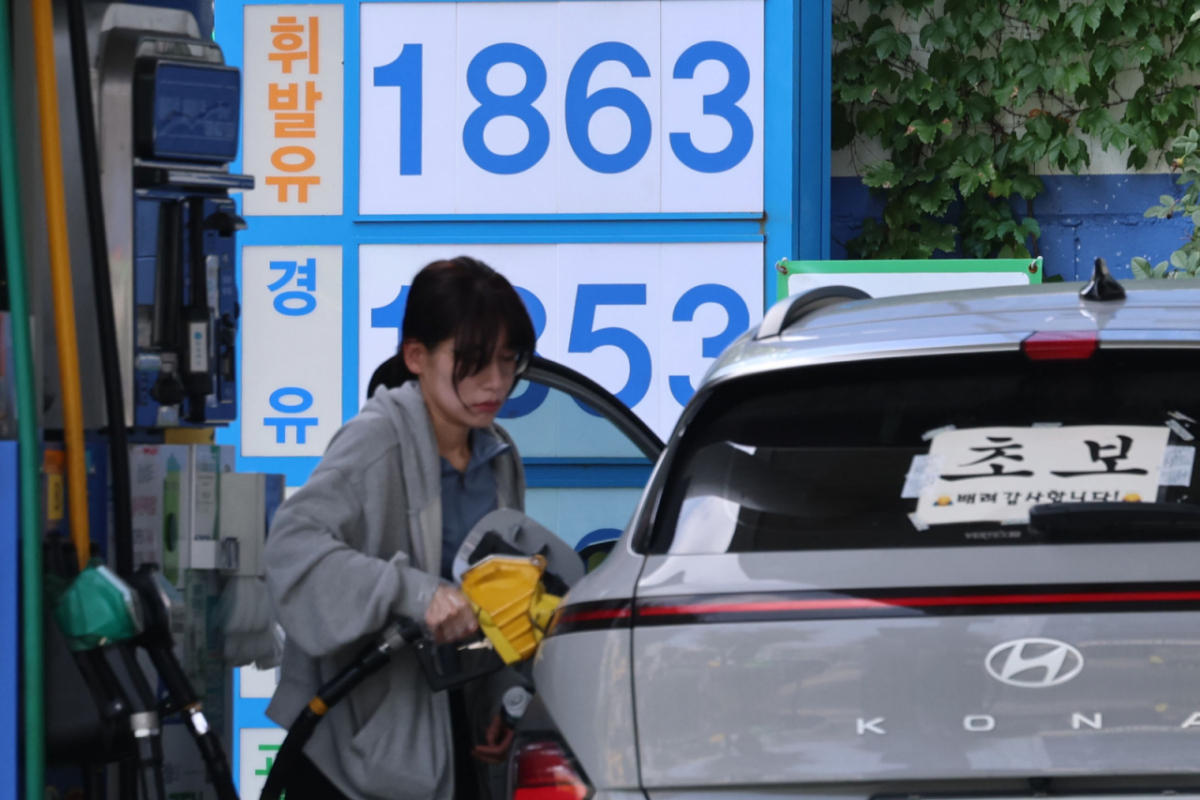
The government maintained the supply price caps for gasoline and diesel in the high 1,700 won range per liter. This marks a fourth consecutive month of freezing prices. While there are factors that would justify raising the cap given the surge in international oil prices caused by the worsening Middle East war situation, the decision to freeze was made taking into account the need to stabilize consumer prices for low-income households and the decline in exchange rates.
The Ministry of Trade, Industry and Energy announced on the 16th that it would freeze the 11th round of oil price caps at the same levels as the previous 10th round. The 11th round caps are set at △1,784 won per liter for gasoline (hereinafter per liter) △1,773 won for diesel and △1,380 won for kerosene. These prices will apply for four weeks starting from the 17th.
Since cutting the 7th round of price caps by 150 won each compared to previous levels on June 27, the government has consecutively frozen prices in the 8th, 9th, and 10th rounds. By maintaining the 11th round prices as well, a fourth consecutive freeze has been achieved.
The recent upward trend in international oil prices due to the worsening Middle East war situation acts as a factor pushing for an increase in the price cap. In the Middle East, tensions continue as Iran’s attacks on vessels passing through the Strait of Hormuz persist and Yemen’s Houthi rebels attack major Saudi Arabian facilities.
As a result, international oil prices for both Dubai and Brent crude are maintaining high levels in the range of 100 dollars per barrel, while international gasoline prices have remained at twice their pre-war levels, in the range of 130 to 140 dollars. International diesel prices are also sustained at around 170 dollars, which is double their pre-war levels.
The oil price cap is calculated by reflecting fluctuations in international petroleum product prices. If recent price changes were reflected, the cap would need to be raised, but the government decided to freeze it after considering factors such as the burden on the livelihood economy and the decline in exchange rates.
Although the consumer price inflation rate slowed to the 2.9% range last month, the burden on citizens due to rising energy prices remains significant, with petroleum product prices in September up 14.8% year-on-year despite the implementation of the price cap system.
Despite the rise in international oil prices, the burden of import costs has been somewhat alleviated by the decline in exchange rates. During the last week of March, when the second round of price caps was raised, the won/dollar exchange rate was 1,505 won, but it is currently in the 1,330 won range, more than 10% lower than at that time. The decline in exchange rates is a factor that lowers crude oil import prices.
Concerns have also been raised that if the price cap system is maintained amid growing energy supply difficulties and increased need for energy conservation, petroleum product consumption could actually increase. In fact, gasoline sales at gas stations last month rose by 3% year-on-year, marking the first time consumption has increased since the implementation of the price cap system.
In response, the Ministry of Trade, Industry and Energy explained that "the increase in September sales is estimated to be mainly due to concentrated demand from a shortened Chuseok (Korean Thanksgiving) holiday compared to the previous year and special discounts at highway gas stations," adding that "sales for the first two weeks of this month decreased by 5.5% compared to the same period last year."
There are also concerns that as the implementation of the price cap system is prolonged, the scale of compensation for losses incurred by refiners could surge. Initially, the government allocated a reserve fund of 4.2 trillion won to compensate refiners for losses, assuming a six-month implementation period for the price cap system. However, even now that six months have passed since implementation, the end of the system remains distant.
The longer the price cap system is in effect and the wider the gap between international sales prices and the cap becomes, the more the government will need to compensate refiners with tax revenue.
The government has decided to strengthen petroleum supply management while making all-out efforts to secure crude oil. The Ministry of Trade, Industry and Energy stated that "we have secured over 100% of the average crude oil import volume for October and November compared to the previous year, meaning there are no issues with crude oil supply," adding that "the government aims to stabilize livelihoods through the oil price cap system and plans to operate the system in accordance with domestic and international conditions."

 in ECONOMY
