

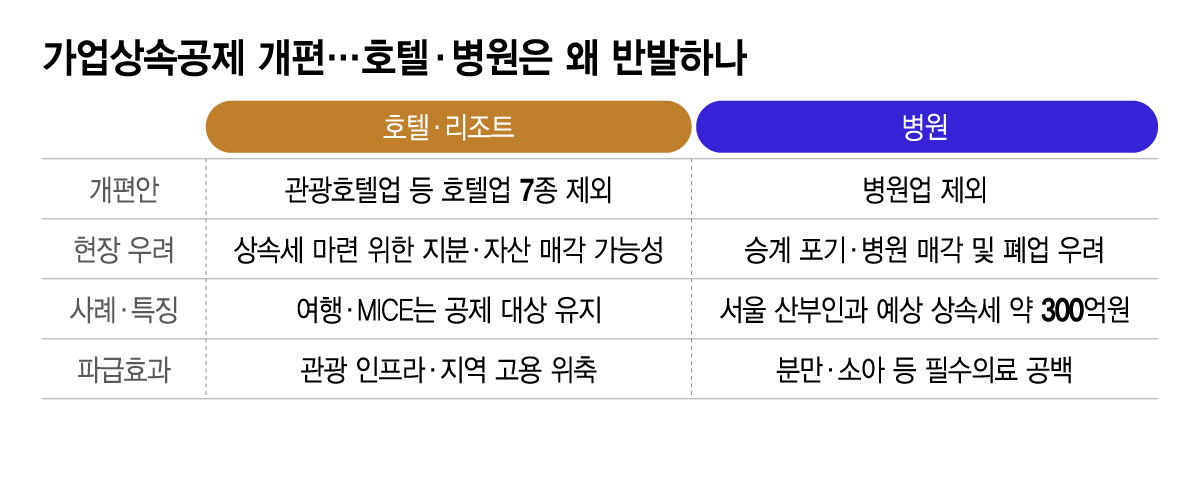
Confusion is growing in the tourism industry, including hotels and resorts, and the hospital industry over the revision plan for the business inheritance tax deduction. Concerns are emerging that even companies that have run their businesses for a long time may abandon succession or sell their facilities because their specific industries are excluded from the deduction targets.
According to relevant industry sources on the 9th, seven types of hotel businesses, including tourist hotels, were excluded from the business inheritance tax deduction targets, while travel and exhibition/convention/event management businesses remained eligible. Related organizations, such as the Korea Tourism Association Central Council and the Korea Hotel Industry Association, recently submitted a petition to the Tax Subcommittee of the National Assembly's Committee on Finance and Economy requesting that existing tourism industries be maintained as deduction targets.
The hotel and resort industry maintains that entire sectors should not be excluded simply because they have a high proportion of real estate assets. They argue that since operations include not only lodging but also food and beverage, banquets, and conventions, and long-accumulated management know-how and employment are inherited together, the characteristics of individual companies must be considered.
In fact, long-established hotels are concerned that if they cannot receive the deduction, inheritance tax could exceed their annual revenue. According to materials submitted by the Korea Hotel Industry Association to the National Assembly, Seoul Metro Hotel, which has been in operation since 1963, faces an estimated inheritance tax of approximately 10.3 billion won if the deduction is not applied, nearly double its last year's revenue of about 5.5 billion won. Daegu Grand Tourist Hotel also has an estimated inheritance tax of approximately 24.3 billion won, exceeding its last year's revenue of about 19.1 billion won.
The Ministry of Culture, Sports and Tourism has also conveyed to the Ministry of Economy and Finance its opinion that tourist hotels need to be included in the deduction targets. The Ministry of Culture, Sports and Tourism stated that it will consult with the industry and relevant ministries during the National Assembly's legislative process to ensure that hotel companies actually inheriting specialized management know-how and employment are given an opportunity for review.
Backlash is also fierce in the hospital industry. In particular, concerns are emerging that succession for private hospitals handling essential medical services, such as obstetrics and gynecology and pediatrics, has become difficult, potentially leading to business closures or real estate sales.
Currently, there are approximately 3,000 hospital-level medical institutions nationwide, including nursing hospitals, oriental medicine hospitals, and dental hospitals, of which more than 80% are private hospitals. Business succession is only possible for private hospitals. The problem is that these private hospitals have debt ratios reaching 200-300% due to chronic low medical fees.
Person A, who operates an obstetrics and gynecology hospital in Seoul, has been preparing for succession for a long time to pass the hospital to his son. He persuaded his son, who worked at a large corporation, to attend a graduate school of medicine and specialize in obstetrics and gynecology, but plans were disrupted when the hospital was excluded from deduction targets.
The inheritance tax estimated by the hospital side is approximately 30 billion won. With hundreds of millions of won in debt also owed by the hospital, there is no ready cash to pay the inheritance tax. Person B, A's son, said, "If the hospital my father has been running is excluded from the business inheritance tax deduction targets, it would be far more advantageous to sell the hospital building and land rather than inherit it while paying hundreds of millions of won."
The hospital industry is concerned that a break in succession could lead to gaps in regional and essential medical care. Shin Bong-sik, president of the Korea Association of Obstetric Hospitals, said, "Pediatric and obstetric care are fields where the supply of doctors is drying up, and for hospitals that have barely held on, succession is the only path to continue into the next generation." He added, "Currently, among obstetrics and gynecology hospitals nationwide, about 15 hospitals, including five in Seoul, are eligible for business succession. If even these disappear, the 'obstetric desert' phenomenon will become more severe."
Lee Sang-un, president of the Korea Hospital Association, argued, "Small and medium-sized hospitals that must maintain business succession are mainly concentrated in rural areas with weak medical infrastructure." He stated, "If more hospitals abandon succession due to excessive tax burdens exceeding 55%, pediatric, obstetric, and surgical operating rooms in local areas will disappear, leading to a tragedy in regional healthcare."

 in ECONOMY
