

The legislative competition over industries eligible for the family business inheritance tax deduction has heated up. As legislation continues to be introduced to rescue industries at risk of being excluded from the deduction, controversy is also growing over the criteria for selecting industries and equity.
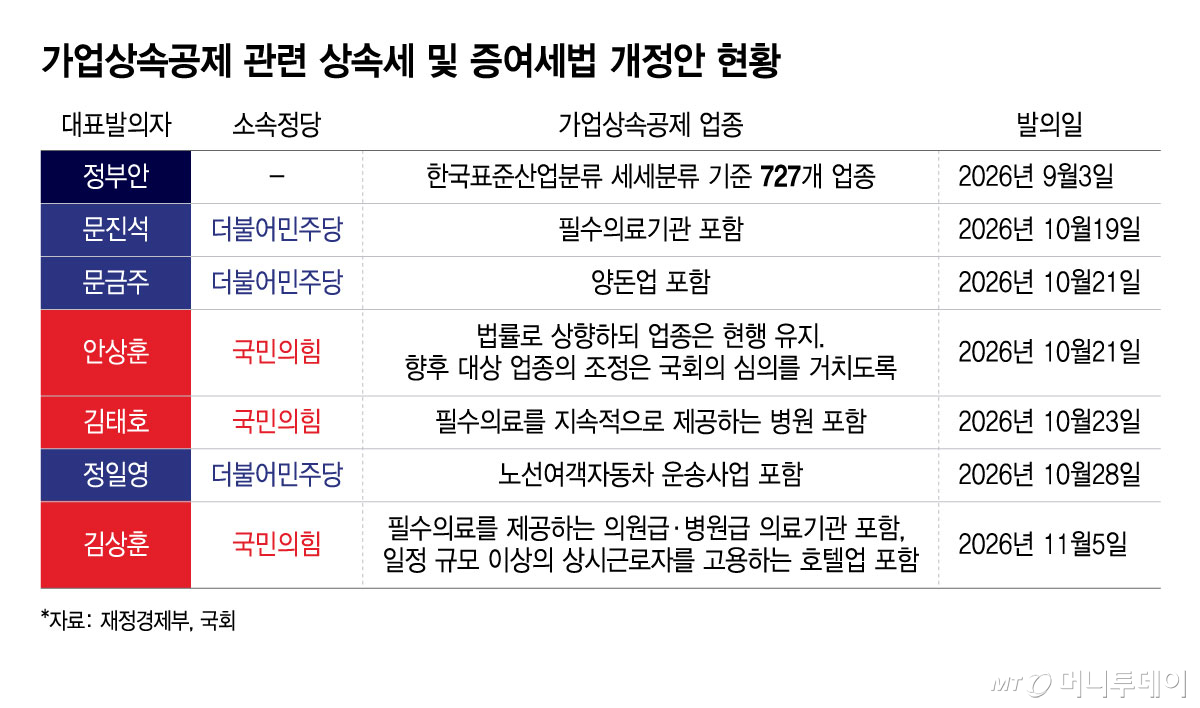
According to political circles on the 9th, a total of six amendment bills to the Inheritance and Gift Tax Act (hereinafter referred to as the Act) have been introduced recently to supplement the eligible industries for the family business inheritance tax deduction. It is unusual for responsive legislation to be enacted before the government’s tax reform proposal passes through the National Assembly.
These bills state that essential medical institutions (Moon Jin-seok, Kim Tae-ho, Kim Sang-hoon), the pig farming industry (Moon Geum-ju), route passenger automobile transportation business (Jeong Il-young), and the hotel industry employing a certain number or more of regular workers (Kim Sang-hoon) should be included among the eligible industries for the family business inheritance tax deduction.
Separately, People Power Party lawmaker Ahn Sang-hoon introduced an amendment bill as the representative sponsor, proposing to maintain the current eligible industries while adjusting them through future National Assembly review.
The amendment bills were drafted based on the judgment that there are problems with the tax reform proposal promoted by the Ministry of Economy and Finance. The Ministry of Economy and Finance is pushing for a revision of the family business inheritance tax deduction, which reduces inheritance taxes for small and mid-sized companies that meet certain requirements. While maintaining a relaxation trend, the government is now significantly strengthening the deduction requirements.
Accordingly, the “continuous management” requirement for the decedent, currently 10 years, will be strengthened to more than 30 years. The post-inheritance management period, currently five years, will also be extended to 10 years.
The threshold for eligible industries has also been raised. Currently, eligible industries are designated primarily based on the major and medium classifications of the Korean Standard Industrial Classification in enforcement decrees. Going forward, only 727 out of 1,205 industries under the detailed classification criteria will be allowed the deduction, based on legal grounds.
For example, while the entire “wholesale and retail industry” is currently eligible for the deduction, going forward, eligibility will vary even within the same wholesale and retail sector. Hospitals, hotels, and others included in the amendment bills are industries not included in the government’s selected list of eligible deductions. The pig farming industry is also not currently eligible for the deduction.
The problem is that the selection criteria are somewhat unclear, and equity controversies have been raised. In the government’s proposal, “flower and plant wholesale” was excluded from the eligible industries, while “fruit wholesale” was included.
The government plans to form a public-private review committee to determine whether to adjust the eligible industries for the deduction. However, confusion is intensifying as interests vary by industry.
Even if hospitals and hotels are included in the eligible list during the regular National Assembly session, problems remain. Dissatisfaction will inevitably grow among industries not included in the eligible list, which could lead to further legislative pressure and competition.
People Power Party lawmaker Kim Sang-hoon, who introduced the amendment bill, said, “Family business succession is something prepared with a 10- or 20-year outlook, so the collapse of predictability is the biggest problem,” adding, “It is inconsistent to say you will examine each company through a review committee while cutting out entire industries.”

 in ECONOMY
