

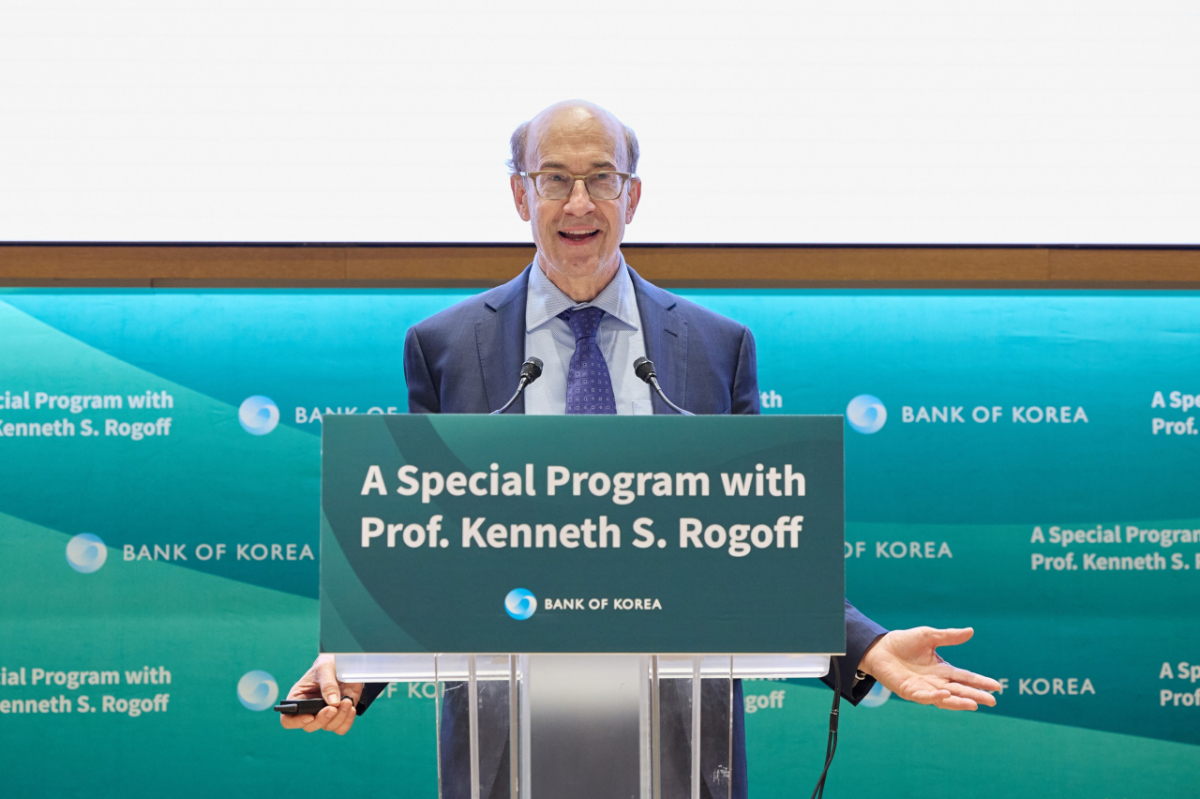
Kenneth Rogoff, a Harvard University economics professor, warned that the bubble fueled by the artificial intelligence investment boom will eventually burst.
While South Korea is a major beneficiary of AI industry growth, he said expanding fiscal spending on the assumption that the boom will last is risky. He also stressed the need to prepare for high interest rates and debt burdens as the era of ultra-low rates that followed the global financial crisis has come to an end.
Rogoff made the remarks at a seminar titled "Rethinking Secular Stagnation" at the Bank of Korea in Jung-gu, Seoul, on Thursday.
"Nobody knows when it will happen, but it is certain that the AI bubble will burst at some point," he said.
Citing the collapse of the dot-com bubble, Rogoff said, "Who knows how much a new technology is worth?" He warned that when a bubble bursts, those who invested at the peak could suffer losses or even go bankrupt.
He described South Korea as one of the major beneficiaries of the AI boom but said it must prepare for a potential collapse. Even if the boom boosts corporate earnings and asset prices, leading to higher tax revenues, the gains should not be treated as permanent, he said.
"The collapse of the AI bubble would be very painful for South Korea as well," Rogoff said. "In such volatile circumstances, governments should not keep increasing spending even when things appear to be improving." He added that countries with lower public debt have greater capacity to absorb economic shocks.
Rogoff also rejected the view that advances in AI would lead to permanently lower inflation. Referring to Tesla CEO Elon Musk's argument that AI could create such abundance that money would become less important, Rogoff criticized Musk's remarks on inflation and macroeconomics as showing a lack of understanding of the subject.
"Prices of resources with limited supplies, such as land and minerals needed for AI, could actually rise," he said. "The fact that television prices have fallen does not mean money has become worthless or that deflation is occurring."
Technological progress also creates new consumer demand, he added.
Rogoff also declared that the era of ultra-low interest rates is over. He has long disagreed with the secular stagnation theory advanced by former U.S. Treasury Secretary Lawrence Summers, which held that low growth and low interest rates would persist following the global financial crisis.
"At the time, the prevailing belief was that government debt was essentially free, but interest rates were low because of the global financial crisis, not secular stagnation," he said.
He argued that the increase in savings, decline in investment and tighter financial regulations following the crisis had been misinterpreted as evidence of structurally low interest rates.
"Real interest rates are now close to normal levels," Rogoff said, adding that they could rise or fall from here. He also challenged the argument that increased AI investment was the main driver of recent rate increases, noting that long-term real rates had begun rising three years ago, before the AI investment boom gained momentum.
He cited geopolitical instability, the cost of the green transition, populism and high debt levels as factors pushing up real interest rates.
"To find the next major crisis, it is a good idea to look at places where everyone thinks a crisis is absolutely impossible," he said, warning against excessive optimism about risks.
Rogoff also raised concerns about U.S. fiscal risks.
"The fiscal deficit exceeds 6 percent of gross domestic product, yet both Republicans and Democrats are focused on increasing spending," he said. "If they think they can keep going like this until something goes seriously wrong, a major problem will eventually emerge."
He also doubted that AI-driven productivity gains alone could resolve the U.S. fiscal problem.
"Basically, a 1 percent increase in productivity leads to a 1 percent increase in interest rates," Rogoff said. "When debt exceeds 100 percent of GDP, a 1 percent rise in interest rates could increase interest costs by an amount equivalent to the government's tax revenue."
However, he clarified that advocating fiscal prudence did not necessarily mean supporting austerity.
"Being fiscally prudent does not necessarily mean supporting austerity," he said. "The best way to address inequality is to collect more taxes from some people and transfer the money to others."

 in ECONOMY
