

A wife shared her troubles, saying her husband discriminates between their two sons and resorts to verbal abuse and violence only toward the firstborn.
On the 24th, a wife worried about her husband, who discriminates between their two sons, appeared on the tvN STORY variety show 'Lee Ho-sun Counseling Office' and met with psychologist Lee Ho-sun.
During the broadcast, the wife shared her concerns, saying, "I am raising two sons, one in high school first year and one in middle school first year, but my eldest son does not speak to his father and their relationship is poor."
The wife revealed that her husband does not hesitate to use verbal abuse and corporal punishment only toward the eldest son. "He hits him, curses at him, throws objects, yells profanities, and even tramples on the child. Even when I try to stop him, he says, 'That XX is fine to hit.' The intensity is gradually increasing," she said, shocking viewers.
She continued, "My husband has a good relationship with our second son." She added, "It seems my husband does not think his behavior is wrong. I am worried that the eldest son will turn out badly if this continues."
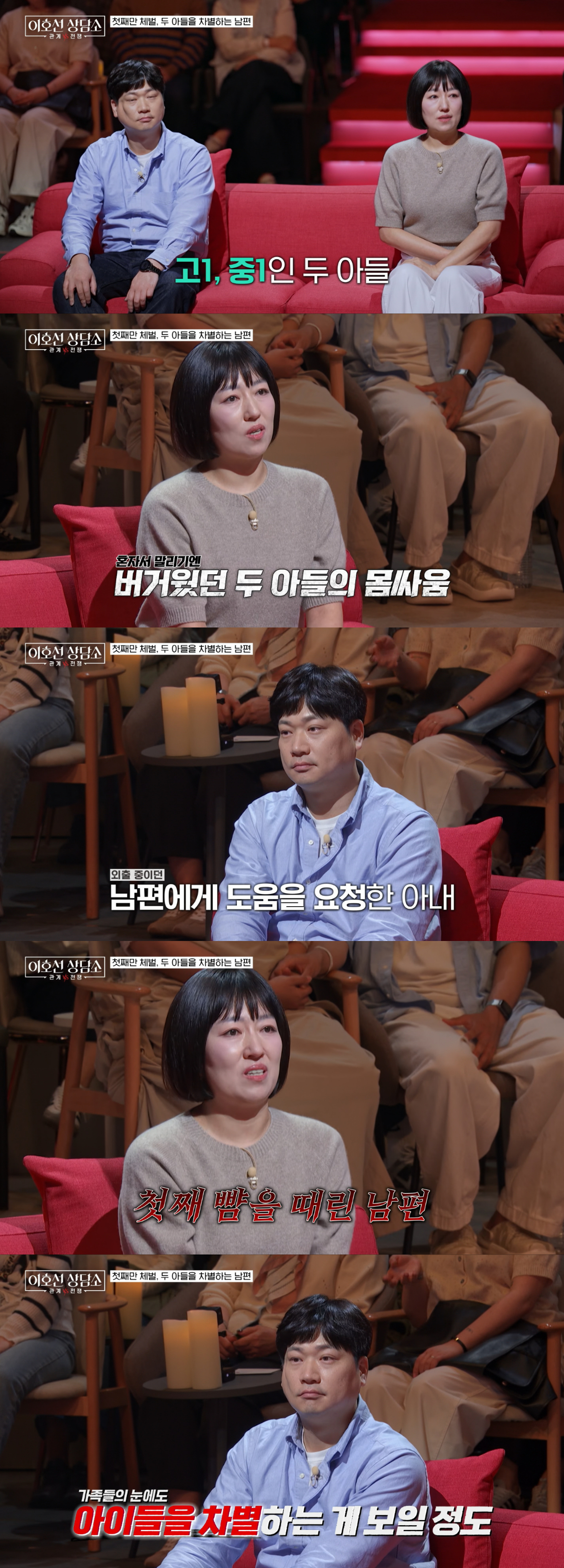
The wife recounted, "A few days ago, my husband was out when our two sons fought over a computer game. They got into a physical altercation, and since I couldn't stop them, I called my husband to come home quickly. As soon as he arrived, he slapped the older boy in the face."
She added, "The boys' aunt also told my husband at one point that 'he treats the older and younger son differently,'" noting that her husband's discrimination had continued since the children were young.
When Jang Young-ran asked, "What does the eldest son think of his father?" the wife replied, "I don't think he thinks well of him. I found out a few days ago that he doesn't have his father's phone number saved. When he needs allowance or has something to say, he sends me a text message."
She explained further, "My husband rarely gives the eldest son allowance. He also tells me not to give it to him. If the boy is late for school or makes a mistake, he says I should do nothing for him at all," describing how her husband cuts off all support whenever the eldest son misbehaves.
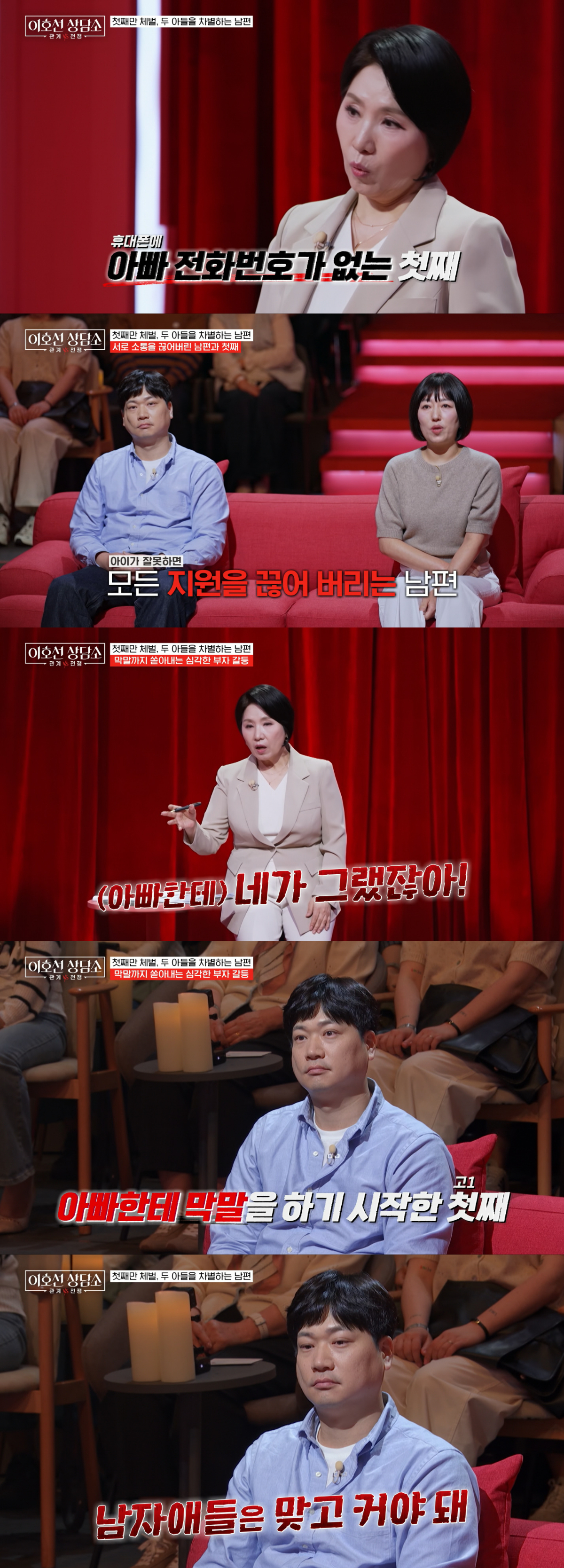
The wife sai
d, "I hate my husband, and seeing how the eldest son behaves rudely toward his father makes me think something is wrong," expressing concern about the increasingly serious situation.
She explained, "The eldest son fights back against his father. Gradually, the eldest started speaking rudely to his father, saying things like 'You!' When his father curses at him and tells him to speak properly, the eldest says, 'How can I speak nicely when my father speaks so rudely?' It seems it could escalate into a physical fight."
The wife revealed that the eldest son had once run away from home. She said, "I was hospitalized in the past because I injured my arm. It was the middle of winter. But apparently (the eldest son and my husband) got into a fight. The eldest son went to a convenience store without wearing thick clothes, borrowed the owner's mobile phone, and called me. I had just gotten my arm casted at the hospital, put on only a coat, took a taxi to the convenience store, and brought the child home with me. It was so heartbreaking."
She added that she tried to mediate the fights between her husband and the eldest son but it was useless. "When my husband is angry, his entire expression changes. He also says, 'Boys need to be hit to grow up.'"
However, unlike with the eldest son, the husband had a good relationship with their second son. Regarding this, the wife said, "I don't know either. The second son talks a lot, is perceptive, and jokes around a lot. He also gets close to his father often. The eldest son is introverted and doesn't talk much. When my husband comes home from work, he only says one or two words of greeting," expressing her frustration.
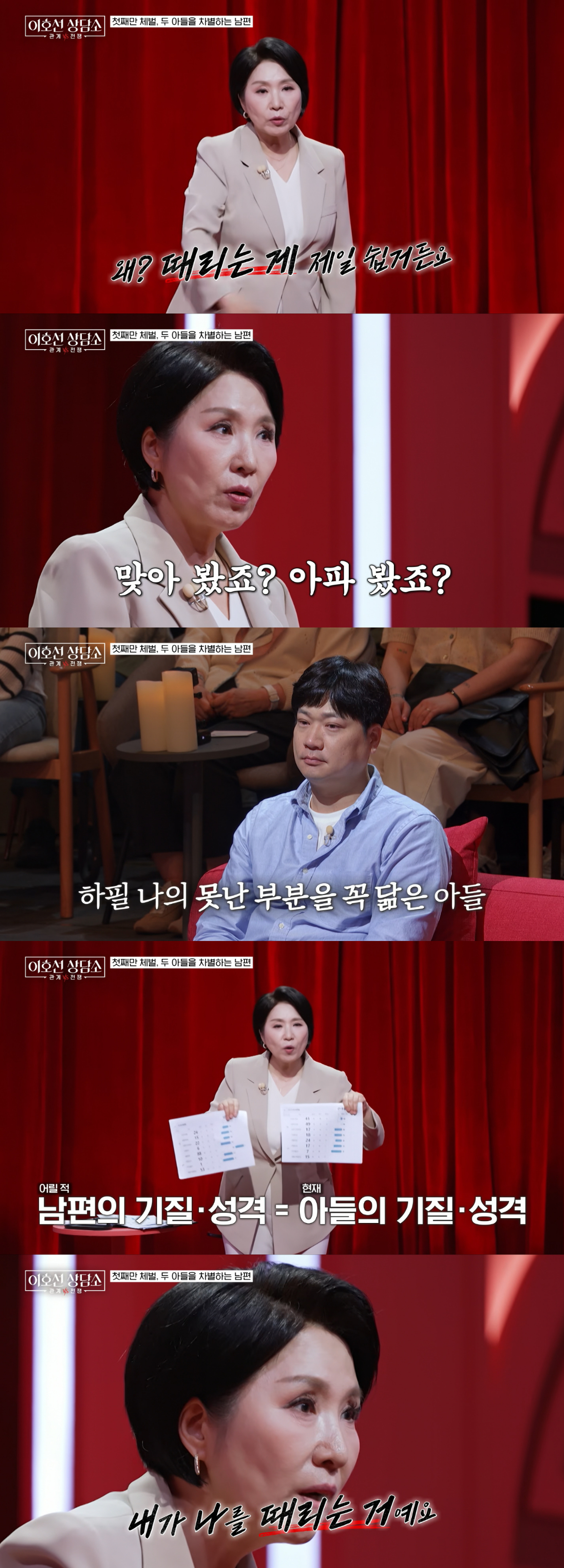
When Lee Ho-sun asked the husband, "What is the reason you are particularly harsh toward the eldest son?" the husband replied, "The second son does everything well. He knows what to do and handles things properly on his own. If I tell him something once, he understands it all and does it himself. With the older boy, I have to repeat myself. Repeating the same thing leads to arguments."
Hearing this, the wife countered, "I think (my husband) just gets angry suddenly." She continued, "He worked at his job for 15 years and said he would speak up when he had to do something unfair. In the early days of our marriage, we also fought frequently as a couple. We even got into physical fights, and I was injured."
The eldest son had frequent absences and tardiness over the past one to two years, and the husband tried to resolve this with corporal punishment.
When Lee Ho-sun asked, "Did your husband also grow up being hit?" the husband confessed that he was beaten by his father during his childhood.
Lee Ho-sun asked, "Which is more severe: the scene of your father hitting you, or how you treat your son?" The husband replied, "I think I am more severe," adding, "Once my stress rises, it seems hard to calm down."
The husband explained that on the day he hit the eldest son, he received multiple calls from his wife while commuting home saying their two sons were fighting. After returning home and seeing the house in a mess, he beat the eldest son.
Lee Ho-sun delivered a sharp critique, saying, "When a problem arises, the wife contacts the husband. Then the husband plays the role of the problem solver, but in reality, it is like calling the fire department, and when the firefighters arrive, they set the fire."
He continued, "Hitting is the easiest thing. If you hit hard, they cower down. But you should not raise your children that way. It is difficult to be a good parent. Persuading, talking, and explaining is a long, difficult, and tedious process. No matter the reason, you must not hit a child. It is the most ignorant and least parental method."
He then shouted, "Haven't you been hit? Didn't it hurt? Do not hit the child. This is violence."
Hearing this, the husband burst into tears. He confessed, "It seems it was all my selfishness." He added, "(The eldest son) is introverted and not confident. I always tell him to speak up louder and live confidently, but I wondered, 'Why can't he do it?'"
The husband was also a quiet child like the eldest son during his childhood. He said, "He is exactly like me," and became emotional.
Lee Ho-sun said, "There are stories that you have not told anyone, not even your wife, but they show in how you treat the child."
He continued, "The eldest son openly reveals the things I want to hide. I cannot bear it, so I hate the child and treat him rudely. 'Don't become like me,'" he said with regret.
Lee Ho-sun explained this as a typical case of 'projective identification," stating, "He went looking for a child who resembles him to punish the ugly self within himself that he most wants to deny." He analyzed, "It is him hitting himself." In fact, test results showed that the husband's temperament and personality were exactly the same as the eldest son's.
Lee Ho-sun said, "Hitting is hitting. Violence is violence. It was not discipline; it was punishment and corporal punishment," and received a promise from the husband that he would never hit his child again.

 in ENTERTAINMENT


