

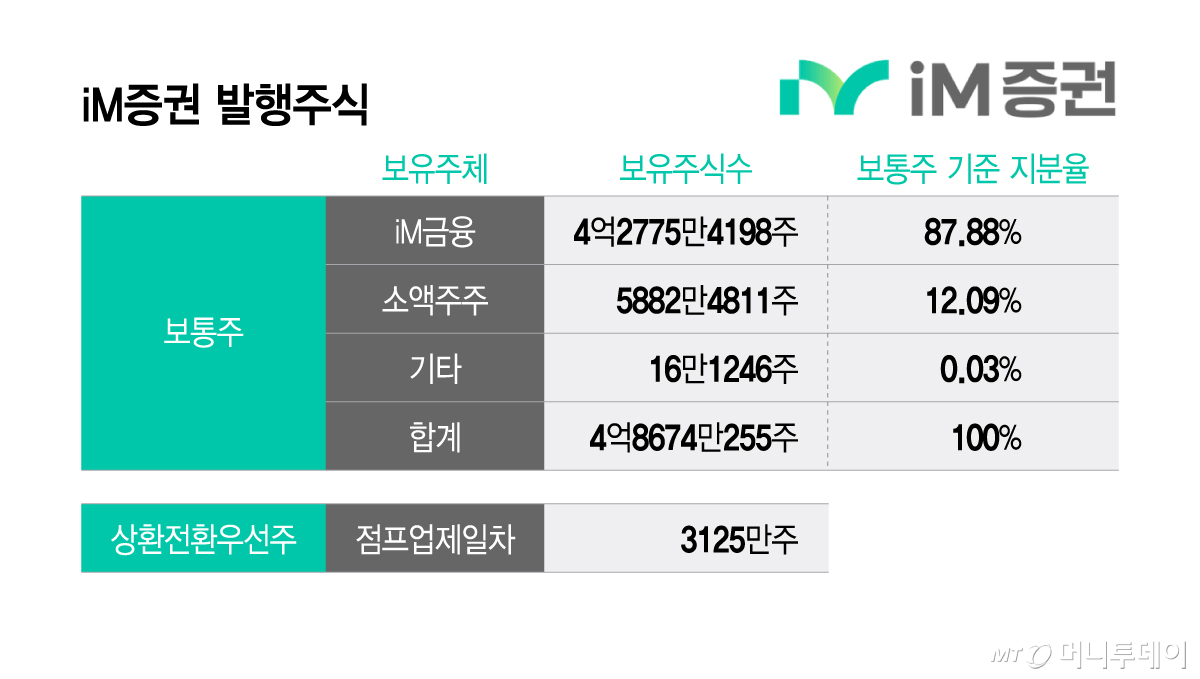
iM Financial Holdings is considering fully incorporating iM Securities as a subsidiary. However, the treatment method for minority shareholders' stakes in the remaining redeemable convertible preferred shares (RCPS) remains a variable factor.
According to financial industry sources on the 29th, iM Financial announced during its first-half earnings announcement conference call that preparations for fully incorporating iM Securities have been completed. Cheon Byeong-gyu, CFO of iM Financial, stated, "When acquiring the securities firm, capital expansion was achieved through RCPS, and there were various theories about whether the preferred shares belonged to controlling shareholders or not. We have resolved this issue, and in terms of timing, sufficient preparations have been made." He added, "We plan to proceed after comprehensively reviewing market valuation levels and other factors."
Previously, iM Securities conducted a rights offering (paid-in capital increase) totaling 217.5 billion won in December 2019 to expand its capital. Of this amount, 100 billion won was issued as third-party allocated RCPS. RCPS are preferred shares with options to be redeemed at maturity or converted into common stock. The special purpose company (SPC) Jumpup Jeilcha acquired these RCPS, and iM Financial entered into a total return swap (TRS) agreement with Jumpup Jeilcha, agreeing to pay a fixed interest rate of 3.7% in exchange for receiving dividends generated from the RCPS.
Subsequently, as iM Securities purchased and retired 50 billion won worth of the issued 100 billion won RCPS, 50 billion won remains outstanding. The market believes that while RCPS are classified as debt until redemption and thus do not immediately pose problems in the capital structure, there is still room to view them as non-controlling interests. Cheon CFO's remarks are also interpreted as considering this accounting treatment controversy. Therefore, the common opinion is that resolution is necessary before proceeding with full subsidiary incorporation.
There are two options: either iM Securities, the issuer, redeems the remaining RCPS, or iM Financial directly acquires them. A capital market official stated, "Share buyback and retirement were the initial priorities, and as we have nearly met our targets, we are now considering full subsidiary incorporation as the next step. Although some RCPS have been redeemed, 50 billion won remains, making this issue an urgent priority."
After resolving the RCPS, the remaining challenge is the common stock held by general shareholders of iM Securities. Currently, iM Securities' shareholding structure consists of iM Financial at 87.9%, general shareholders at 12.07%, and U-Lisa Partnership at 0.10%. For general shareholders, iM Financial's push for full subsidiary incorporation is seen as the only exit option.
While there are two methods—public tender offer and comprehensive share exchange—it is widely observed that the comprehensive share exchange method is more likely to manage common equity tier 1 (CET1) ratio requirements. Unlike public tender offers, which require significant cash injection, the comprehensive share exchange allows the holding company to issue new shares to existing minority shareholders of iM Securities and absorb their stakes with minimal capital outflow, thereby defending against a decline in the CET1 ratio. Currently, iM Financial's CET1 ratio stood at 12.27% as of the end of the second quarter, improving by 16 basis points (1BP=0.01 percentage point) compared to the end of last year. However, a CET1 ratio of around 13% is generally considered stable.
The key factors in comprehensive share exchange are the share exchange ratio and the exercise price for dissenting shareholders' appraisal rights. Although iM Securities is unlisted, amid a trend toward strengthening minority shareholder protection, the fairness of determining the exchange ratio and claim price has emerged as a sensitive issue.
Even amidst these variables, the industry's drive to increase the proportion of non-bank affiliates has also acted as a factor accelerating the transition to full subsidiary status. In a period where expectations for securities affiliate performance are rising, making stakes 100% ensures that related profits are fully reflected in the controlling shareholders' net income. Another anticipated benefit is the ability to eliminate conflicts of interest when additional capital investment becomes necessary for securities affiliates in the future.
However, some analyses suggest that it may be necessary to monitor developments in the second half of the year, as iM Securities' performance has not yet fully normalized. A financial industry official stated, "When iM Securities performed well due to real estate project financing (PF), there were discussions about reflecting its results in the holding company's performance through full subsidiary incorporation. However, after interest rates rose and conditions worsened, these discussions subsided. Recently, with improved sentiment in the securities sector, expectations for reflecting controlling shareholders' profits have grown again, but it is still difficult to say that iM Securities has fully entered a sustainable growth trajectory, making it hard to definitively declare the optimal timing."

 in FINANCE
