

Despite an overall rise in the stock market this year, the variable life insurance market has not recovered as expected. While the net assets of variable life insurance policies have increased due to the stock market boom, the sales market for these products is contracting.
According to the life insurance industry on the 31st, recently, the net assets of variable life insurance at major insurers have grown significantly amid the stock market rally. Samsung Life Insurance, ranked first, saw its variable life insurance net assets rise from 28 trillion 954.8 billion won at the end of last year to 32 trillion 937.5 billion won as of the 28th, an increase of nearly 4 trillion won in just six months. During the same period, Kyobo Life Insurance grew from 17 trillion 408.6 billion won to 20 trillion 178.8 billion won, and Hanwha Life Insurance increased from 15 trillion 391.9 billion won to 16 trillion 670.9 billion won. Future Asset Life Insurance, which has a high proportion of variable life insurance, also saw its net assets grow from 13 trillion 125.9 billion won to 14 trillion 492.3 billion won.
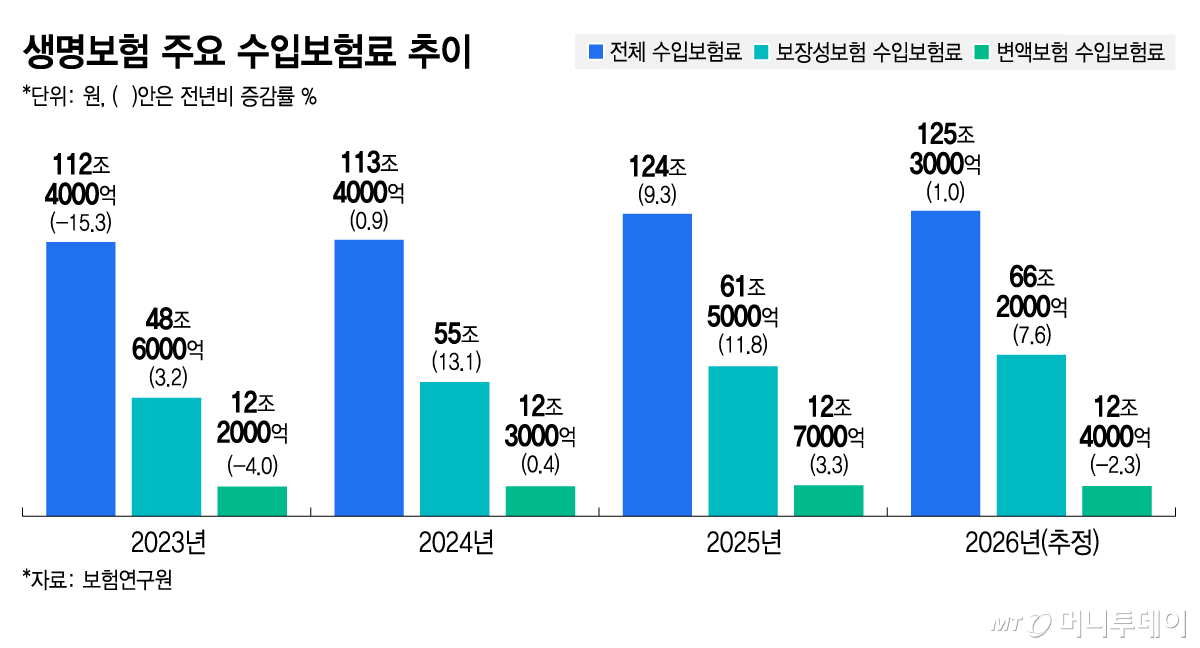
However, the overall variable life insurance market is in a stagnation phase. According to the Korea Insurance Research Institute, collected premiums for variable life insurance this year are estimated at 12.4 trillion won, down by 300 billion won from last year, projecting a negative growth of 2.3%. This indicates that sales of variable life insurance products are not occurring in the market.
In fact, when examining collected premiums at life insurers, while total collected premiums for life insurance have been rising annually centered on protection-type insurance, variable life insurance has remained flat or declined. According to the Korea Insurance Research Institute's "2026 Insurance Industry Outlook," total collected premiums this year are estimated at 125.3 trillion won, a 1% increase from last year's 124 trillion won. Notably, protection-type insurance premiums for life insurers are projected to reach 66.2 trillion won this year, up 7.6% from last year. As total collected premiums grow while variable life insurance remains at similar levels, the share of variable life insurance in overall insurance is gradually shrinking.
The primary reason for the decline in variable life insurance's influence is analyzed to be insurers' strategic shifts in product offerings following the introduction of new accounting standards (IFRS17). Since implementing IFRS17, life insurers have expanded sales of protection-type insurance such as health insurance, which allows them to secure more Insurance Contract Margin (CSM). Variable life insurance, where most premiums are managed through special accounts, has a relatively low contribution to CSM and has thus been deprioritized in sales efforts.
Changes in consumers' investment environments have also worked against variable life insurance. In the past, variable life insurance was considered a representative long-term investment product; however, recently, various alternative investment options have emerged, including exchange-traded funds (ETFs), Individual Comprehensive Asset Management Accounts (ISA), and retirement pension performance-linked products. With the spread of mobile investment platforms, direct investment accessibility has increased, leading to evaluations that variable life insurance's competitiveness has weakened compared to the past when viewed solely from an investment perspective.
An industry official stated, "If demand for investment-type insurance products expands with stock price movements, new sales will likely remain at a certain level," but also added, "However, overall collected premiums are expected to decline due to increased contract cancellations aimed at realizing profits."

 in FINANCE
