

The process of filing real-expense insurance claims, which currently requires patients to take photos of receipts and detailed billing statements after hospital visits and upload them one by one to insurance company apps, is expected to become much simpler. With all major EMR (Electronic Medical Record) providers deciding to join 'Real-Expense 24', a foundation has been established that allows 97% of medical institutions nationwide to connect with the computerized real-expense insurance claims system.
According to financial authorities on the 30th, the proportion of medical institutions that have completed actual connection with Real-Expense 24 rose by 15.7 percentage points (P) from 24.7% on January 5 to 40.4% on this day.
Compared to 28.4% on April 1, this represents a rise of about 12 percentage points in just three months.
Real-Expense 24 is a service where hospitals and pharmacies electronically send medical receipts, detailed billing statements, prescriptions, and other documents when consumers request insurance payments via an app or website. Patients no longer need to visit the hospital again to obtain paper documents or photograph them for upload to insurance company apps.
The core foundation for spreading Real-Expense 24 has also been established. This is because the top five EMR providers used by domestic medical institutions have all agreed to join. Following GC Med-i (formerly UbiCare), E-Zis Healthcare, Bit Computer, and NeoSoft Bank, Jeonung IT was also understood to have conveyed its intention to participate to the Financial Services Commission on this day.
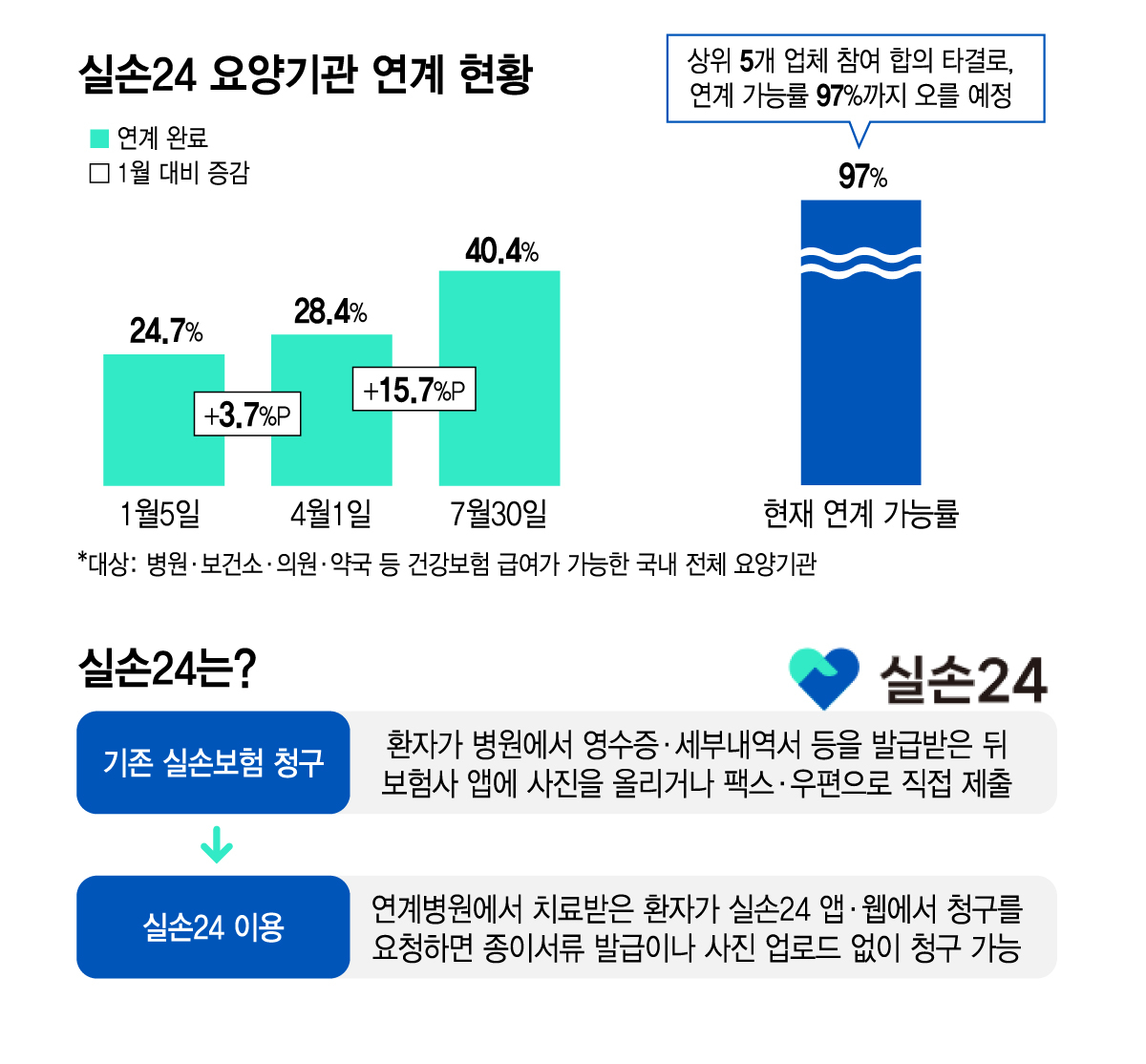
EMR is a computer program used in hospitals to manage medical records, prescriptions, and billing. Medical institutions and pharmacies using EMR providers' programs can apply for system connection only if those EMR providers join Real-Expense 24. Including medical institutions that use the top five providers' programs, the potential connectivity rate with Real-Expense 24 is expected to reach 97%. With paths opening for most medical institutions nationwide to participate in Real-Expense 24, it is being evaluated as having effectively overcome a major hurdle.
The Financial Services Commission (FSC) set a goal last May to raise the Real-Expense 24 connectivity rate to over 90% within the year and ultimately to 100%. Even considering that it typically takes about two months for EMR providers to complete their own system development after joining, with all top five providers now participating, achieving the target in the second half of the year is expected.
Procedures to speed up connection rates for individual medical institutions have also been simplified. Previously, EMR providers had to collect participation intentions from hospitals and clinics and submit them collectively to the Insurance Development Institute; however, medical institutions can now directly apply for connection through the Real-Expense 24 program. The Insurance Development Institute will also directly support technical requirements for computerized connection, such as security certificates and fixed IP addresses (Internet Protocol addresses) that medical institutions previously had to prepare separately.
With a foundation established allowing 97% of medical institutions to connect, completion rates are expected to rise quickly once individual system development and applications are finalized. Financial authorities plan to cooperate with EMR providers to directly visit hospitals and clinics facing difficulties in connection, provide support for computerized linkage, and strengthen publicity on the usage methods and convenience of Real-Expense 24.
The FSC is also pushing forward with amendments to the Insurance Business Act to expand the obligation to participate in computerized claims to EMR providers and allow fines to be imposed on non-participating medical institutions and companies. Once the law revision and individual medical institution linkage work are completed, an environment will expand where consumers can file real-expense insurance claims without paper documents even at local clinics and hospitals.

 in FINANCE
