

# In 2024, a man in his 70s traded semiconductor ETFs (exchange-traded funds) at a bank 13 times with an initial investment of 100 million won. From January 6 to June 4, the cumulative return was 78.8%. He paid 17.04 million won in upfront fees to the bank. Had he chosen the deferred fee option, the fee would have been reduced to just 560,000 won. If the saved fee amount had been reinvested, the final cumulative return could have reached as high as 103.1%.
While the number of investors signing up for ETFs at banks has surged this year, most have chosen upfront fees, which are disadvantageous for short-term trading. In fact, the fees collected by banks were more than seven times higher than what would have been charged if optimal fees matching the investment period had been applied.
The Financial Supervisory Service issued a consumer alert of "caution" on the 30th targeting bank trust investors in ETFs.
A total of six banks—KB Kookmin, Shinhan, Hana, Woori, SC First, and NH NongHyup Bank—sold ETFs worth 64 trillion won across 1.03 million transactions from January last year through May this year. Sales in May reached 108 billion won, an 8.8-fold increase compared to 12 billion won in December of the previous year. From January last year through May this year, trust fee revenues for ETFs at these six banks totaled 586.4 billion won. Fee revenue in May alone was 103.6 billion won, a 10.2-fold increase compared to December of the previous year.
The average age of bank ETF trust investors is 59 years old, and 93.3% signed up through face-to-face channels. The average holding period for their ETFs was just 42 days. Transactions sold within six months accounted for 94.6%, while those sold within 10 days reached 37.9%. The average number of contracts opened by the same individual was 5.5 times, with the most active investor making 362 transactions over 17 months.
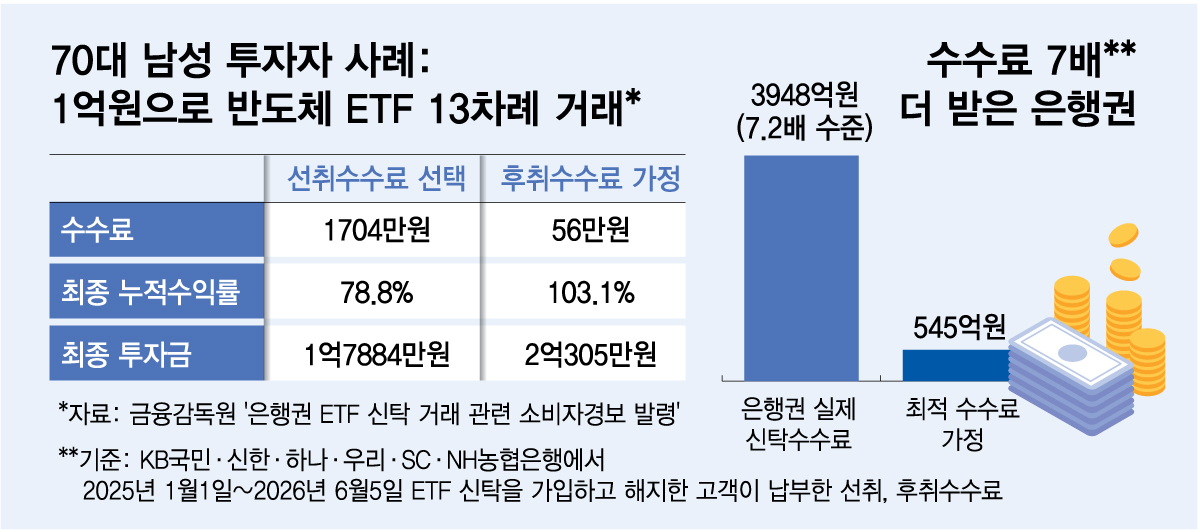
Although most trades were short-term, 91.7% of investors chose upfront fees, which require paying the fee in full at the time of signing. Upfront fees typically involve an immediate payment of around 1% of the investment amount, whereas deferred fees are paid gradually at a rate of around 1% annually based on the actual holding period. Deferred fees are more advantageous if the holding period is less than one year; however, 98% of investors who canceled within 10 days still chose upfront fees.
After recalculating fees according to investment periods, the Financial Supervisory Service determined that the optimal fee amount banks should have collected was 54.5 billion won. However, the actual amount collected by banks was 394.8 billion won—7.2 times higher.
This means that 13.6% of the 291 billion won in capital gains from investors' ETF sales went to banks as fees.
The Financial Supervisory Service explained that the shorter the holding period for ETFs, the more advantageous deferred fees become, and setting low target returns can lead to frequent trading, increasing fee burdens. Unlike securities company MTS (mobile trading systems), bank ETF trusts do not allow real-time trading and do not guarantee principal repayment.
The Financial Supervisory Service has formed a task force (TF) with the banking sector and industry association to review trust fee systems—including upfront fees, deferred fees, and early termination fees—from scratch. It also plans to improve relevant indicators and sales procedures to ensure that customer investment returns are adequately reflected in banks' internal performance evaluations.
Furthermore, it intends to establish improvements to sales procedures so that consistent sales strategies considering customers' asset levels and age groups—not individual branch staff capabilities—are uniformly applied across all branches.

 in FINANCE
