

Banks have accumulated substantial fee profits by selling high-risk exchange-traded funds (ETFs) as trust products, but they now face growing risks of incomplete sales. This is because banks are responsible for thoroughly explaining product structures and fees at the time of sale, and for carefully evaluating whether high-risk-grade products are appropriate to be offered as bank-sold items.
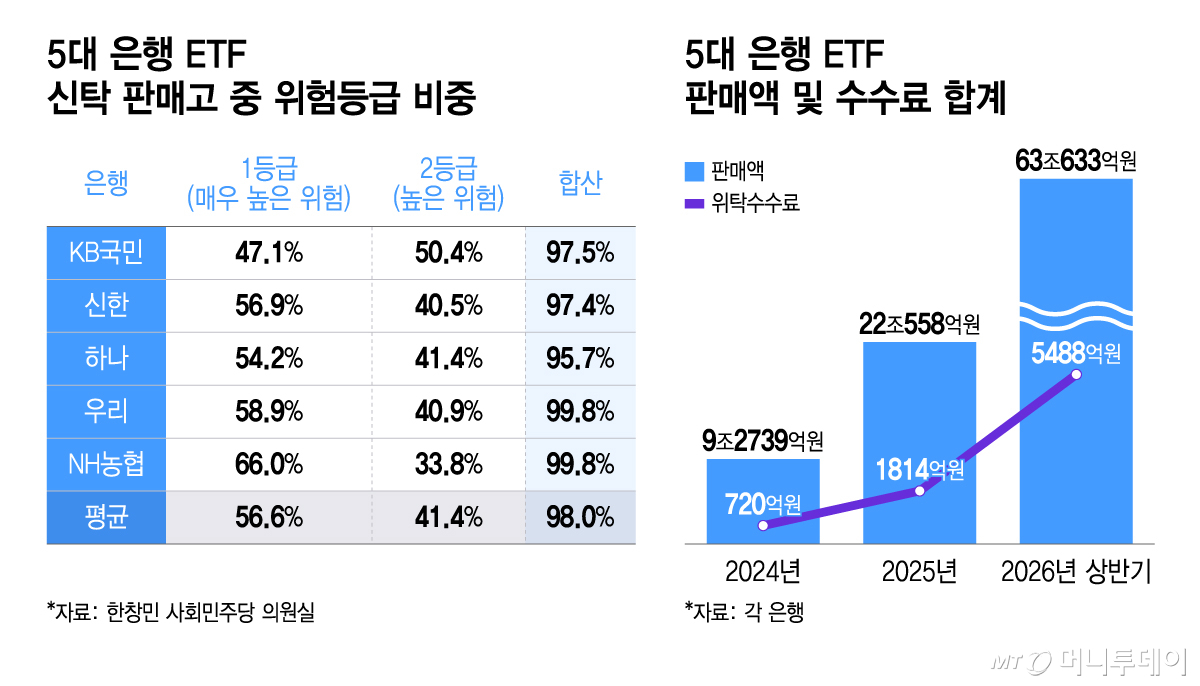
According to data submitted by the Financial Supervisory Service to the office of Han Chang-min, a lawmaker from the Social Democratic Party serving on the National Assembly’s Political Affairs Committee, among ETFs sold by the five major banks—KB Kookmin, Shinhan, Hana, Woori, and NH Nonghyup—from January to June this year, an average of 57% were classified as investment risk grade 1 (very high risk).
In Korea, demand has long been concentrated in equity-type ETFs, leading to a historically high proportion of risk grades 1–2 in bank trust sales. This trend has become particularly pronounced this year. While the share of grades 1–2 stood at 76% in July 2024 and reached 87% last year, it surged to 98% this year.
This surge is attributed to increased sales of stock-themed ETFs such as 'KODEX AI Semiconductor TOP2 Plus', 'TIGER Semiconductor TOP10', 'SOL AI Semiconductor TOP2 Plus', and 'HANARO Fn K-Semiconductor', amid a market rally driven by Samsung Electronics and SK Hynix.
Consequently, fee income from ETF trust sales by the banking sector has also surged sharply. Some banks operate on a structure where higher investment risk grades yield higher fees. For example, under non-face-to-face enrollment standards, Kookmin Bank charges a front-end load of 0.7% for grade 1–2 products, compared to 0.5% for grade 4 (moderate risk). Shinhan Bank sets fees at 0.8% for grades 1–2 and 0.5% for grade 4. Hana Bank charges 0.8% for grades 1–2 and 0.3% for grade 4.
As sales of high-risk products increased, related fee profits also expanded. The five major banks earned a total of 548.8 billion won in fees from ETF trust sales between January and June this year—more than triple the 181.4 billion won recorded for the full previous year.
The problem lies in the fact that, as these products carry a risk of principal loss, the risk of incomplete sales may also grow. The higher the risk grade, the more stringent the internal review process required before listing the product for sale; whether banks properly fulfilled this requirement is now critical. According to Mo Beomgyun, banks must submit sales decisions on risk grades 1–3 products to their Non-Deposit Product Committee for deliberation.
With the Financial Supervisory Service set to inspect each bank’s ETF sales status next month, a backlash against the banking sector is anticipated if incomplete sales are uncovered regarding high-risk-grade ETFs. There is also no excluding the possibility that this could escalate into compensation issues similar to the past Hong Kong equity-linked securities (ELS) crisis.
A financial authority official stated, "Simply selling high-risk-grade products is not inherently problematic," but added, "However, as risk grades rise, there is a heightened obligation to carefully assess whether sales recommendations were appropriately made to consumers, meaning relevant internal control procedures will become subject to inspection."

 in FINANCE
