

Fees associated with financial MyData will decrease starting this year. MyData operators share hundreds of billions of won annually based on data transmission. This cost burden was one of the primary reasons leading some to abandon MyData operations. With reduced fee burdens, attention is now focused on whether the MyData business model can take root in the future.
According to financial sector sources on the 12th, the fees borne by MyData operators will decrease significantly starting this year. This is because a cost review conducted for the first time in three years revealed a substantial reduction in costs.
For customers to utilize MyData services, operators must receive data from information providers such as banks, card companies, and insurance firms. Operators are required to pay annual development and operation costs for the computer networks established to transmit this customer information to these information providers, with each MyData operator sharing the burden.
For example, if a customer links an A bank account through a fintech platform like Toss, A bank sends balance and transaction details in response to Toss's request. The server, security, and operation system costs required for this are borne by the MyData operator.
The Credit Information Agency established the fee system for MyData transmission and conducted its first cost review in 2023. As a result, fees totaling 28.2 billion won were set for 2023. The following year, the amount was increased to 32.8 billion won.
Cost reviews are conducted every three years, with this year marking the third review. MyData operators pay related costs at year-end based on annual data transmission volumes. With the newly calculated costs applied this year, the fee amount is expected to decrease.
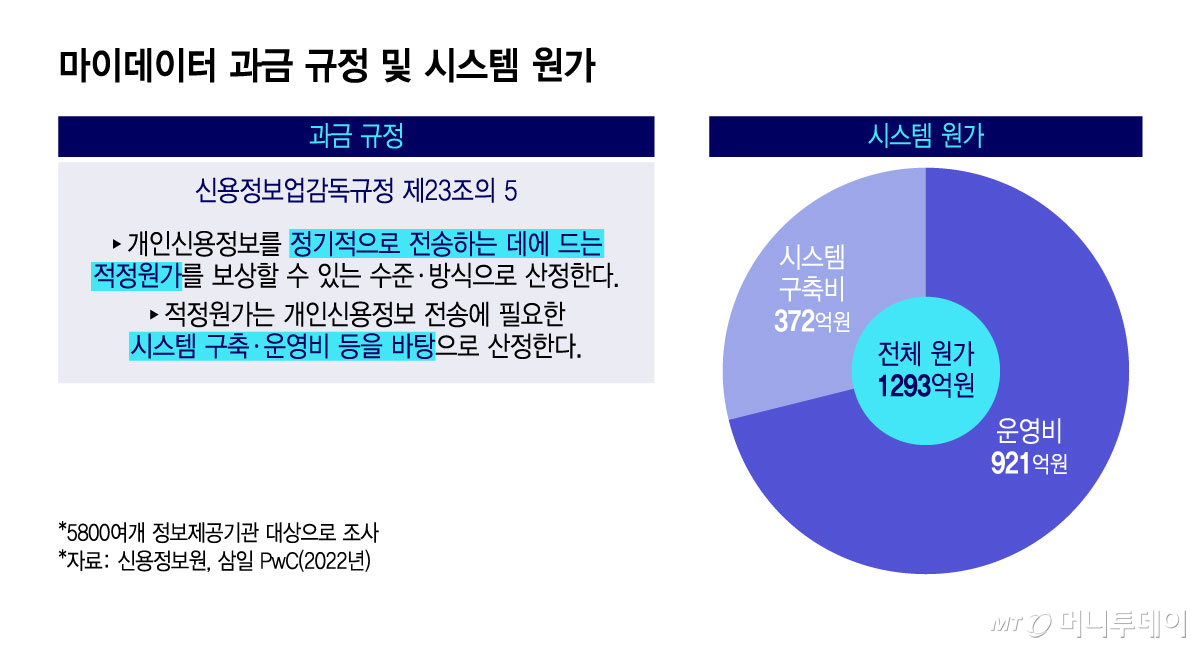
The reduction in costs stems largely from the removal of initial system setup expenses for MyData. During the first review in 2023, total costs amounted to 129.3 billion won, with system setup costs accounting for 37.2 billion won.
Additionally, a more thorough cost review led to operational efficiency improvements. A financial regulatory official stated, "We strengthened documentation requirements and approved only verified expenses, making the cost calculation more meticulous," adding, "The burden is expected to decrease significantly compared to previous years over the next three years."
Fees based on data transmission have been a major burden for MyData operators. This is because costs are incurred without any clear revenue model utilizing MyData services yet.
In fact, the three major telecommunications companies (SK Telecom, KT, and LG Uplus) sequentially returned their MyData licenses from last year through this year. Large corporate groups SK and LG also launched MyData services through SK Planet and LG CNS respectively but ultimately discontinued their operations.
MyData fees place a particularly heavy burden on fintech companies. Traditional financial institutions such as banks, card companies, and insurance firms serve as both information providers and MyData operators. When one side pays MyData fees, the other side receives that same money back. In contrast, fintech firms, which hold limited financial information, primarily only pay costs.
The fintech industry has taken a cautious stance regarding future impacts since the exact scale of fee reductions remains unclear. A fintech official stated, "Reduced MyData fee burdens would not be unfavorable for companies," while adding, "Actual perceived benefits will vary depending on the extent of the reduction."

 in FINANCE
