

In the second half of this year, while significantly relaxing the total loan volume to ensure no inconvenience for actual buyers through down payment loans and other forms of financing, renting loans for non-resident single-homeowners with speculative purposes will be prohibited in principle. To promote housing supply, the limit on relocation expense loans will increase by 30%, and financial support for real estate project financing (PF) sites will be dramatically expanded to around 48 trillion won.
The Financial Services Commission announced a "Comprehensive Financial Measures for Stabilizing the Real Estate Market" centered on these contents on the 13th. This measure differs significantly from previous policies that emphasized regulatory tightening following last year's the 27th measures. The key features are clearly relaxing loans for actual buyers and dramatically executing financial support related to housing supply. At the same time, it strictly maintains existing principles of household debt management, including a 0.6 billion won limit on mortgage loans, a Debt Service Ratio (DSR) cap of 40%, and a Loan-to-Value (LTV) ratio of 40%.
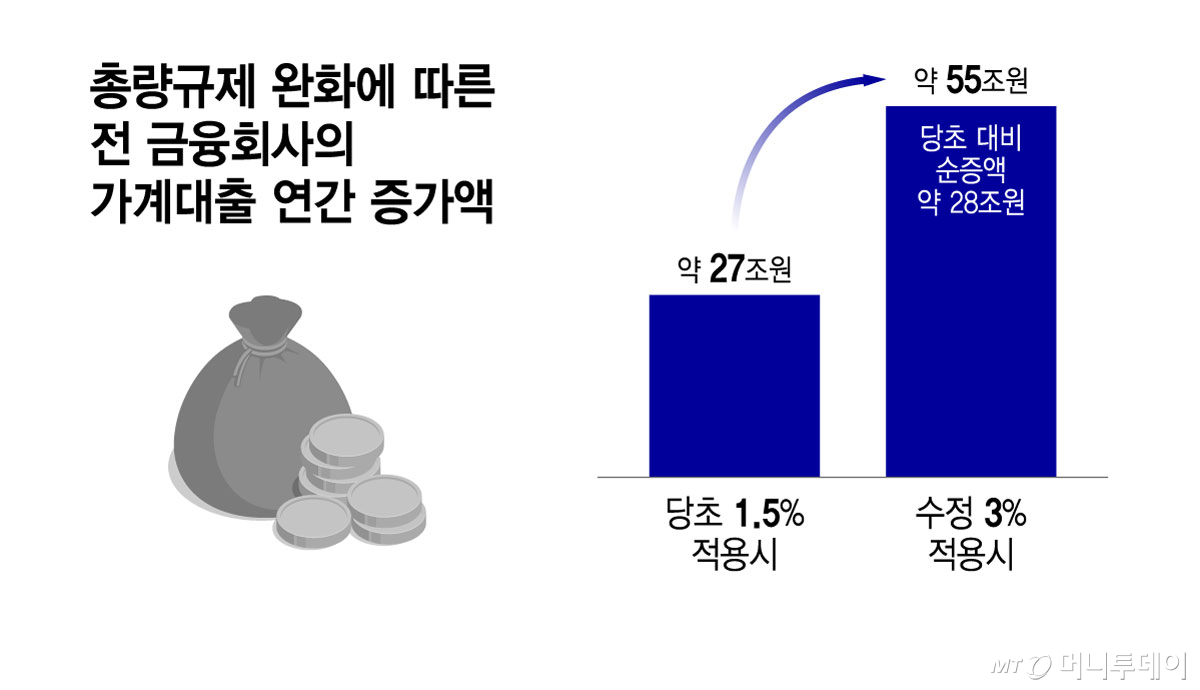
The Financial Services Commission raised the household loan total management target from the previous 1.5% to 3%, doubling it, even accepting criticism of "flip-flopping" in order to support actual buyers. This is the first time that annual total volume regulation has been raised. It is even contrary to last year's second half when total volume regulation was further tightened. Given the rapid changes in the situation due to increased housing trading volumes following the expiration of the special tax rate on capital gains for multi-homeowners and market boom driven by "margin investing" (investing with debt), the total amount of household loans that can be increased annually has been expanded from the previous 27 trillion won to around 55 trillion won.
The increased loan resources will mostly be used for interim payment and down payment loans in newly constructed housing complexes. The threshold for loans for actual buyers, who have faced difficulties due to a "loan rush," will be lowered. In addition, the limit on relocation expense loans for redevelopment and reconstruction cooperatives will be expanded by approximately 30% compared to the previous level. To ensure sufficient relocation funds, the collateral value standard was changed from existing housing prices to cooperative member sales prices based on new construction (post-construction asset evaluation). Changes in down payment loans or relocation expense loans ultimately aim to promote housing supply.
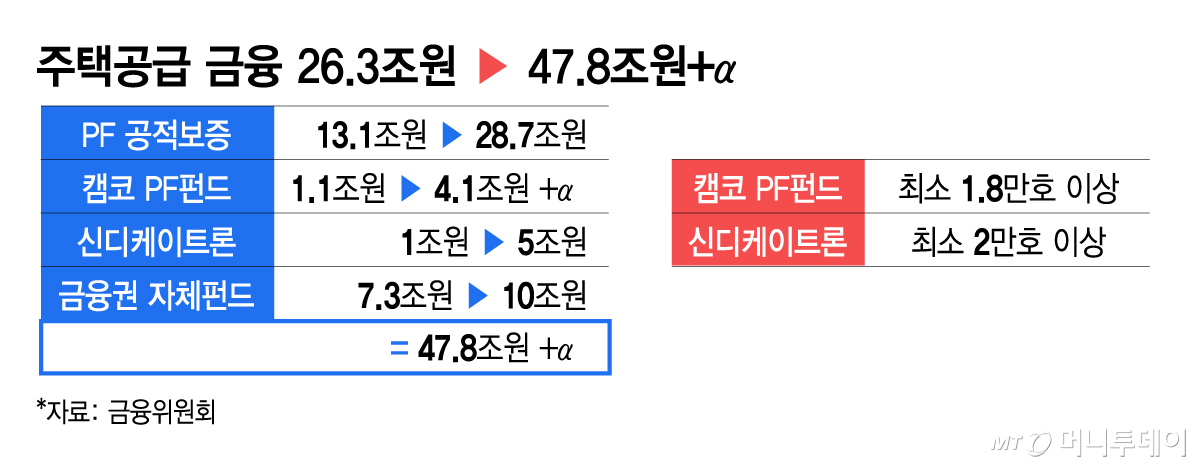
In fact, the Financial Services Commission decided to dramatically increase financial support for PF sites to 47.8 trillion won, up from the previous 26.3 trillion won, to provide side support for a race in housing supply speed. A 3 trillion won fund from the Korea Asset Management Corporation (KAMCO) for normalization will also be injected into distressed housing projects. In addition, regulations on capital adequacy ratios (5% in the first year) will be temporarily suspended for two years exclusively for housing projects.
On the other hand, speculative demand will be firmly blocked. Renting loans for non-resident single-homeowners who have "never actually lived in" a property they purchased will not be allowed to extend their maturity, and new loans will be prohibited. The guarantee ratio for renting loans for single homeowners will decrease from 80% to 70% in the Seoul metropolitan area and from 90% to 80% in other regions.
In response to concerns that this real estate measure undermines the policy goal of "decoupling real estate and finance," Financial Services Commission Chairman Lee Wook-yong emphasized, "The direction of real estate policy remains clear and consistent," adding, "We will firmly block speculative demand while definitely providing support for housing supply and targeted assistance for actual buyers."

 in FINANCE

