

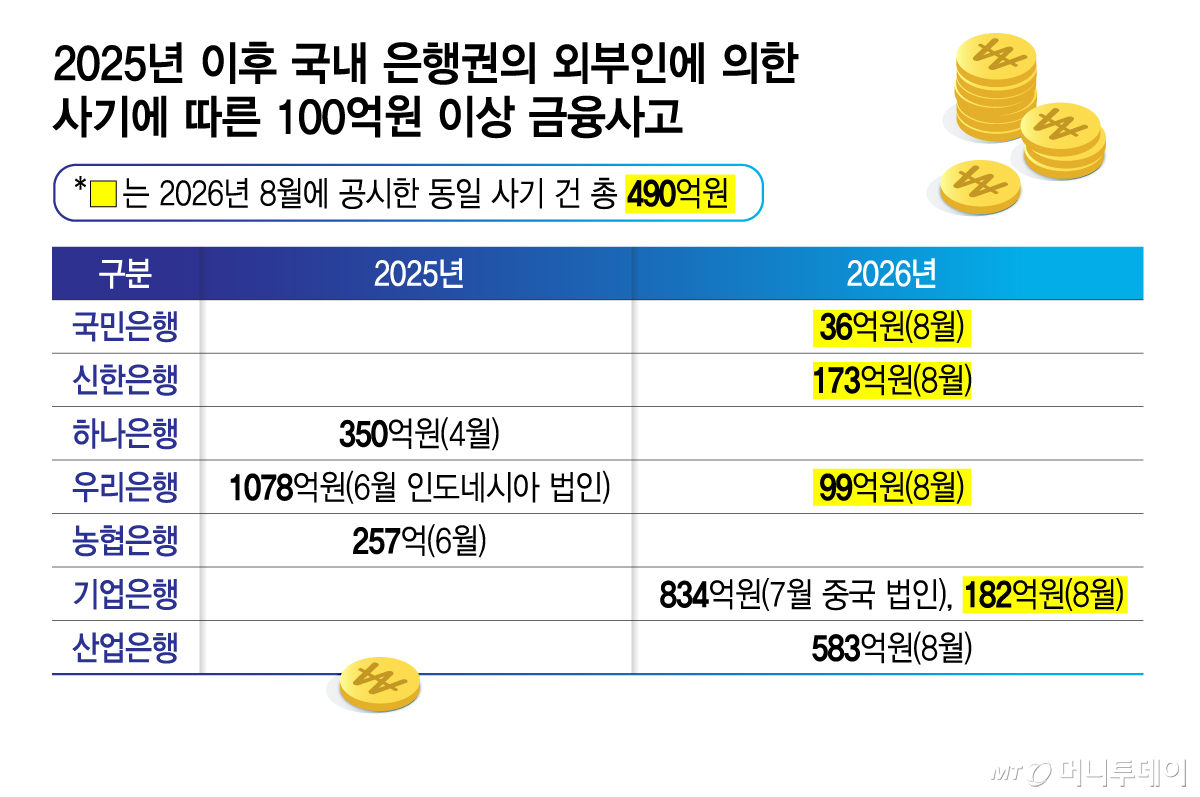
While the banking sector has strengthened internal controls to prevent financial accidents such as embezzlement and breach of trust by internal employees, incidents of fraud committed by outsiders deceiving banks have continued. A case was revealed in which an attempt was made to siphon off 49 billion won from four banks using fake real estate pre-sales, and large-scale frauds totaling around 100 billion won have been repeatedly occurring at overseas subsidiaries. As the methods of fraud have become more sophisticated, banks are also facing difficulties in detecting them.
According to the financial sector on the 13th, KB Kookmin Bank, Shinhan Bank, Woori Bank, and IBK Industrial Bank of Korea simultaneously disclosed financial accidents caused by fraud from outsiders the previous day. The total amount involved was 49 billion won: 357.79 million won at Kookmin Bank, 173.4355 billion won at Shinhan Bank, 98.7 billion won at Woori Bank, and 182.2 billion won at Industrial Bank of Korea.
These banks were found to have fallen victim to a scheme in which documents were fabricated to make unsold commercial properties appear as if they had completed pre-sales, followed by the execution of loans using fake pre-sale applicants. It is known that multiple real estate developers and brokers were involved in the crime, and most incidents occurred in the metropolitan area.
Until two years ago, financial accidents involving internal employees or embezzlement by staff members were common in the financial sector. However, analyses suggest that the starting point of recent banking sector financial accidents has shifted from 'internal' to 'external.' Following large-scale internal embezzlement incidents continuing through 2024, banks have strengthened control systems to prevent employee misconduct, including the introduction of responsibility structure charts that clearly define individual responsibilities for employees.
On the other hand, fraud by outsiders originating outside the bank has emerged as a new financial accident risk. In 2025, there were 88 financial accidents caused by fraud from outsiders in the banking sector, more than five times the 16th cases recorded the previous year. During the same period, financial accidents such as breach of trust and embezzlement decreased from 112 to 96 cases.
The risk of outsider fraud is not limited to domestic cases. Last July, a financial accident related to allegations of outsider fraud involving 83.37604 billion won occurred at IBK Industrial Bank of Korea's China subsidiary. During the process of an offline small-loan business partnered with a Chinese financial company, a platform company separately entrusted by that financial institution defrauded customers by receiving loan principal and interest into a separate account instead of the normal account.
In June last year, a financial accident involving 78.5 million dollars (approximately 107.8 billion won) occurred at Woori Bank's local subsidiary in Indonesia, Woori Sodara Bank, after false content was discovered in export letters of credit submitted by a local company.
The banking sector explains that when professional fraud organizations manipulate documents to obtain loans, it is difficult to filter them out through the usual screening at branch offices. In particular, recently, multiple parties including developers, brokers, and borrowers have participated in an organized manner to manipulate documents such as pre-sale contracts, employment certificates, and financial statements, and execute false or excessive loans.
In response, banks are advancing document forgery detection and collateral verification systems utilizing AI. However, under the current situation, it is difficult for frontline branches to verify all documents related to loans one by one. This is also because companies need to secure funds quickly at required times, making it difficult for banks to conduct long-term due diligence on all loans.
A banking sector official stated, "If credit screening through AI becomes fully implemented, some cases can be detected, but the timing is an issue, and accuracy must continue to be improved."

 in FINANCE
