

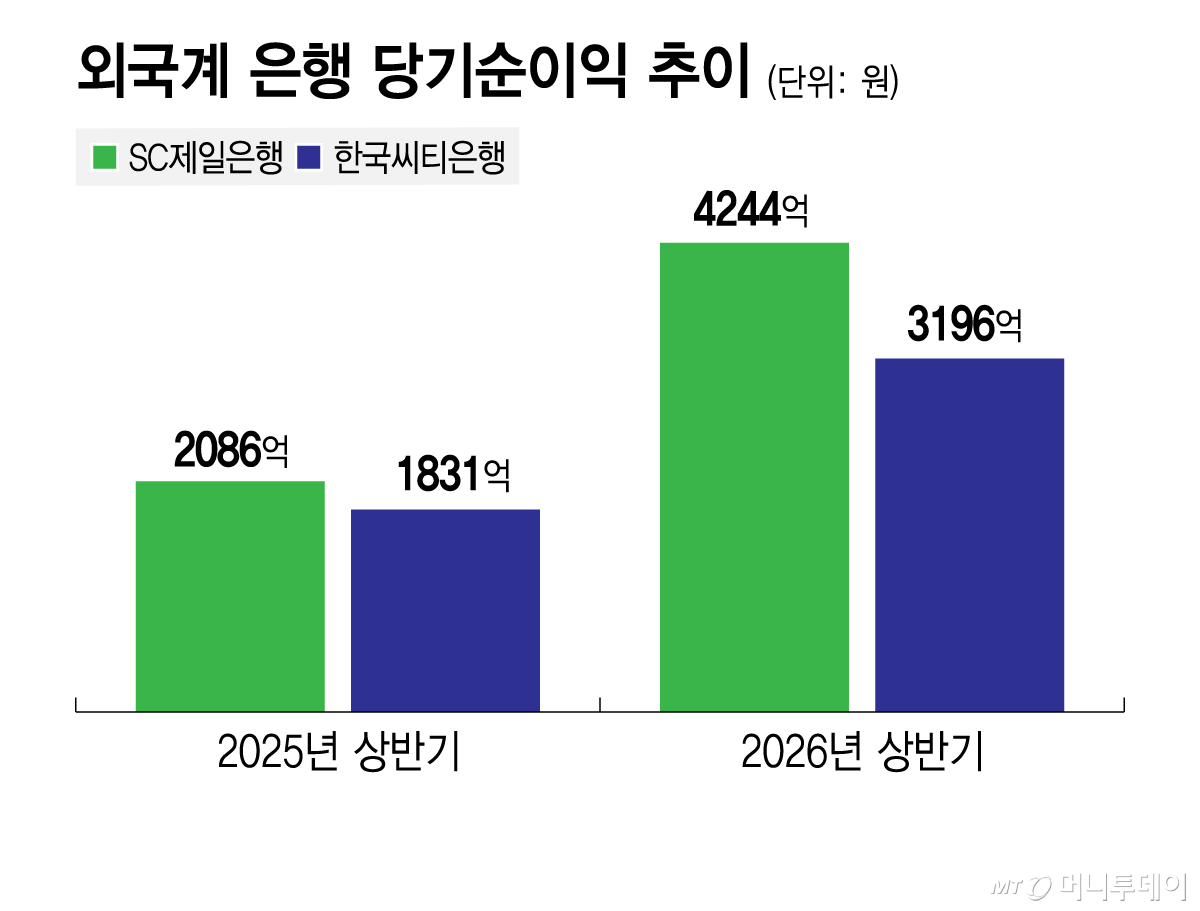
Foreign banks, including Standard Chartered Bank Korea and Citibank Korea, recorded their highest-ever net profits in the first half of this year, buoyed by a booming stock market. For both banks, non-interest income from asset management, foreign exchange, derivatives, and securities outperformed interest income in driving results.
According to the financial sector on the 16th, Standard Chartered Bank Korea's consolidated net profit for the first half of this year reached 424.4 billion won, a 103.5% increase from the same period last year, marking an all-time high. Citibank Korea also posted its highest-ever performance with a first-half net profit of 319.6 billion won, up 75% from last year.
Looking at second-quarter results alone, the growth momentum of both banks was even steeper. Standard Chartered Bank Korea's second-quarter net profit reached 319.6 billion won, a 230.5% increase from the same period last year. Citibank Korea also recorded its highest-ever quarterly net profit at 186.8 billion won, up 86%.
For both banks, growth in non-interest income was more pronounced than that of interest income. Standard Chartered Bank Korea's first-half non-interest income rose 77.5% to 365.6 billion won, driven by an increase in high-net-worth clients, growth in the wealth management (WM) segment due to the stock market boom, and expanded performance in the foreign exchange derivatives sector.
Citibank Korea's non-interest income increased 67% year-on-year to 483.4 billion won, reflecting a sharp rise in revenue from foreign exchange, derivatives, and securities amid favorable capital market conditions.
In contrast, the interest income segment performed relatively weakly. Standard Chartered Bank Korea's first-half interest income stood at 609 billion won, roughly on par with the same period last year (609.8 billion won), impacted by a decline in its net interest margin (NIM) to 1.24% as of late June, down 0.24 percentage points from the same period last year. Citibank Korea's first-half interest income also fell 20% year-on-year to 215.3 billion won, compared to 269.5 billion won in the same period last year.
A reduction in provisions for credit losses also contributed to improved results. Standard Chartered Bank Korea's total expected credit losses and other provisions amounted to 73.4 billion won in the first half, down 28% from the previous year. Notably, 110.2 billion won out of the 151 billion won in provisions related to penalties on equity-linked securities (ELS) tied to the Hang Seng Index, which were recognized last year, was reversed.
Citibank Korea also saw its bad debt expenses drop 76% year-on-year to 9.9 billion won in the first half, influenced by base effects from increased corporate loan provisions last year and a decline in consumer finance bad debt provisions.
Loan growth rates showed divergence. As of late June, Standard Chartered Bank Korea's total loans rose 3.6% year-on-year to 447.661 billion won, while Citibank Korea's total loans fell 8% to 104 billion won over the same period due to its exit from consumer finance. However, Citibank Korea saw securities rise 30% and deposits increase 16% year-on-year to 213 billion won and 223 billion won, respectively, as of late June last year.
A foreign bank official stated, "While we achieved strong results in the first half due to the capital market boom, earnings volatility may arise in the second half amid stock market corrections." The official added, "We plan to actively expand corporate finance and other areas to strengthen our core profitability."

 in FINANCE
