

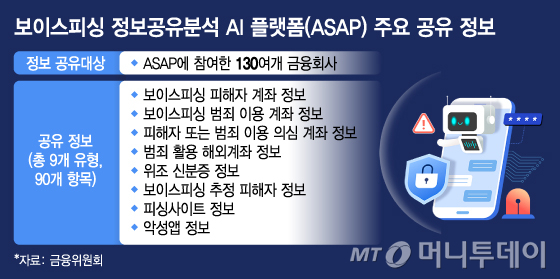
Financial authorities, having previously prevented losses totaling over 60 billion won through the financial sector's voice phishing suspicious information sharing platform 'ASAP', are now significantly expanding cooperation among finance, telecommunications, and law enforcement authorities. In the future, plans are under review to assess the status of shell accounts across all financial institutions and take necessary measures in collaboration with the Ministry of Justice, National Tax Service, and National Police Agency.
The Financial Services Commission (FSC) held its second meeting on eradicating voice phishing on the 20th at Woori Bank's headquarters in Jung-gu, Seoul, chaired by Vice Chairman Kwon Dae-young. The meeting reviewed the operational status of the 'ASAP' AI platform for sharing and analyzing voice phishing information and discussed future challenges.
ASAP was launched last October as a platform for banks to share suspicious information related to voice phishing. Over nine months, from last October through the end of last month, 463,000 cases of suspicious bank information were shared. Based on this data, 7,009 accounts were suspended. Financial authorities explained that these efforts prevented losses totaling 66.36 billion won in advance.
With the revised Law on Refund for Victims of Telecommunications Fraud taking effect on the 4th of this month, the scope of information sharing has expanded from the financial sector to include telecommunications and investigative fields. Financial institutions, telecom companies, and law enforcement authorities can now exchange suspicious information via ASAP to utilize it for account suspensions, communication blocking, and apprehending suspects. Since the law took effect, telecom companies have shared over 100 pieces of information, including phone numbers suspected of being used in voice phishing, through ASAP.
Financial institutions are integrating information received from telecom companies and law enforcement authorities into their Fraud Detection Systems (FDS). In actual cases, banks have blocked victim transfers by cross-referencing suspicious account information from other financial firms, remote-control malicious app installation data from the National Police Agency, and new activation details for Daejeon SIM cards provided by telecom operators.
Collaboration is also expanding in the private sector. Woori Bank has established an integrated response system linking its FDS for detecting voice phishing with its Anti-Money Laundering (AML) department. From late March through last month, it shared 576 cases of suspicious interbank accounts detected by its AML system via ASAP. LG Uplus is collaborating with police and banks to detect malicious app control servers and utilize them for victim prevention.
The FSC is also pursuing additional measures to eradicate shell accounts. It plans to investigate the status of shell accounts across all financial institutions and consider taking necessary actions in collaboration with the Ministry of Justice, National Tax Service, and National Police Agency. Simultaneously, it intends to improve regulations aimed at reducing the occurrence of new shell accounts.
Vice Chairman Kwon stated, "The greatest significance of ASAP lies not merely in its technical platform itself, but in connecting previously isolated finance, investigative, and telecommunications sectors into a single system through new technologies and methods, enabling practical collaboration." He added, "Moving forward, we will deepen collaboration among government agencies, institutional investors, and industry sectors to reduce financial crime losses, including those from voice phishing."

 in FINANCE
