

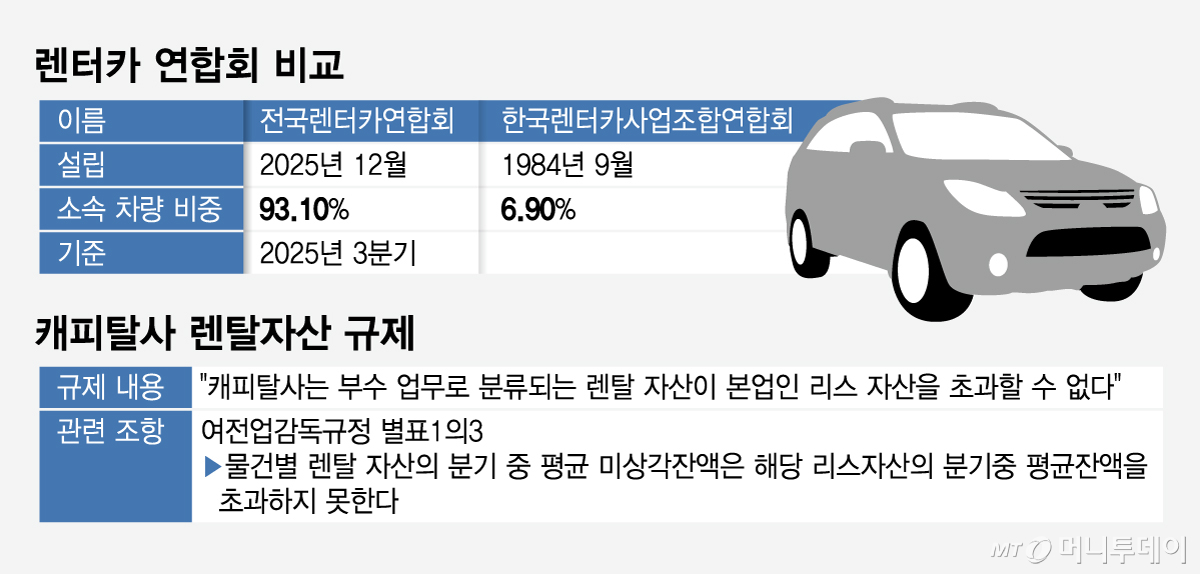
Financial authorities are meeting with two major car rental associations to discuss easing capital rental regulations. The capital industry has proposed mutual growth finance measures to appease small and medium car rental companies, but opposition continues. Financial authorities are also considering an analysis of the impact that regulatory easing would have on the car rental market.
According to financial sector sources on the 20th, the Financial Services Commission will hold a meeting on the 28th with two major car rental associations: the National Car Rental Federation (National Federation) and the Korea Car Rental Business Association (Korea Federation), as well as the Credit Finance Association. This is to discuss the issue of easing capital rental asset limits. Since the meeting date was set only recently, it is understood that the exact agenda has not yet been finalized.
Easing rental asset limits has long been a goal for the capital industry. Under the supervision regulations for specialized credit finance companies, capital rental assets cannot exceed the leasing portion. However, recent consumer spending trends show a preference for rentals over leases. Capital firms with assets tied up in leases cannot increase their handling of rentals. The Financial Services Commission announced last November that it would actively consider easing capital rental asset limits.
The car rental industry opposed this, arguing that if capital firms increase their rental handling, the profits of small and medium-sized companies would be infringed upon. In response, the capital industry proposed mutual growth finance measures such as lowering loan interest rates for small and medium car rentals and deferring principal repayments. The proposal also included provisions for small and medium companies to provide replacement vehicle services without fees when accidents occur involving rental or leased vehicles from capital firms.
The National Federation agrees with the mutual growth finance content. It holds the position that if capital firms participate in mutual growth, it can accept regulatory easing. However, the Korea Federation continues to oppose it until the end. Although the Korea Federation represents a single-digit proportion of affiliated vehicles, it is a legally designated organization approved by the Ministry of Land, Infrastructure and Transport, making it difficult for the Financial Services Commission to ignore its views.
The divergence in opinions between the two major car rental associations is analyzed as stemming from a struggle for leadership. Originally, the Korea Federation was established earlier in 1984. Later, groups dissatisfied with the association's operations broke away to form the National Federation.
The Financial Services Commission is also considering an impact assessment requested by the Korea Federation. The purpose is to analyze what effects easing capital rental asset limits would have on the car rental market and small and medium-sized companies.
Small and medium companies primarily operate short-term rentals, so their markets do not overlap with the long-term rentals handled by capital firms. However, the main argument against easing regulations is that if capital firms increase their handling of long-term rentals and compete with large car rental companies, large corporations may shift toward increasing their share of short-term rentals to avoid competitive pressure, thereby harming small and medium companies.
A financial authority official stated, "We are still in the preparation stage for the meeting, so we have not yet decided on the discussion content," adding, "Since there was a request for market impact analysis, we are reviewing it from various angles."
The capital industry finds the impact analysis somewhat burdensome. If reports indicate that capital firms' market share is increasing, it would further strengthen the Korea Federation's arguments against regulatory easing.
A capital industry official emphasized, "We must increase this proportion to reflect consumer preferences for rentals," and added, "Since this essentially means shifting lease customers to rentals, the actual market pie captured by capital firms will not be large."

 in FINANCE
