

As the National Pension Service launched a public trust service targeting dementia-related funds this year, it is expected to reshape the landscape of the testamentary trust market, which has gained prominence amid an aging society. Banks that have long invested in testamentary trusts are now on edge with the arrival of the "big fish," the National Pension Service.
According to financial sector sources on the 20th, the National Pension Service launched its dementia-safe asset management service in April this year. Three months later, in July, four contracts were finalized.
This service is part of a pilot project for a public trust system promoted by the Ministry of Health and Welfare. It is Korea's first public trust product designed to support basic pension recipients who struggle with dementia or mild cognitive impairment and find it difficult to manage their assets independently, enabling them to stably manage funds needed for daily life. As this remains a pilot program, eligibility criteria and entrusted asset limits are in place. Entrusted assets are limited to cash-like assets, with a cap of 1 billion won.
The National Pension Service has signaled its full-scale market entry through public trusts via legislative amendments. To fulfill the role of a public trust provider, the National Pension Service requires new provisions in the Dementia Management Act allowing it to be entrusted with asset management support services, as well as an amendment to the National Pension Act to add public trust operations to the Korea Pension Corporation's duties. A National Pension Service official stated, "We are currently operating this as a pilot program based on government ministry approval and are pushing for legislative changes."
Concerns have arisen in the banking sector that this could encroach upon the private testamentary trust domain. Historically, testamentary trust services in Korea have been the exclusive domain of banks. This service allows depositors to entrust their accumulated assets to a bank in advance, with the bank managing funds from initial collection through posthumous inheritance. Hana Bank introduced testamentary trusts in 2010 as the first financial institution, followed by other commercial banks launching various products such as dementia-safe trusts, disability trusts, and guardianship trusts. Recently, some banks have established dedicated teams to offer consulting services bundled with inheritance and gifting services alongside their trust offerings. Hana Bank operates a total care organization comprising legal, tax, real estate, and trust experts, while Shinhan Bank has set up a dedicated team within its trust division.
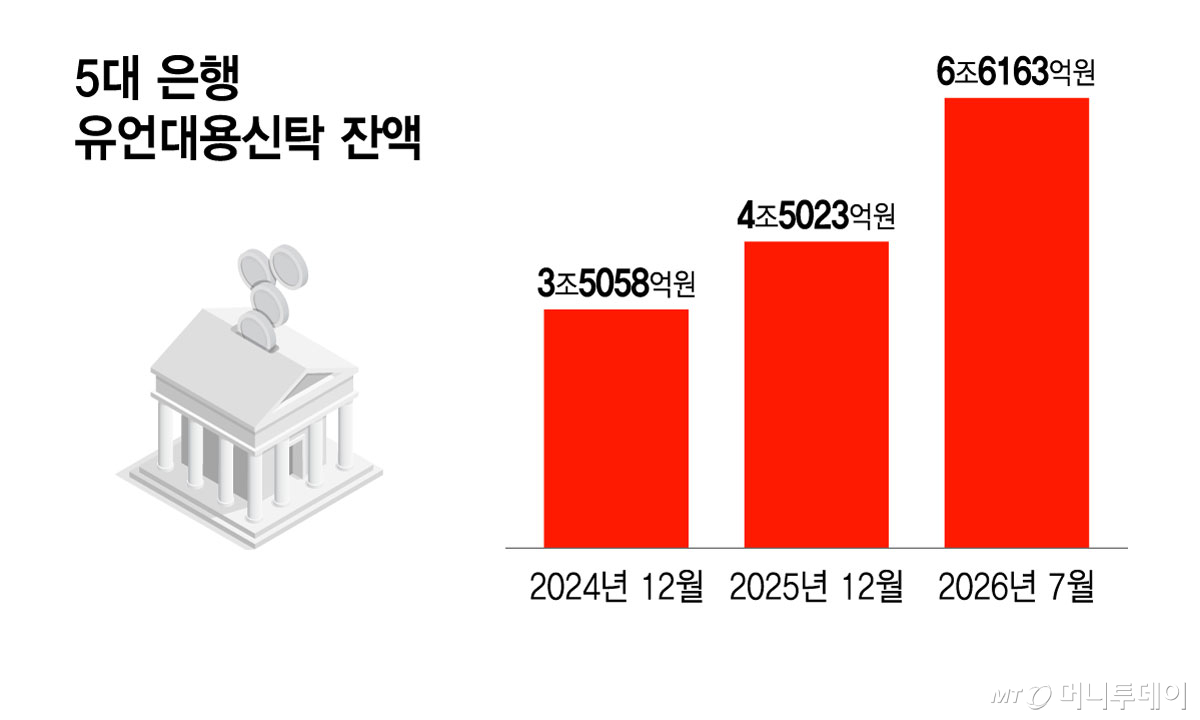
Consequently, the testamentary trust market has grown annually, approaching a scale of 7 trillion won. As of late July this year, the combined reserves of testamentary trusts at five major banks—KB Kookmin, Shinhan, Hana, Woori, and NH Agricultural Cooperative Bank—totalled 6.6163 trillion won, an increase of over 3 trillion won compared to the end of 2024 (3.5058 trillion won).
While there is optimism that the introduction of public trusts will expand the overall market size, practitioners in banking departments express concern that competition could intensify if the target audience for public trusts expands to include the middle class. A bank official stated, "The National Pension Service's public trust and financial institutional investors' dementia-safe trusts may overlap with some customers and functions, leading to anticipated competition." Another bank official added, "Commercial banks will face pressure on their fee structures alongside social responsibility obligations."
Calls are also emerging to open public trusts not only to pension funds but also to private banks. The argument is that banks can leverage their accumulated operational experience to demonstrate expertise. A financial sector official remarked, "If banks enter the trust business, it could serve as an opportunity not only to expand their existing customer base but also to popularize trusts and broaden the market's foundation."

 in FINANCE
