

Sh Cooperative Bank plans to increase its dividend to the Sh Cooperative Central Association this year after reducing it for two consecutive years. This is because net profit has risen, and with the adoption of the internal ratings-based approach, capital reserves available for dividends and acquisitions of non-bank financial institutions have expanded.
According to the financial sector on the 24th, Sh Cooperative Bank is seriously considering expanding its 2026 fiscal year-end dividend. The dividend for this year will be finalized after the March 2027 fiscal year-end settlement. As a wholly-owned subsidiary of the Sh Cooperative Central Association (100% stake), all dividends paid by Sh Cooperative Bank flow directly to the Central Association.
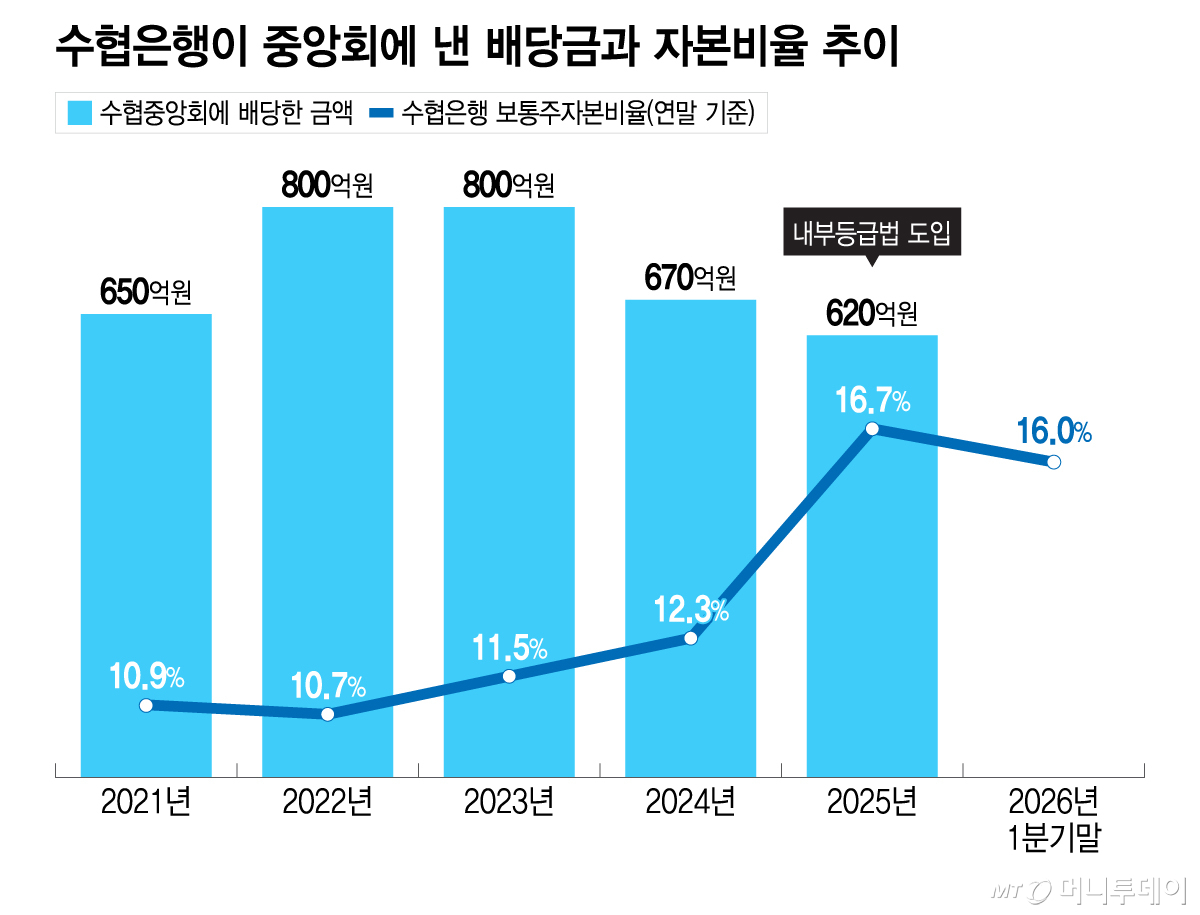
The fact that the Sh Cooperative side is reconsidering dividend expansion for the first time in three years suggests the bank has determined it maintains stable capital adequacy even after acquiring non-bank affiliates. Notably, Sh Cooperative Bank saw a significant improvement in its capital ratio following the adoption of the internal ratings-based approach at the end of last year. The bank’s common equity tier 1 capital ratio rose from 12.3% at the end of 2024 to 16.7% at the end of last year, an increase of 4.4 percentage points (P). It also recorded 16.0% as of the end of the first quarter this year, maintaining a high level.
Previously, Sh Cooperative Bank paid dividends of 80 billion won to the Central Association in both 2022 and 2023, but reduced the dividend scale for two consecutive years to 67 billion won in 2024 and 62 billion won in 2025. Over the same period, net profit showed an upward trend: 204.8 billion won in 2022, 237.6 billion won in 2023, 235.5 billion won in 2024, and 245.7 billion won in 2025.
As a result, the dividend payout ratio for 2025 fell to 25.2%, down 3.3 percentage points (P) from the previous year. This reflects a strategy of managing capital by reducing the portion of net profit allocated to dividends and instead retaining capital within the bank.
Until last year, the Sh Cooperative Central Association supported the acquisition of non-bank financial institutions by expanding Sh Cooperative Bank’s capital adequacy. Following its acquisition of asset management firm Trinity Asset Management last year, Sh Cooperative Bank has recently also moved to acquire Sangsangin Securities.
For Sh Cooperative Bank, expanding into non-bank businesses is crucial given the limits of growth driven solely by bank profits. With ongoing restrictions on household loans, rapidly increasing loan assets is difficult. Moreover, to avoid being left behind in the recent stock market boom, there is a need to boost non-interest income, making asset management and securities affiliates essential.
The Sh Cooperative Central Association also anticipates that, in the long term, it can expand revenue sources by increasing both dividends received from the bank and name usage fees amounting to 2.5% of operating income. The calculation was that even if dividends are adjusted in the short term, acquiring non-bank affiliates such as asset management and securities firms would grow Sh Cooperative Bank’s profit scale, thereby increasing funds flowing into the Central Association.
A banking sector official stated, “Sh Cooperative Bank has significantly exceeded the cut-off line for regulatory ratios under BIS standards following the adoption of the internal ratings-based approach.” The official added, “It appears that with increased capital adequacy enabling loan expansion or M&A activities, the Central Association is now planning to increase dividends again.”

 in FINANCE
