

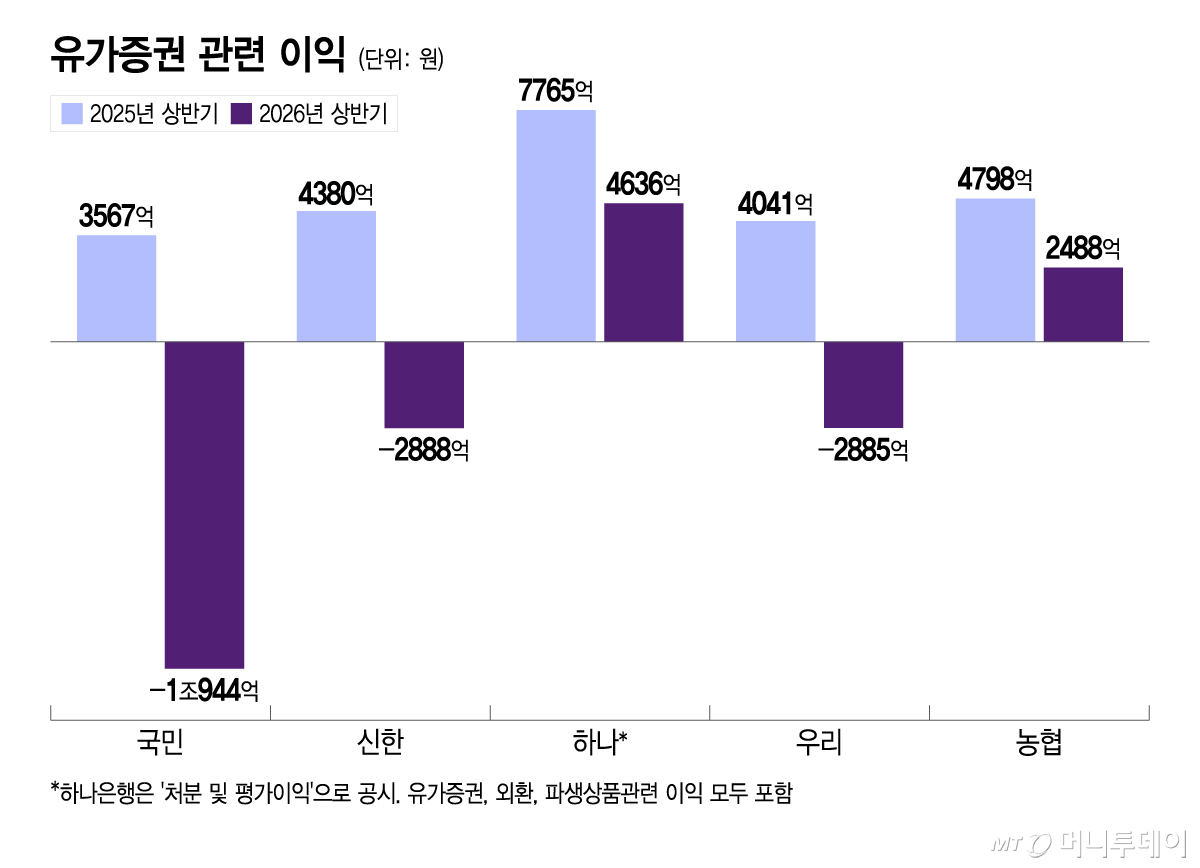
Banking sector profits from bond operations have deteriorated significantly due to rising interest rates in the first half of this year. With high volatility expected to continue in domestic and international bond markets during the second half, forecasts suggest the 10th-year government bond yield could rise to 4.7%. In response, banks plan to reduce spot purchase positions and shift operations toward short-term instruments to manage interest rate rise risks.
According to the Korea Financial Investment Association's Bond Information Center on the 24th, the 10th-year government bond yield closed at 4.335%, down 0.041 percentage points (P) from the previous trading day. Although the yield saw a slight adjustment today, it has been trending upward since surpassing the 4th% level in May, after ending last year in the high 3% range.
Bond yields move inversely to prices. Therefore, rising interest rates have widened banks' valuation losses on bonds. KB Kookmin Bank reported a loss of 1 trillion 94.4 billion won related to securities in the first half, marking a shift from a profit of 356.7 billion won in the same period last year. Shinhan Bank and Woori Bank also turned into losses, recording losses of 288.8 billion won and 288 billion won, respectively. NH NongHyup Bank maintained profitability but saw a 48% decline compared to the same period last year. Hana Bank, which does not separately report securities-related profits, saw its combined profit from securities, foreign exchange, and derivatives drop by 40%.
A financial industry official stated, "In periods of rising interest rates, banks holding more bonds inevitably face larger valuation losses based on market prices. While we have compensated through profits in foreign exchange (FX) and derivatives segments, the bond losses were so severe that dealers' stress reached its peak as long-term purchase positions collapsed."
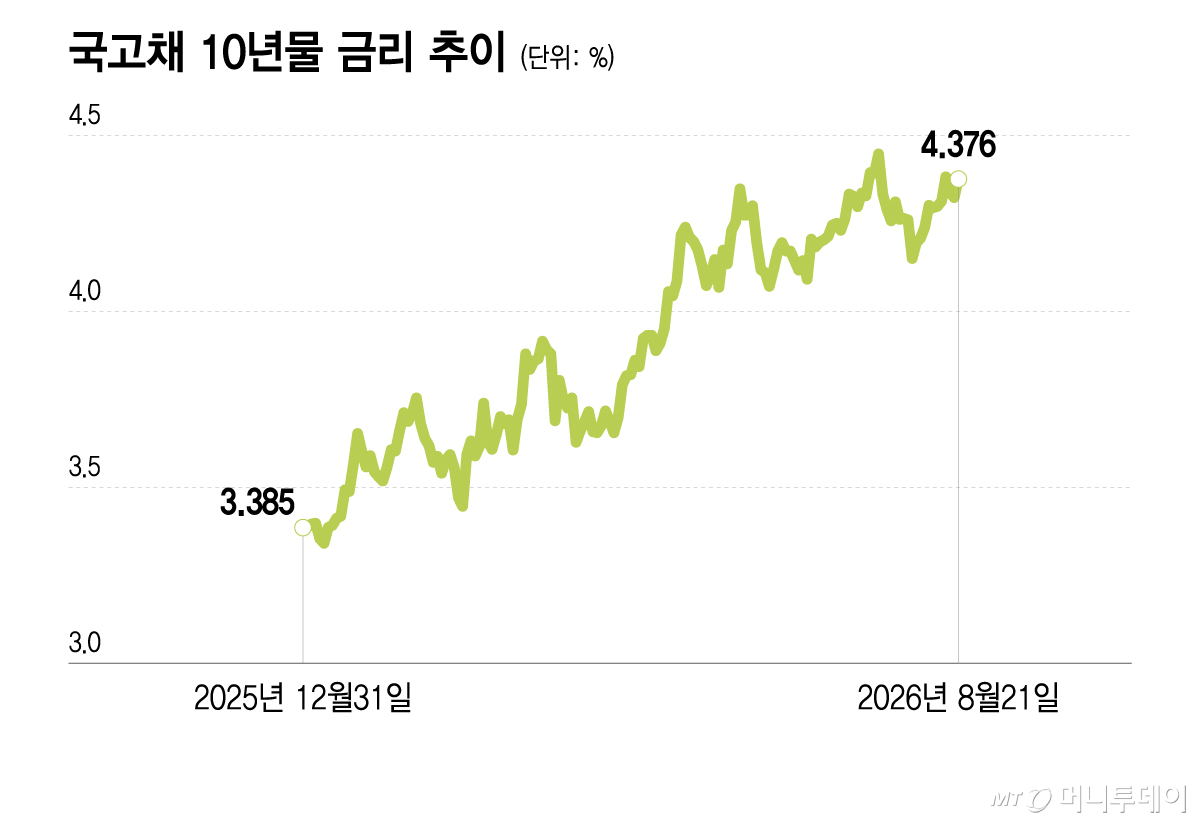
The problem is that interest rates are expected to continue rising through early next year, creating significant risk. In particular, the upward trend in U.S. long-term rates is alarming. The U.S. 30-year bond yield reached 5.311% on the 17th (local time), marking its highest level since June 2007—19 years ago. Soaring long-term yields were driven by fiscal deficit concerns combined with expanded corporate bond issuance by big tech companies. The 10-year yield also surged to above 4.7%, drawing market attention to the possibility of breaking through the 5th% threshold.
Although the U.S. Treasury Department announced plans to expand its "buyback" program for purchasing government bonds, market forces continue to exert stronger upward pressure on yields. Not only in the U.S., but Japan's 10-year bond yield also hit a 30-year high, while Germany and France saw their 30-year yields rise to levels not seen since 2008. Alongside global bond market weakness, domestic base rate hikes are pushing interest rates higher. Markets widely anticipate that the Bank of Korea, which raised the base rate by 0.25 percentage points in July, will implement additional rate hikes before year-end. Banks have set upper limits for the 3rd-year government bond yield at 4.1% and the 10th-year yield at 4.7%.
Banks are expected to adopt operating strategies aimed at minimizing valuation losses amid rising interest rates. The primary approach involves reducing spot positions and shifting operations toward short-term instruments with lower interest rate sensitivity. Additionally, banks plan to actively utilize derivatives such as put options as hedging tools.
Bank A plans to maintain a strategy of reducing its spot bond position in the second half while purchasing put options. This strategy bets on falling bond prices to minimize valuation losses. Bank B has adopted a strategy of shortening duration and securing interest income primarily through short- to medium-term instruments. Bank C also plans to strengthen monitoring of interest rate trends while reducing its bond purchase positions.
A banking sector official stated, "Considering market volatility, we will focus less on actively betting on directional moves and more on selectively identifying investment opportunities that secure sufficient returns against risks."

 in FINANCE

