

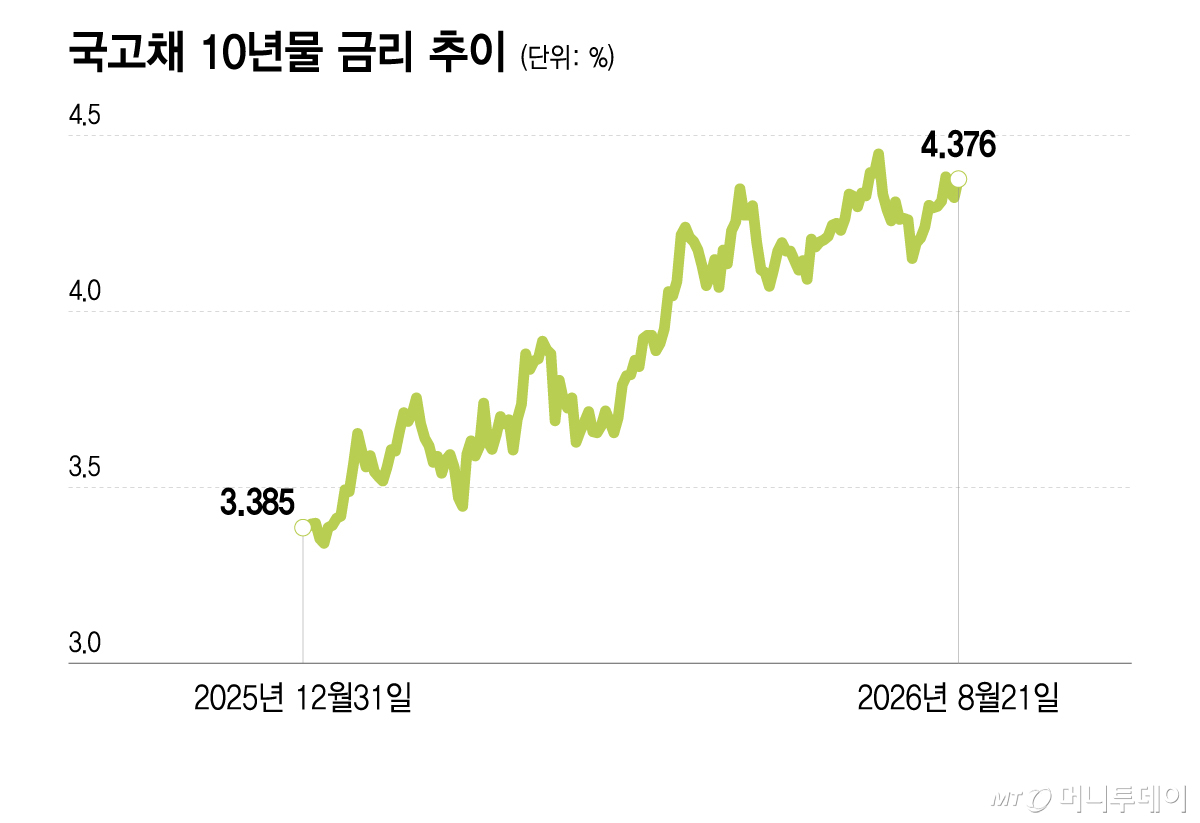
Bank investment income from bonds deteriorated significantly in the first half of this year due to rising interest rates. With high volatility expected to continue in domestic and international bond markets during the second half, forecasts suggest the 10th-year government bond yield could rise as high as 4.7%. In response, banks plan to reduce spot purchase positions and shift operations toward short-term instruments to manage interest rate rise risks.
According to the Korea Financial Investment Association's Bond Information Center on the 24th, the 10th-year government bond yield closed at 4.335%, down 0.041 percentage points (P) from the previous trading day. Although the yield saw a slight adjustment today, it has been trending upward since breaking through the 4th% range in May, after standing in the late 3% range as of the end of last year.
Bond yields move inversely to prices. Therefore, rising interest rates are widening banks' bond valuation losses. KB Kookmin Bank's first-half losses related to securities totaled 1 trillion 94.4 billion won, marking a shift from a profit of 356.7 billion won in the same period last year. Shinhan Bank and Woori Bank also turned into losses, recording deficits of 288.8 billion won and 288.5 billion won, respectively. NH NongHyup Bank maintained profitability but saw profits drop by 48% compared to the same period last year. Hana Bank, which does not separately report securities-related income, saw its combined income from securities, foreign exchange, and derivatives fall by 40%.
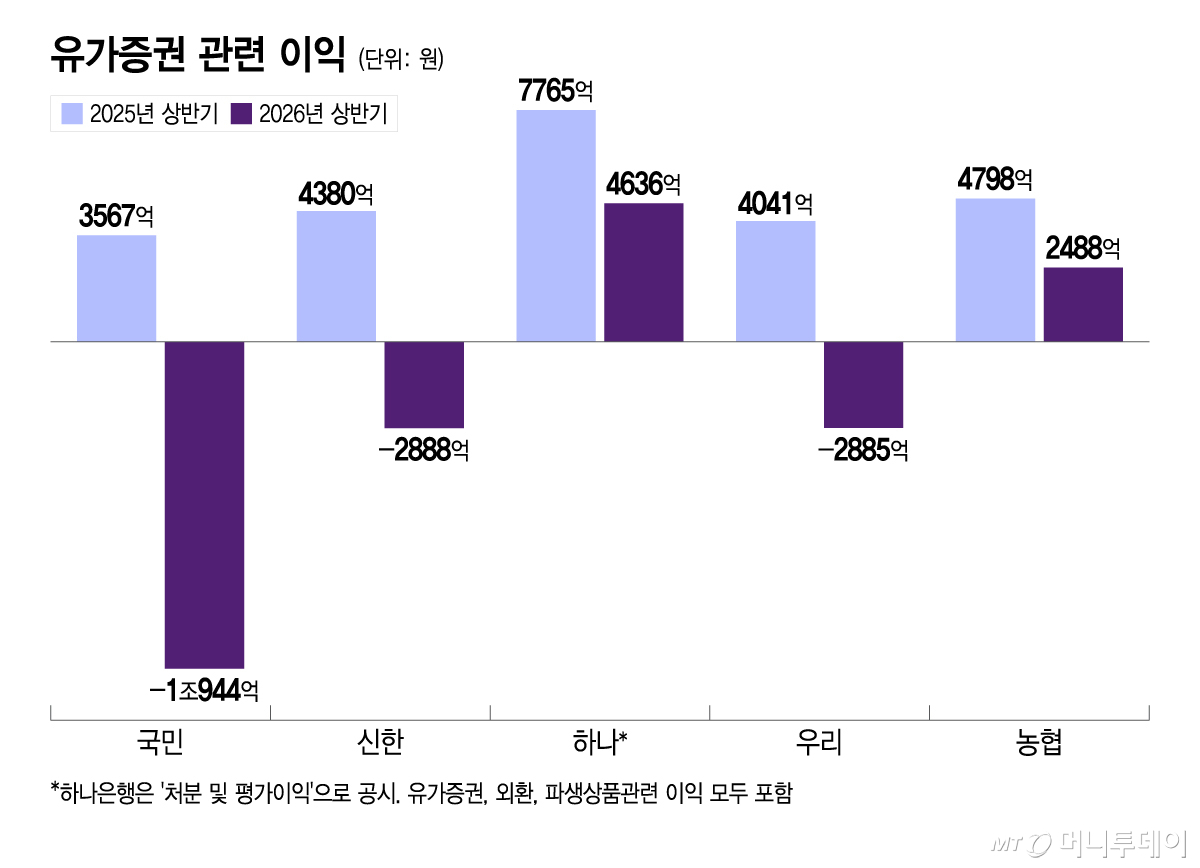
A financial industry official said, "In a rising interest rate environment, the more bonds banks hold, the greater their market-value-based valuation losses inevitably become. Although profits from foreign exchange (FX) and derivatives helped offset some of this, bond losses were so large that long-term purchase positions collapsed, pushing dealers' stress to its peak."
The problem is that interest rates are expected to continue rising through early next year, creating significant risk. In particular, the upward trend in U.S. long-term interest rates is alarming. The 30-year U.S. Treasury yield hit a 19-year high of 5.311% on the 17th (local time), the highest since June 2007. The 10-year yield also surged into the 4.7% range, drawing market attention to the possibility of breaking through 5%. Although the U.S. Treasury announced plans to expand its "buyback" program for purchasing government bonds again, market forces continue to exert greater upward pressure on interest rates.
Alongside weakness in global bond markets, domestic base rate hikes are pushing interest rates higher. Markets anticipate that after the Bank of Korea raised the base rate by 0.25 percentage points in July, it may implement additional hikes within this year. Banks have set upper limits for the 3rd-year government bond yield at 4.1% and for the 10th-year yield at 4.7%.
Banks are expected to adopt operational strategies to minimize valuation losses in anticipation of rising interest rates. This mainly involves reducing spot positions and focusing operations on short-term instruments, which have relatively lower interest rate sensitivity. In addition, banks plan to actively utilize derivatives such as put options as hedging tools.
Bank A plans to maintain a strategy of reducing its second-half spot bond positions and purchasing put options. This is a strategy to reduce valuation losses by betting on falling bond prices. Bank B has adopted a strategy of shortening duration and securing interest income primarily through short- to medium-term instruments. Bank C also plans to strengthen monitoring of interest rate trends while reducing its bond purchase positions.
A banking industry official stated, "Considering market volatility, we will focus not on aggressively betting on direction but on selectively identifying investment opportunities that secure sufficient returns against risks."

 in FINANCE

