

As the trend of rising interest rates continues, tension is mounting over the soundness management of regional banks. This is because the burden of non-performing loans is increasing in industries closely tied to local real economies. Financial authorities have recently begun checking bank-wide non-performing loan ratios more frequently than before and are also breaking down indicators by region and industry for closer scrutiny.
According to financial authorities on the 1st, the Financial Supervisory Service has recently shortened its monitoring cycle for bank-wide non-performing loan ratios and is examining weak links by borrower category, including small and medium-sized enterprises (SMEs) and individual business operators, in addition to overall non-performing loan ratios.
The approach involves further segmenting trends of non-performing loans by industry and region; if figures rise rapidly in a specific bank or industry, the cause is investigated and soundness management measures are required. In particular, regional banks, which are relatively more affected by sluggish local economies, are being closely monitored.
The financial sector is concerned that prolonged high interest rates may gradually weaken borrowers' repayment capacity. At the beginning of the year, there was strong expectation for falling interest rates, but market rates have since risen again, keeping interest costs for SMEs (small and medium-sized enterprises) at a high level.
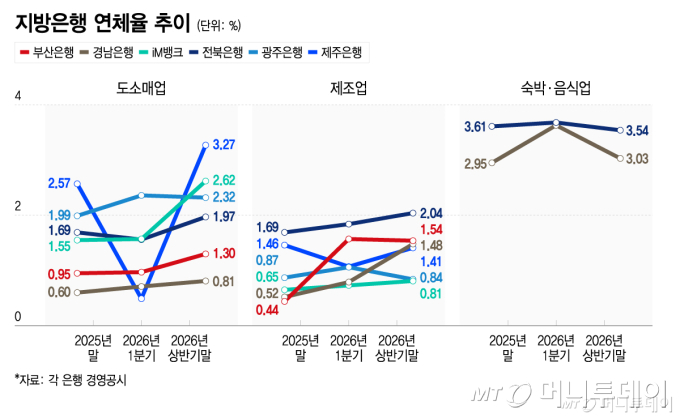
Non-performing loan ratios in wholesale and retail trade rise across all six regional banks... Manufacturing sector also sees increases in four banks
In fact, in regional banks, the burden of non-performing loans is growing, particularly in certain industries sensitive to local economic conditions. The non-performing loan ratios for the wholesale and retail trade sector have all risen compared to the end of last year across six regional banks: Busan, Gyeongnam, iM, Jeonbuk, Gwangju, and Jeju Banks. This is interpreted as a signal that repayment burdens are increasing in industries broadly affected by local domestic demand and self-employment conditions.
Jeju Bank's non-performing loan ratio for the wholesale and retail trade sector rose from 2.57% at the end of last year to 3.27% at the end of the first half of this year, the highest among the six regional banks. iM Bank also jumped from 1.55% to 2.62% during the same period, while Gwangju Bank rose from 1.99% to 2.32%.
Signs of deterioration also appeared in the manufacturing sector, which is closely linked to regional core industries. Among the six regional banks, non-performing loan ratios for manufacturing increased compared to the end of last year at four banks: Busan, Gyeongnam, iM, and Jeonbuk Banks. Busan Bank rose from 0.44% to 1.54%, and Gyeongnam Bank from 0.52% to 1.48%, each increasing by approximately one percentage point (P). Jeonbuk Bank also climbed from 1.69% to 2.04%, surpassing the 2nd% mark.
In some vulnerable sectors such as accommodation, which already had high non-performing loan ratios, high non-performing loans are proving difficult to resolve. The non-performing loan ratios for accommodation and food services at Jeonbuk Bank and Gyeongnam Bank reached 3.54% and 3.03%, respectively, at the end of the first half of this year, both recording figures in the 3rd% range.
Typically, rising interest rates can immediately benefit bank profitability. Loan interest rates tend to rise relatively quickly in response to changes in market rates, while deposit rates increase with a lag, potentially improving net interest margins (NIM). Banks have also hedged a significant portion of the interest rate risk on their bond holdings, so even if bond prices fall, it does not place a heavy burden on soundness management. What authorities are focusing on is not the interest rate itself but the impact of prolonged high interest rates on borrowers' repayment capacity.
A financial authority official stated, "Non-performing loans initially appear gradually in some vulnerable borrowers, but once they exceed a certain level, they can expand rapidly." The official added, "Now is the time to carefully examine which regions and industries are seeing deterioration first."

 in FINANCE
