

It is expected that regional Saemaul Geumgo member-investors will find it easier to receive dividends in the near future. Once the Saemaul Geumgo Act is amended soon, regional credit unions will be able to use their accumulated statutory reserve funds to cover deficits. If approximately 2.7 trillion won in cash is used for deficit coverage, individual credit unions can accelerate the resumption of dividend payments.
According to financial sector sources on the 3rd, the National Assembly Administration and Safety Committee held a plenary session on the 1st and passed an amendment to the Saemaul Geumgo Act.
The bill includes provisions allowing regional Saemaul Geumgo to use previously accumulated statutory reserve funds for deficit coverage.
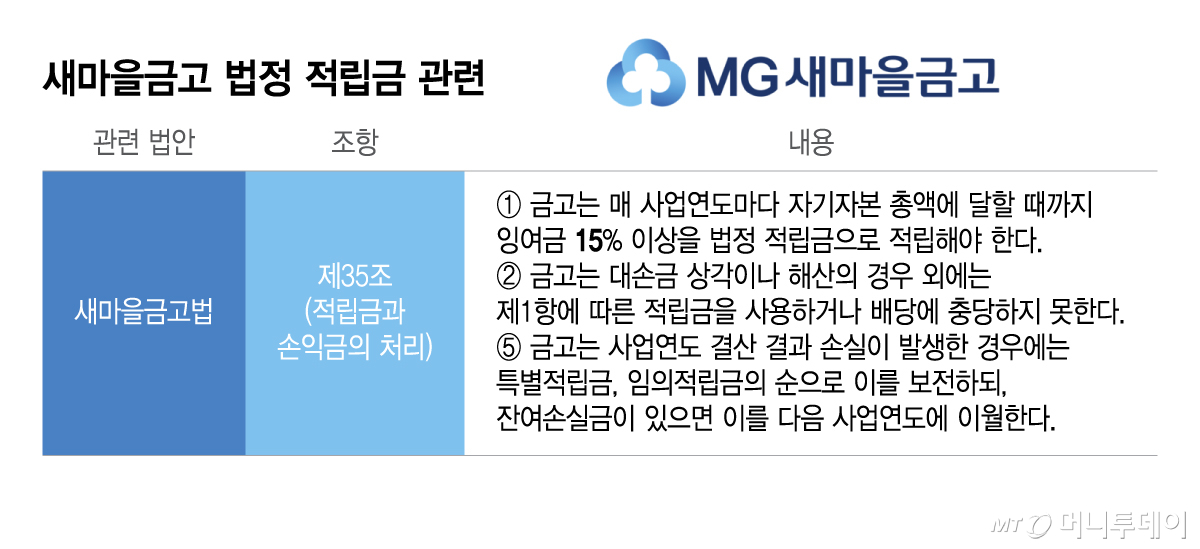
Under the current Saemaul Geumgo Act, individual credit unions must accumulate at least 15% of annual surplus as statutory reserve funds. Accumulation continues until the cumulative statutory reserve fund reaches the previous fiscal year-end capital.
The problem is that these statutory reserve funds cannot be used except in cases such as writing off non-performing loans (NPLs) from the books or liquidating a credit union.
They cannot be used to cover deficits arising from a credit union's annual operating results. When a deficit occurs, it is first covered by special reserves and then by voluntary reserves; any remaining loss is carried forward to the next year.
The amount of regional Saemaul Geumgo statutory reserve funds that remained unused as of last year stands at 2.7363 trillion won. In 2022, it was 2.2042 trillion won, increasing by more than 500 billion won over three years. Meanwhile, the number of credit unions reporting deficits rose from 47 to 697 during the same period. Due to current regulations, even as the number of deficit-incurring credit unions increased, statutory reserve funds did not decrease but instead grew.
There is also an issue of equity among mutual financial institutions. Other mutual financial institutions such as Nonghyup and Suhyup can use their statutory reserve funds for loss coverage. Shinhyeop also had its law amended relatively recently in 2024 to allow this. Among mutual financial institutions, only Saemaul Geumgo cannot cover deficits using statutory reserve funds.
Saemaul Geumgo has experienced large-scale deficits in recent years due to real estate project financing (project financing) failures and other issues. Regional credit union member-investors have not been receiving dividends well up until now. High dividend rates that once reached the 7.0% range are now a thing of the past.
If regional credit unions cover losses using statutory reserve funds, their capacity for dividends will expand. For example, if a credit union incurred a 10 billion won deficit this year and has only 6 billion won in special and voluntary reserves combined, it can use statutory reserve funds to handle the remaining 4 billion won loss.
If that credit union turns profitable the following year, it can resume dividend payments thereafter.
There is also an indirect effect of improving the soundness of regional credit unions. Once dividends normalize, member-investors' withdrawal of capital can be prevented. If dividend suspensions continue for a long time, members may withdraw their investments, reducing the credit union's capital base.
The amendment passed by the Administration and Safety Committee is expected to proceed through the Legislation and Judiciary Committee plenary session before being submitted to the National Assembly plenary session. Given that there is not a significant difference in opinion between the government and political circles, it may be approved at the plenary session scheduled for mid-month.
A Saemaul Geumgo official stated, "Once the amendment passes, it will certainly help with capital expansion and securing dividend capacity," adding, "It also has the merit of eliminating regulatory disparities among mutual financial institutions."

 in FINANCE
