

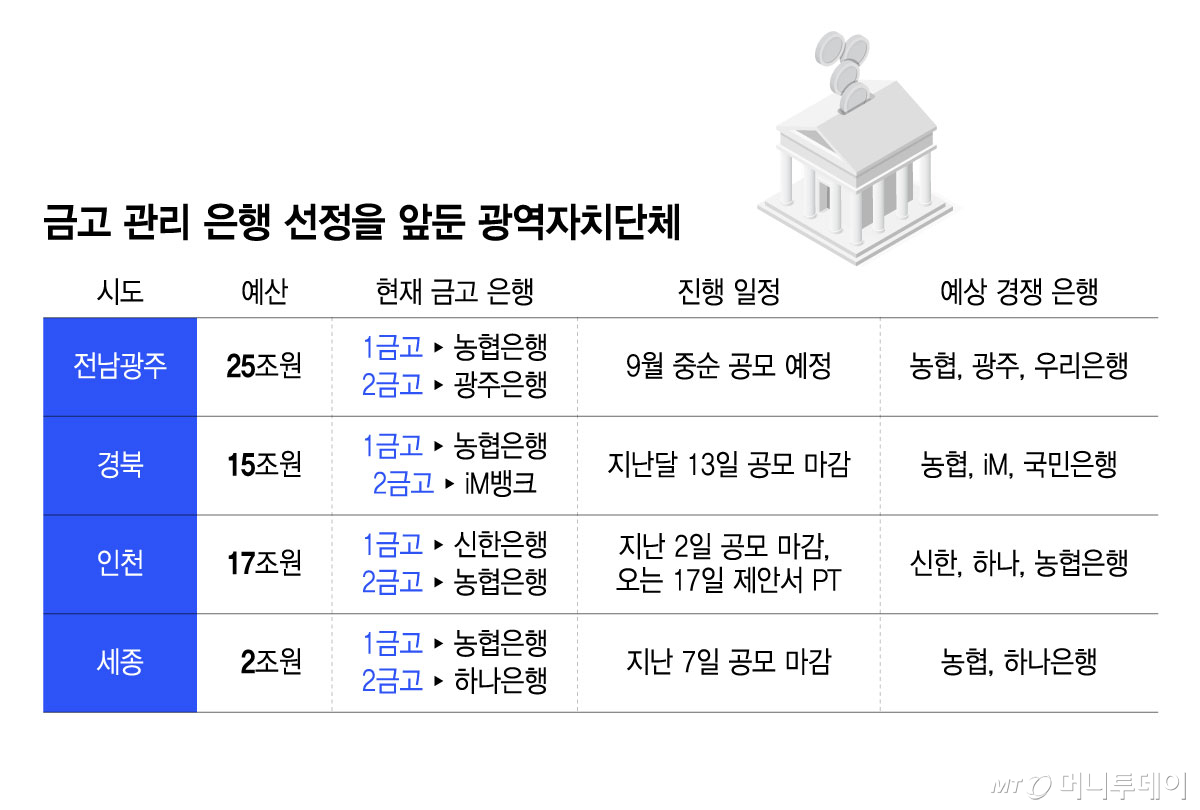
Competition among banks is heating up ahead of the selection of a unified depository for Gwangju Metropolitan Special City in Jeollanam-do, valued at approximately 25 trillion won. A rematch between NH NongHyup Bank, which currently holds the temporary first depository, and Gwangju Bank, which has safeguarded the former Gwangju City first depository for 57 years, is expected, while Woori Bank is also actively considering participation. In the Gyeongbuk Provincial depository, KB Kookmin Bank is challenging existing participants NH NongHyup Bank and iM Bank, signaling an expanding territorial competition among banks over local government depositories.
According to financial industry sources on the 13th, Gwangju Metropolitan Special City in Jeollanam-do plans to issue a public notice as early as this week to select its next depository bank. Unlike the temporary depository selected last May and valid until the end of this year, the newly selected depository bank will manage the special city's finances for four years through 2030. The current fiscal scale of Gwangju Metropolitan Special City is approximately 25 trillion won.
There is a high possibility that NH NongHyup Bank, currently managing the temporary first depository, and Gwangju Bank, which has protected the former Gwangju City first depository for 57 years, will face off again. As the selection of the depository approaches, controversies over evaluation criteria are also intensifying.
Notably, a revision to local ordinances (proposed by Park Jin-han, a Democratic Party of Korea lawmaker from Gwangju Metropolitan Special City) that requires evaluating financial institutions' regional business networks not merely by the number of branches but by their distribution across cities, counties, and districts has been passed and will apply starting with this depository selection. Observations suggest this criterion may be relatively more favorable to NH NongHyup Bank, which has a broad business network extending throughout Jeollanam-do's cities and counties, compared to Gwangju Bank, whose branches are concentrated in downtown Gwangju.
Controversies over evaluation criteria are not new for the first time. During the process of selecting the temporary depository, fairness concerns arose when NH NongHyup Bank's business network was evaluated including branch offices of local agricultural cooperatives, which are separate legal entities. Conversely, when evaluating financial institutions' creditworthiness, only NH NongHyup Bank's credit rating was reflected without including lower-rated local agricultural cooperatives, prompting Gwangju Bank to raise issues of equity.
With other major banks also showing signs of joining the competition, the competitive landscape is becoming increasingly complex. In particular, Woori Bank is actively considering participation in the public bid. Hana Bank, KB Kookmin Bank, and IBK Industrial Bank of Korea are also monitoring the announcement details and evaluation criteria to decide on their participation.
The offensive by commercial banks toward local depositories has already materialized in other regions. The Gyeongbuk Provincial depository, valued at approximately 15 trillion won, is a prime example. Following the submission of applications for the next depository bank by Gyeongbuk Province on the 12th–13 last month, not only NH NongHyup Bank (the existing first depository) and iM Bank (the second depository), but also KB Kookmin Bank submitted proposals. In response, iM Bank has publicly demanded that KB Kookmin Bank withdraw its proposal, citing "mutual prosperity."
However, not all commercial banks are actively expanding into local depositories. Shinhan Bank faced strong backlash from the local community after taking over the primary banking business for Chosun University, a private institution in Gwangju Ji Yeok (CEO), from Gwangju Bank in 2023. Subsequently, it signed a "Growth Together" agreement with Gwangju Bank and has refrained from entering the local depository market.
A banking industry official stated, "As acquiring new customers has become the top priority for banks, it is inevitable that major banks are showing interest in local depositories," adding, "For regional banks as well, with their deposit base weakening, the importance of securing depositories has grown even greater."

 in FINANCE
