

Toss (Viva Republica) payment terminal subsidiary Toss Place is issuing new capital securities for the first time. The structure reinforces credit by having the parent company, Toss, assume the debt in case of default. This move is analyzed as an effort to improve the financial condition of Toss Place, which has fallen into a complete capital impairment state.
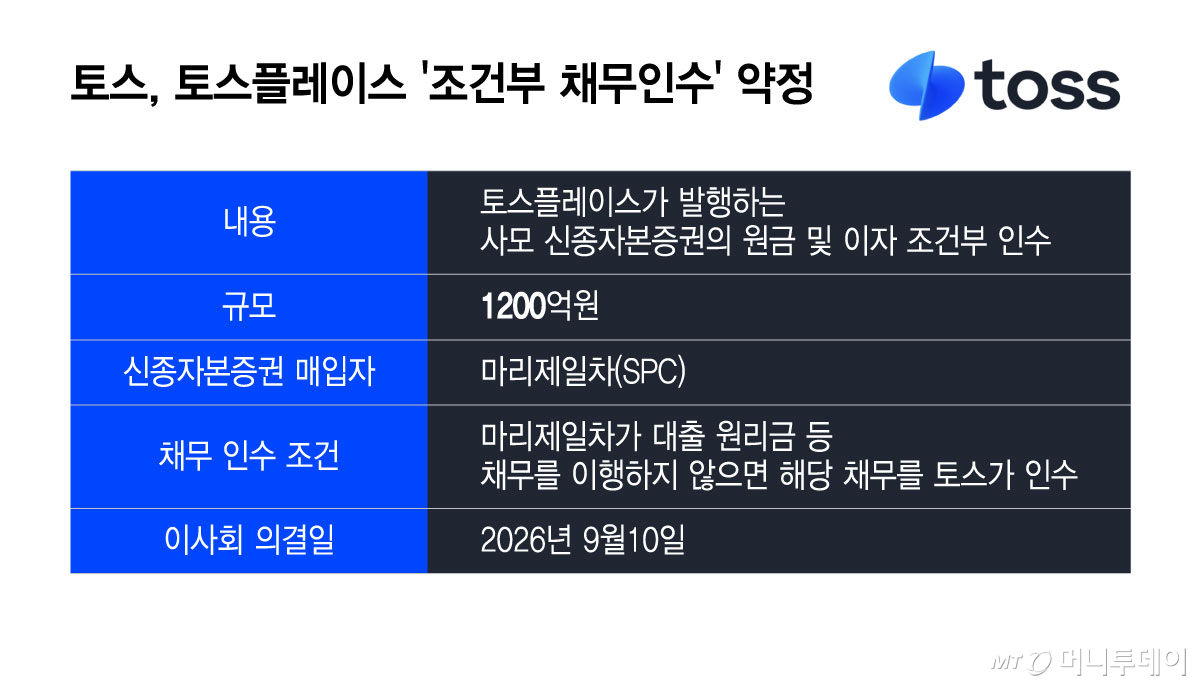
According to the financial sector on the 14th, Toss recently held a board meeting and approved a contingent debt assumption agreement for new capital securities to be issued by Toss Place. Toss Place plans to issue 'First Series Unregistered New Capital Securities' totaling 120 billion won.
Specifically, an SPC (special purpose company) named 'Marie First Class' will borrow 120 billion won from a financial institution and purchase Toss Place's new capital securities. If the SPC fails to repay the loan principal and interest, the parent company Toss will assume the debt. This is a method for the parent company to reinforce credit given Toss Place's fragile financial condition.
This marks the first time Toss Place has issued new capital securities. Until now, Toss Place has relied heavily on borrowing and capital increases from its parent company. In 2024, Toss lent 40 billion won to Toss Place and conducted a capital increase of about 27.5 billion won. Last year, it carried out an additional borrowing of 20 billion won and a capital increase of 50 billion won.
Toss Place also borrowed 10 billion won from Hana Bank last year. In April this year, it issued private corporate bonds totaling 100 billion won at an annual interest rate of 5.3%.
Although it has been sustained by the parent company's capital strength, Toss Place's financial condition is not good. Toss Place was already in a complete capital impairment state last year. Based on separate financial statements for last year, Toss Place recorded a net loss of approximately 74.6 billion won. Total equity stands at a negative balance of about 28.8 billion won. Short-term funding pressure is also significant. Current liabilities amount to 93 billion won, while current assets are only 37 billion won, resulting in a current ratio of 39.8%.
The issuance of new capital securities is analyzed as an effort to raise capital to resolve capital impairment. Unlike general corporate bonds, new capital securities are recognized as equity, thereby improving the financial structure.
The borrowing agreement with Hana Bank may have also influenced the issuance of new capital securities. When lending 10 billion won to Toss Place, Hana Bank imposed a condition that 'if complete capital impairment occurs by the end of 2025, it must be resolved before maturity; if not resolved, the entire loan amount must be repaid.'
Toss Place's offline terminal business is increasing the burden on the parent company due to high costs. Toss has previously set aside the full 60 billion won lent to Toss Place as a bad debt allowance.
However, Toss is expanding investments for the vision of connecting online and offline payment ecosystems into one. Securing offline terminal merchants allows access to specific payment data that card companies cannot reach, enabling future B2B business opportunities using this data.
A Toss Place official stated, "The issuance of new capital securities was pursued to secure working capital necessary for Toss Place's business operations," and added, "If the financial structure improves, we expect positive effects on transactions with financial institutional investors, including Hana Bank."

 in FINANCE
