

"There is no way to know how many times you will be hit, so you are forced to beg for your life." (A source in the financial sector)
The financial sector has been thrown into chaos by the "roller coaster" penalties imposed by financial authorities. While companies must develop aggressive sales strategies leveraging customer information in the age of AI (artificial intelligence), a single violation of the Credit Information Act (hereinafter referred to as the New Credit Information Act) could result in penalties amounting to trillions of won. The Financial Supervisory Service mechanically imposes large-scale penalties, while the Financial Services Commission frequently reduces them significantly—a "roller coaster" sanction that is repeated over and over. Critics argue that fundamental countermeasures are urgently needed.
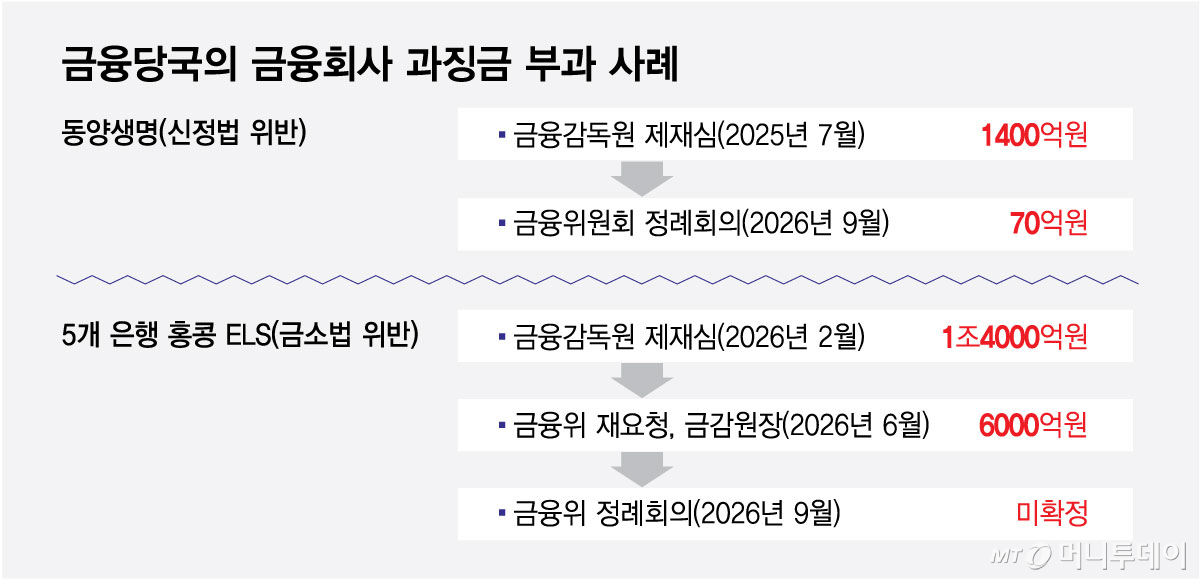
According to the financial sector on the 14th, Dongyang Life Insurance received a final penalty of 70 billion won from the Financial Services Commission for violating the New Credit Information Act. This marks four years since it was caught by the Financial Supervisory Service in 2022 for transferring customer information without consent to its affiliated GA (insurance agency). The penalty imposed on Dongyang Life Insurance drew intense attention not only from other insurance companies with similar violations but also from the entire financial sector. More than ten financial institutions have undergone inspections by the Financial Supervisory Service over allegations of violating the New Credit Information Act.
Penalties under the New Credit Information Act are unpredictable. Since the 2020 revision, the maximum penalty is capped at 3% of sales revenue. The problem lies in what follows. Financial authorities must consider factors such as the severity of the violation, the amount of damage caused, and the efforts made by financial institutions when imposing sanctions. While penalties under the Personal Information Protection Act or the Financial Consumer Protection Act are differentiated at 1–100% of the base penalty, the New Credit Information Act lacks such detailed criteria. Once a violation is confirmed, the Financial Supervisory Service selects one reduction rate—50%, 75%, or 100%—based on inspection and sanction regulations to impose the base penalty. Even applying the maximum mitigation rate of 50%, Dongyang Life Insurance faced a penalty of 140 billion won. If the same standard applied to Shinhan Life, which is facing similar penalties for comparable issues, the penalty would exceed 200 billion won.
The banking sector has even more reason to be on high alert. This is because the concept of sales revenue for banks—operating income—reaches tens of trillions of won. KB Kookmin Bank's operating income stands at 39 trillion won, Shinhan Bank at 36 trillion won, and Hana Bank at 46 trillion won. Even if only 3% of operating income is applied with the Financial Supervisory Service's maximum mitigation rate of 50%, base penalties could reach hundreds of billions of won.
Penalties imposed by the Financial Supervisory Service are finalized by the Financial Services Commission. The Financial Services Commission has the authority to reduce penalties based on mitigation for minor violations, taking into account the severity of the offense. However, both the Financial Supervisory Service's excessive penalty sanctions and the Financial Services Commission's significant reductions place a burden on both institutional investors. The Financial Supervisory Service faces criticism for making mechanical judgments while mindful of audits by the Board of Audit and Inspection, while the Financial Services Commission's decision to significantly reduce penalties based on feasibility considerations may appear as "sentimentalism."
This was also evident in the sanctions related to Hong Kong H-Index ELS (equity-linked securities). The Financial Supervisory Service initially sent a penalty of 1.4 trillion won to the Financial Services Commission "according to principle," but after a request from the Financial Services Commission, it reduced the penalty to 600 billion won and resubmitted it. Even with the 600 billion won sanction proposal, the Financial Services Commission held 14 subcommittee meetings but still failed to reach a conclusion.
Financial institutions unanimously agree that urgent improvements are needed for the "yo-yo" penalty system. They point out that the Financial Supervisory Service's sanctions must be corrected first, as they fail to consider the severity of violations. Although financial authorities are working on establishing detailed criteria for penalties under the New Credit Information Act, progress remains slow.
There is also a view that the dual system of financial institution sanctions, split between the Financial Supervisory Service and the Financial Services Commission, should be completely reorganized. A source in the financial sector stated, "If we are hit with penalties that are simply unacceptable, we will inevitably have to appeal through litigation." In the case of Hong Kong ELS, a bank recently won a lawsuit filed by an investor.

 in FINANCE
