

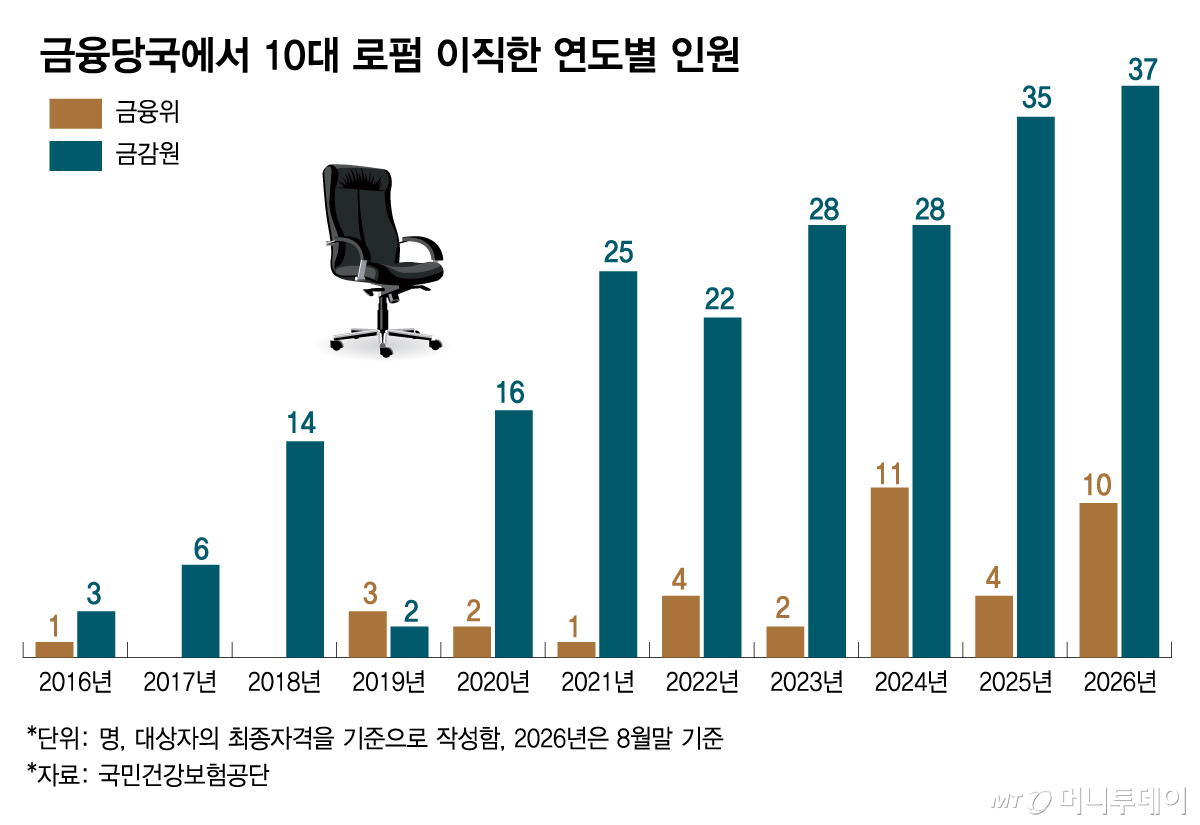
The number of former financial regulators leaving the Financial Services Commission (FSC) and the Financial Supervisory Service (FSS) to join major law firms is rising rapidly. In just eight months this year, 47 individuals have moved to domestic top 10 law firms, already surpassing the total annual figure for last year. Concerns are emerging that the exodus of specialized talent could accelerate due to a combination of controversies over the relocation of financial regulators to regional areas and disparities in treatment between the public and private sectors.
According to data submitted by the National Health Insurance Corporation to Han Chang-min, a member of the Social Democratic Party on the National Assembly's Political Affairs Committee, a total of 47 former FSC and FSS officials moved to domestic top 10 law firms from January to August this year. Of these, 37 were former FSS officials and 10 were former FSC officials. This figure surpassed the 39th individuals who made such moves in all of last year within just eight months.
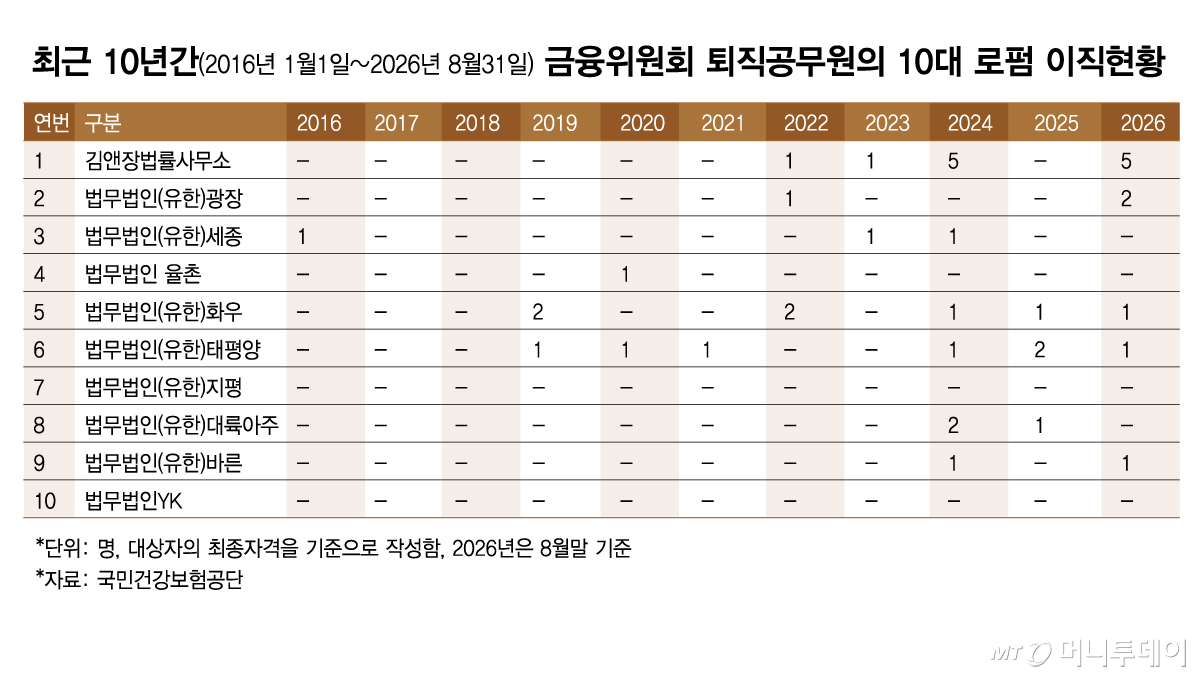
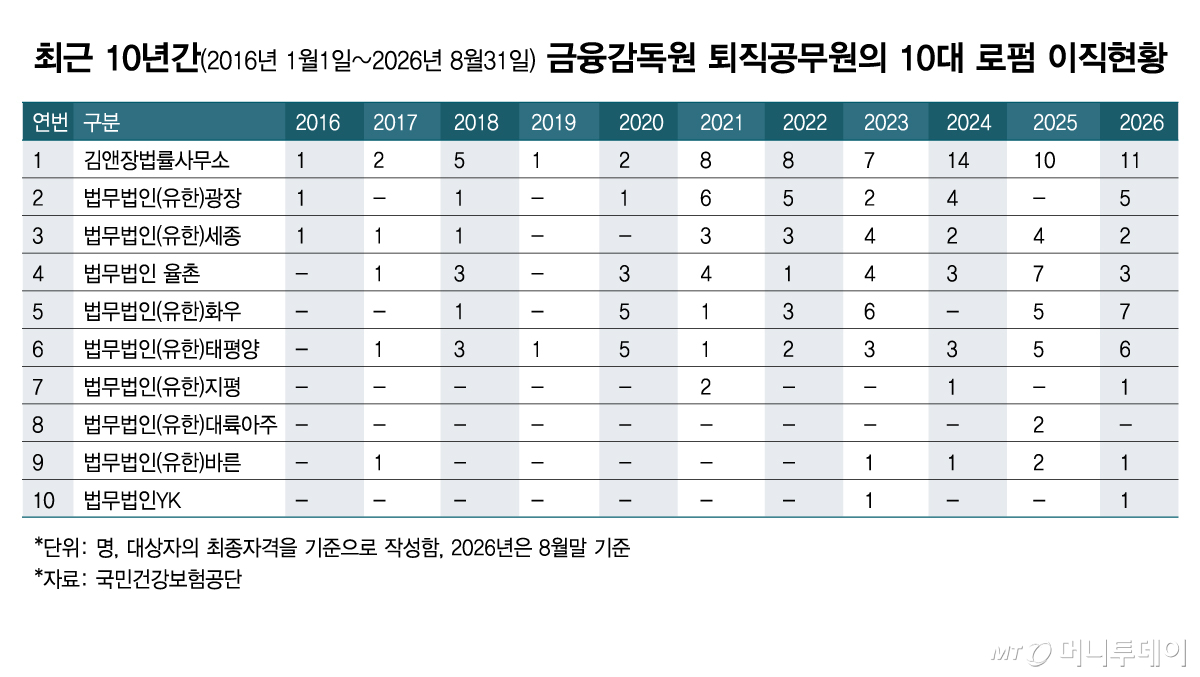
The trend of former financial regulators joining major law firms has shown a clear increase recently. The number of moves to top 10 law firms was 30 in 2023, 39 in 2024, and 39 in 2025, but surged to 47 as of the end of August this year. Over approximately 10 years from 2016 through August this year, the cumulative number of such moves reached 254. Former FSS officials accounted for 216, or 85% of the total, while former FSC officials numbered 38.
By law firm, Kim & Chang Law Office had the highest number with 81 individuals. This was followed by Taepyongyang Law Firm with 37, Hwawoo with 35, Yulchon with 30, Gwangjang with 28, and Sejong with 24. Among the 81st who moved to Kim & Chang, 69 were former FSS officials and 12 were former FSC officials.
After moving to major law firms, their "market value" also increased significantly. The average monthly compensation for the 12th former FSC officials who joined Kim & Chang was approximately 7.34 million won before the move, but it rose to about 31.83 million won afterward, a 4.3-fold increase. This represents an increase of approximately 24.49 million won in average monthly compensation.
A similar pattern emerged at other major law firms. The average monthly compensation for the seven individuals who moved from the FSC to Hwawoo rose from about 5.88 million won to 38.54 million won, while those who moved to Taepyongyang saw their compensation increase from approximately 9.35 million won to 41 million won.
Former FSS officials also experienced significant compensation increases after joining major law firms. The average monthly compensation for the 69th former FSS officials who moved to Kim & Chang rose from approximately 13.34 million won before the move to about 33.60 million won afterward, a 2.5-fold increase. For the 28th who moved to Hwawoo, compensation increased from about 13.54 million won to 27.03 million won, and for the 29th who moved to Yulchon, it rose from approximately 13.99 million won to 25.52 million won.
Concerns over talent outflow are growing within financial regulatory bodies recently. As the possibility of relocating financial regulators to regional areas has been raised during the government's second phase of public institutional investor relocation, voices are emerging, particularly from the FSS labor union, that the exodus of specialized talent could worsen. In fact, the number of FSS officials who voluntarily resigned increased from 22 in 2017 to 77 last year. Additionally, concerns have been raised at the FSC regarding the increasing trend of staff moving to the private sector, including those at the administrative officer and clerk levels.
The data also includes former FSC officials below Grade 4 who are not subject to employment review under the Public Officials Ethics Act. Consequently, the results reflect not only the so-called "post-retirement re-employment" of senior officials but also the trend of relatively younger practical-level staff leaving for the private sector.
The issue is that the FSC and FSS are institutional investors responsible for supervising, inspecting, and sanctioning financial institutions. As more former financial regulators move to major law firms, concerns have been raised regarding the possibility that their expertise, information, and human networks accumulated during their tenure could be utilized in financial institutions' responses to inspections and sanctions.
Han (Rep.) stated, "The number of former financial regulators moving to major law firms is increasing, and their compensation after the move has risen significantly," adding, "We will closely examine in the national audit whether these individuals' duties at law firms, their contact with financial regulators, and employment reviews and restrictions on handling specific business are being properly conducted."

 in FINANCE


