

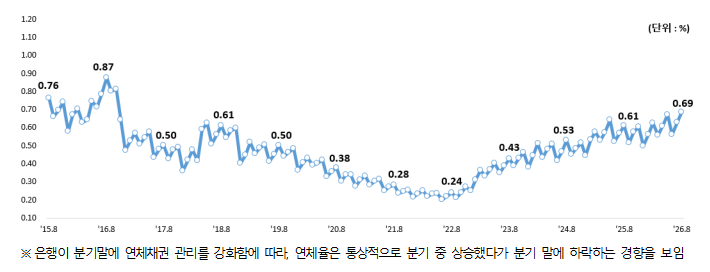
The won-denominated loan delinquency rate of domestic banks rose to 0.69% in August. In particular, while the delinquency rate for SME (small and medium-sized enterprise) loans reached 1%, the upward trend in delinquency rates continued, centered on vulnerable sectors such as small and mid-sized corporations and individual business owners.
According to the "Status of Won-Denominated Loan Delinquency Rates at Domestic Banks as of End-August 2026" released by the Financial Supervisory Service on the 23rd, the won-denominated loan delinquency rate of domestic banks was recorded at 0.69% as of the end of August. This represented an increase of 0.06 percentage points (p) from the end of the previous month (0.63%) and a rise of 0.08%p compared to the same month last year (0.61%).
The amount of newly generated delinquent debt in August was 3 trillion won, a decrease of 200 billion won from the previous month (3.2 trillion won). During the same period, the scale of delinquent debt resolution increased by 100 billion won, from 1.4 trillion won to 1.5 trillion won. The net increase, calculated by subtracting the amount of resolved delinquent debt from newly generated delinquencies, was 1.5 trillion won. The new delinquency rate stood at 0.12%, unchanged from the previous month.
By sector, the corporate loan delinquency rate rose to 0.86%, up 0.08%p from the previous month (0.78%). Compared to the same month last year (0.73%), it was higher by 0.13%p.
In particular, the SME (small and medium-sized enterprise) loan delinquency rate rose to 1.00%, up 0.09%p from the previous month (0.91%). The delinquency rate for small and mid-sized corporations increased by 0.10%p to 1.10% from the previous month (1.00%). The delinquency rate for individual business owner loans also rose by 0.09%p, from 0.77% to 0.86%. The large enterprise loan delinquency rate increased by 0.03%p to 0.39% from the previous month (0.36%).
The household loan delinquency rate rose to 0.45%, up 0.03%p from the previous month (0.42%). The mortgage loan delinquency rate increased by 0.02%p, from 0.29% to 0.31%. The delinquency rate for household loans excluding mortgages, such as credit loans, rose by 0.07%p, from 0.84% to 0.91%.
The Financial Supervisory Service assessed that the upward trend in delinquency rates is continuing, centered on small and mid-sized corporation loans, individual business owner loans, and household credit loans. However, it explained that the overall banking sector delinquency rate remains below the long-term average of 0.78% over the decade prior to the pandemic, indicating a manageable level in the medium to long term.
Considering uncertainties in domestic and international economic conditions and the trend of rising market interest rates, the Financial Supervisory Service viewed that there is a possibility of further increases in delinquency rates centered on vulnerable sectors. Accordingly, it plans to encourage the banking sector to proactively expand loss-absorbing capacity and strengthen soundness management through measures such as non-performing loan (NPL) sales.
Additionally, it will monitor compliance with relevant regulations to ensure that debtors' rights are not infringed upon during the sale and collection of delinquent debt, and plans to actively encourage debt restructuring for vulnerable borrowers lacking repayment capacity.

 in FINANCE
