

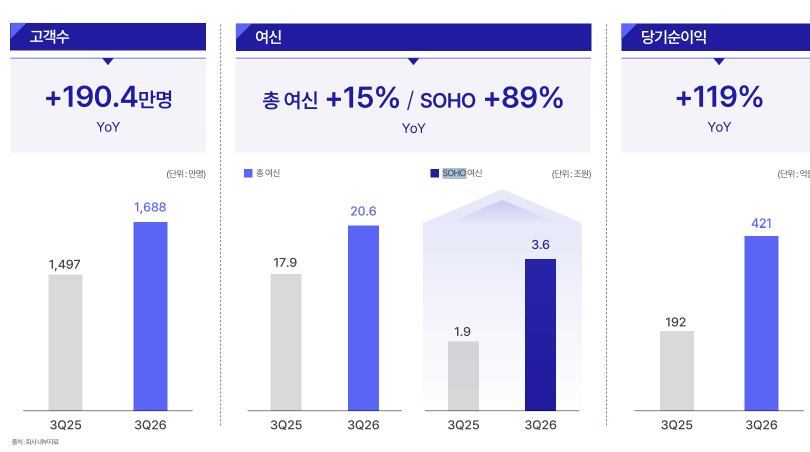
Kbank forecast that the net increase in its Small and Home Office (SOHO) loan portfolio for this year will remain within 1.8 trillion won. Considering that non-face-to-face channels account for only 2% of the corporate loan market, the bank predicted high future market growth potential. Next year, Kbank plans to expand into the corporate loan market to broaden its corporate finance territory, while focusing on soundness management through strict credit review.
Choi Woo-hyung, President and CEO of Kbank, stated during the third-quarter earnings conference call on the 30th, "Amid a financial environment that is uncertain in many respects, we are continuing healthy high growth based on quality assets and building a sustainable foundation." He added, "Just as we have been pioneering the non-face-to-face SOHO market, we are preparing new markets and new services."
Kbank's total loan balance this year reached 20.579 trillion won, a 15% increase from the same period last year. While household loans grew by only 6.4% (1.116 trillion won), SOHO loans surged by 89% (1.709 trillion won), leading loan growth.
As a result, the share of SOHO loans in the total portfolio expanded from 10.8% in the third quarter last year to 17.7%. Kbank's share of the net increase in domestic bank SOHO loans on a cumulative basis for the first three quarters of this year also reached 33.1%.
Kim Min-chan, Head of the Corporate Group, forecast, "We expect the SOHO loan market to see a net increase of 17 trillion to 18 trillion won this year," adding, "We anticipate a net increase of 2 trillion won next year."
One reason Kbank highly evaluates the growth potential of SOHO loans is that the non-face-to-face segment of the corporate loan market has not yet been fully activated. Group Head Kim explained, "In the 500th trillion won SOHO loan market, the portion where digitalization has taken place is less than 109 trillion won, meaning there is ample room for business expansion in the non-face-to-face sector."
Kbank plans to strengthen its business loans next year while also entering the Small and Medium-sized Enterprise (SME) loan market. The bank aims to launch various partnership products within the year, such as 'Naver Pay Business Owner Loans' and 'Musinsa Money Kbank Account/Check Card,' and is preparing a non-face-to-face loan service for corporations by June next year.
However, concerns remain regarding soundness management due to rapid loan growth. Kbank's delinquency rate and Non-Performing Loan (NPL) ratio in the third quarter rose slightly from the previous quarter to 0.62% and 0.60%, respectively. The credit cost ratio also increased by 0.04 percentage points (P) from the previous quarter to 1.12%.
Yoo Doo-soo, chief risk officer, said, "Compared to personal loans, this segment has characteristics that are relatively sensitive to interest rate fluctuations, so we plan to maintain stricter review and soundness management standards than those applied to household loans."
He added, "The SOHO delinquency rate is at a manageable level, and the likelihood of this indicator rising in the future is low. The year-end credit cost ratio (CCR) will decrease to the low 1% range."
Non-interest income, which had declined to the 9.1 billion won range in the second quarter, recovered to 26.9 billion won in the third quarter. This represents a 28% increase from the same period last year. The positive impact was driven by loan receivable disposal profits turning to an upward trend.
Lee Jun-hyung, head of the Strategy Division, said, "Until last year, we sold off a significant portion of accumulated non-performing loans (NPLs), which caused fluctuations. However, from this year onward, we are providing stable volumes each quarter, so volatility is expected to decrease."
Despite the burden of increased funding costs due to rising interest rates, the Net Interest Margin (NIM) remained solid in the 1.9% range. Deposit usage fees related to Upbit played a role in defending the NIM.
Lee said, "The usage fee rate for Virtual Asset Service Provider (VASP) deposits is 2.1%. In the past low-interest-rate environment, this acted as a factor limiting profitability, but recently, with rising interest rates, it has served to defend the NIM."
He added, "We expect funding costs to rise due to higher interest rates, so strengthening customer relationships to lead primary banking and maximizing the expansion of low-cost deposits are key objectives."

 in FINANCE
