

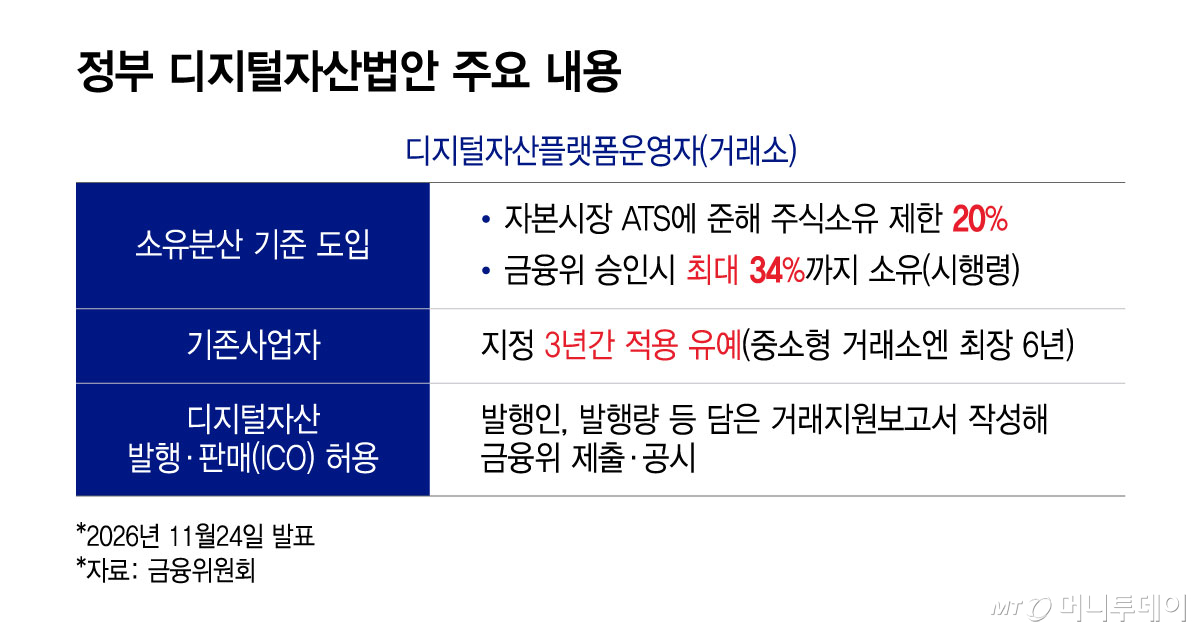
The government's move to cap major shareholders' stakes in cryptocurrency exchanges at 34 percent has introduced uncertainty into Naver Financial's planned acquisition of Dunamu.
If Naver Financial restructures the deal to acquire Dunamu alongside other shareholders rather than making it a wholly owned subsidiary, Hana Bank could play a larger role, having secured a stake in Dunamu ahead of the transaction.
According to financial industry sources on Friday, the Financial Services Commission announced the previous day that the proposed Digital Asset Innovation and User Protection Act would cap major shareholders' stakes in cryptocurrency exchanges at 20 percent.
However, financial institutions and other eligible entities may hold stakes of up to 34 percent with FSC approval.
The deal directly affected by this regulation is Naver Financial's acquisition of Dunamu. Naver Financial had planned to make Dunamu a 100% subsidiary through a comprehensive share exchange by March next year.
Had the transaction concluded as scheduled, existing Dunamu shareholders would have transferred their shares in exchange for new Naver Financial shares.
However, if the government's bill is applied, restrictions will arise on Naver Financial holding 100% of Dunamu's shares long-term, even if it secures full ownership through a share exchange.
Even if it initially holds 100%, it would eventually be required to hold only up to the cap and transfer the remaining shares to other corporations.
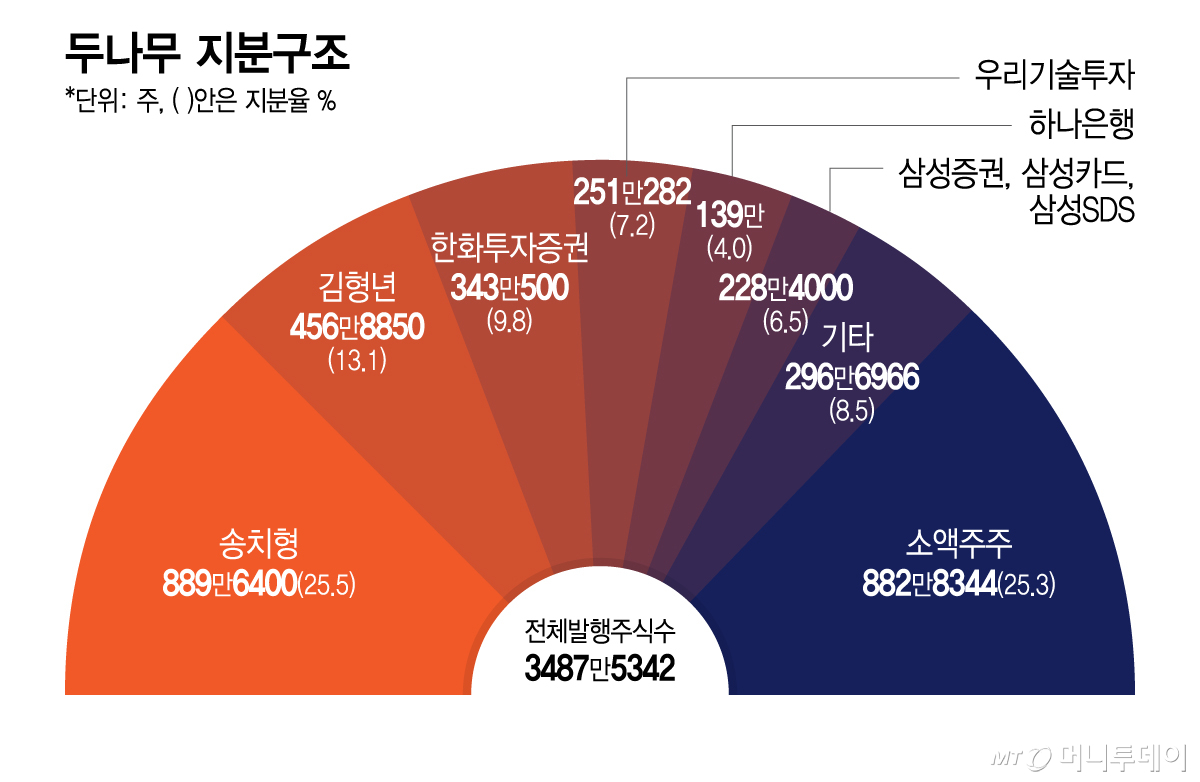
If Naver Financial does not relinquish its stake in Dunamu, the most likely realistic alternative mentioned in the market is that Naver Financial obtains an exception approval to directly hold up to 34% and secures the remaining shares by forming a consortium with friendly shareholders.
Hana Bank is mentioned as a cooperation candidate in this process. Hana Bank invested 1 trillion 32 billion won to purchase 2,284,000 shares (6.55%) of Dunamu and is currently the fifth-largest shareholder of Dunamu.
This is because it already holds shares and, as a financial holding company with sufficient capital strength, has the capacity to provide cash support, resulting in a lower burden for additional purchases.
The implication of lifting the "15% rule" restriction also serves to broaden Hana Bank's room for maneuver. Under the Banking Act, banks can only hold up to 15% of non-financial companies' shares, but the Financial Services Commission has decided as a policy to review lifting the 15th% rule in the future.
A financial authority official said, "Under current law, the virtual asset industry is not classified as a finance-related sector, so both stablecoin issuance consortiums and trading platforms are restricted from investing more than 15%," adding, "To lift this restriction, discussion is needed in each sector-specific law."
Given that Hana Financial has actively continued business cooperation in the digital asset field, its proactiveness in business is also highly evaluated.
Hana Bank completed a Proof of Concept (PoC) for overseas remittances using Kiwachaen, developed by Dunamu, and recently applied for regulatory sandbox review. It has also expanded collaboration with Hana Card to verify stablecoin card payments and merchant settlement.
Meanwhile, it is pointed out that whether banks will participate as friendly shareholders depends on business practicality. Adjustment of management rights and voting rights is cited as the key issue.
A financial industry official said, "From the bank's perspective, it could lead to cannibalization (erosion of its own market), so it is questionable how cooperative they will be with the digital asset industry," adding, "Sufficient carrots are needed to maintain clear management control while simultaneously recruiting banks as white knights."
A Hana Bank official said, "There is nothing we can decide at this point," adding, "A three-year grace period has been given, and it depends on how Naver Financial structures Dunamu's governance."

 in FINANCE

