


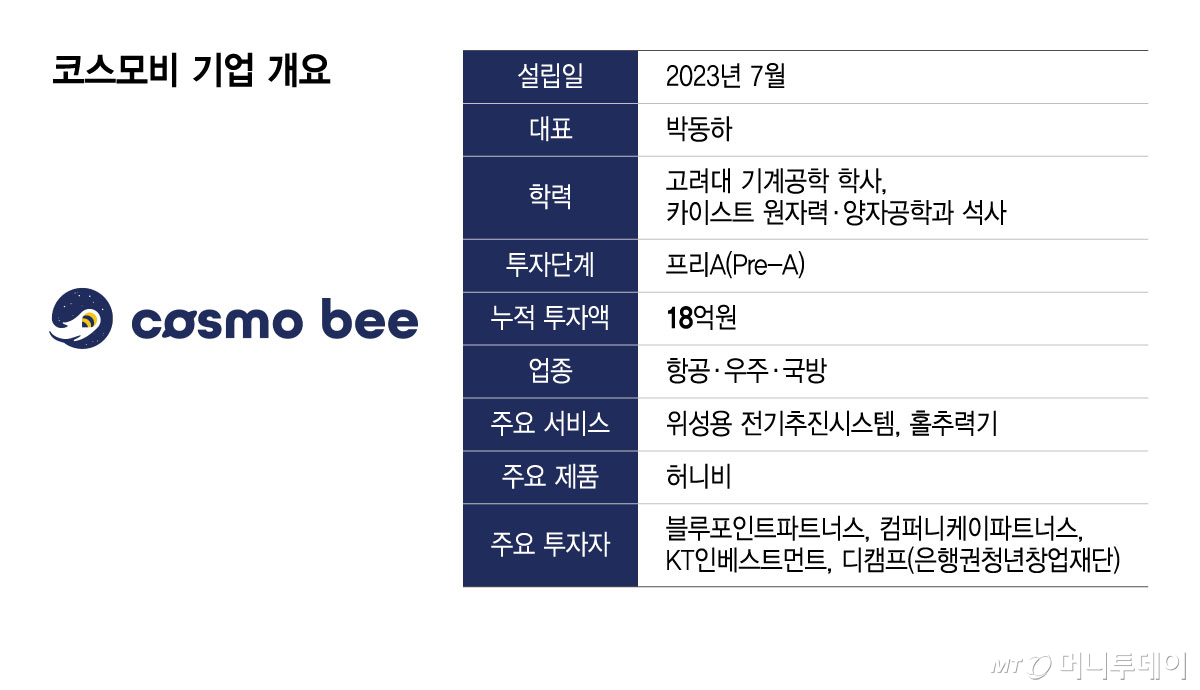
"Cosmobi is a company developing technology that enables free movement in space. It is an essential technology for launching new businesses within space, such as On-Orbit Services (OOS). If the era comes when humans reside on Mars in the future, we want to engage in logistics delivery from Earth to Mars."
Park Dong-ha, CEO of Cosmobi, recently made these remarks during a meeting with MoneyToday's startup media platform 'Unicorn Factory.' The company's vision and ambition are also reflected in its corporate name, which means "the honeybee of the universe."
Established in 2023, the space startup Cosmobi succeeded in developing the first-ever Hall thruster (electric propulsion) for ultra-small satellites in Korea. This is a propulsion system that adjusts satellite movement, such as maintaining and correcting orbits.
While rockets can lift satellites from Earth to space orbit by burning fuel, separate propulsion technology suitable for the space environment is required afterward for satellites to move to other orbits or head toward the Moon or planets in oxygen-free space. This is where Hall thrusters are essential.
Unlike conventional chemical fuel engines, Hall thrusters ionize gaseous fuel (gas) and accelerate it using an electric field to create movement. Thanks to their high thrust, they have been adopted for low-orbit satellite constellations and are the most widely used technology.
Using Hall thrusters allows satellites to carry less fuel, making them smaller and lighter. While SpaceX's 'Starlink' satellites led by Elon Musk also use the same electric propulsion method, they are specialized for medium-to-large satellites.
The ultra-small satellite Hall thruster developed by Cosmobi is gaining more attention as private satellite services begin to fully bloom. In particular, this technology is essential for 'low-orbit satellite constellations.' Low orbit refers to altitudes between 160 and 2,000 kilometers above the ground. To improve observation accuracy, dozens of satellites are often launched into a single orbit.
Park (CEO) stated, "To maintain proper spacing between multiple satellites within the same orbit, speed must be consistently adjusted while using fuel appropriately," adding that this is why electric thrusters capable of minimizing payload by efficiently using fuel are needed.
Cosmobi, established less than three years ago, is rapidly building its space heritage. In November last year, the company's electric thruster was applied to the K-Hero Cube satellite mounted on the fourth launch of Korea's Nuri rocket. In the fifth Nuri rocket launch scheduled for August this year, a hollow cathode—one of the core components of electric propulsion—will be mounted for verification.
Park (CEO) said, "We plan to verify our technology step-by-step through Nuri rocket launches and accumulate space heritage. Ultimately, we aim to contribute to the commercialization of electric thrusters and the localization of Korea's space industry."
The ultimate goal is Mars. Park (CEO) stated, "When humans begin residing on Mars, our goal is for Cosmobi, a Korean company, to grow into a central hub of the Earth-Mars logistics system."
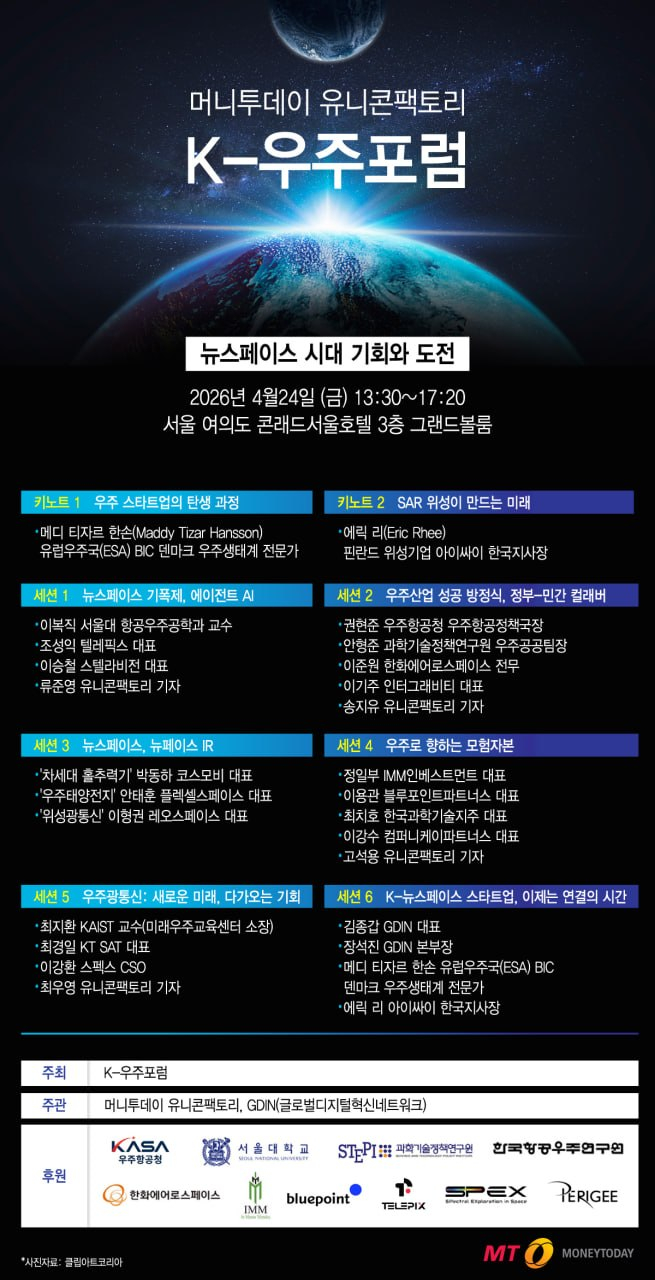
Meanwhile, Cosmobi will hold an IR (investor relations) session at MoneyToday's global conference '2026 Key Platform Special Program K-Space Forum' to be held on the 24th at Conrad Hotel Seoul Yeouido. The event will be attended by over 200 people, including space industry executives, experts, and investors. <☞Click to Apply>
The K-Space Forum was launched in March last year to expand its vision of the space industry across the entire value chain, including satellite manufacturing and operations, ground station infrastructure, data analysis, and materials, components, and equipment (MCE) supply. It aims to connect capital, technology, and companies to drive overall industrial growth.
As the forum's first activity, this conference will examine the space industry from multiple perspectives—technology, investment, research, and global reach—and present insights from experts in each field through a talk concert format.
[MoneyToday startup media platform 'Unicorn Factory']

 in FUTURE


