

[For more diverse corporate information on the startups mentioned in this article, please visit Unicorn Factory's Big Data Platform 'Data Lab' .]
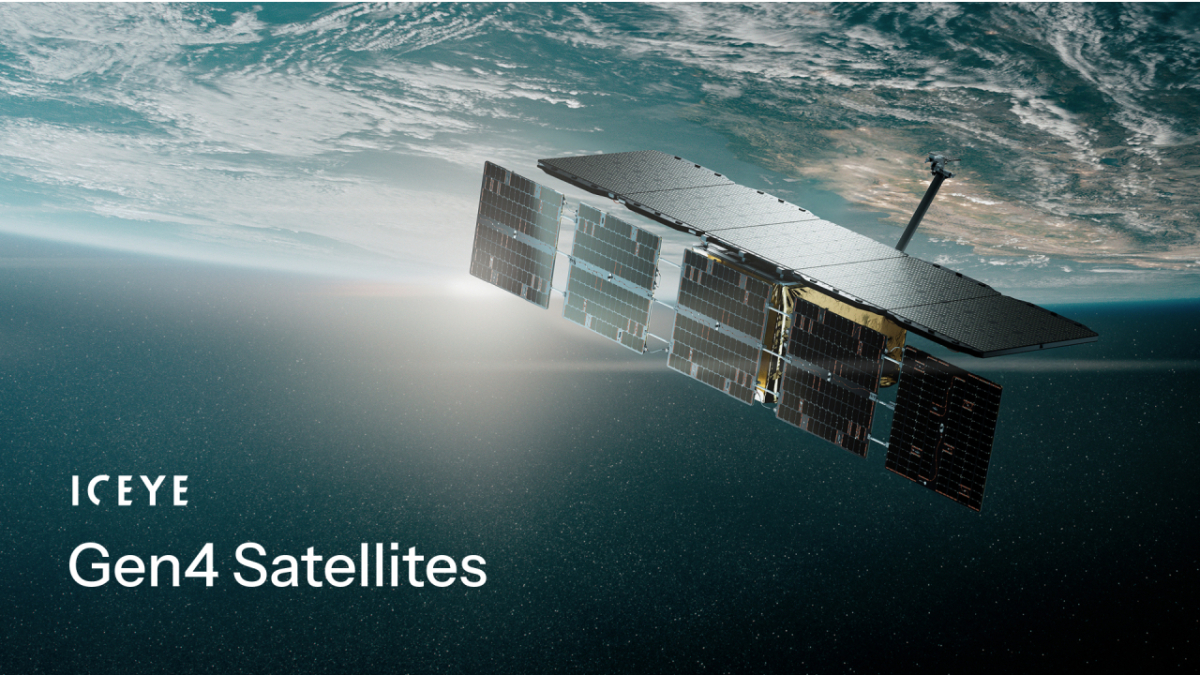
Finland-based SAR (Synthetic Aperture Radar) satellite startup ICEYE has launched a new funding round totaling €250 million (approximately 440 billion won). This comes just six months after the conclusion of its previous round.
Once negotiations are finalized, ICEYE's corporate valuation is expected to nearly double from its current €2.4 billion (about 4.2 trillion won) to as high as $5 billion (approximately 7.5 trillion won). The names of the lead investor and participating investors for this round have not yet been disclosed.
Founded in 2014, ICEYE designs, manufactures, and operates its own SAR constellation (satellite cluster) for space and defense startups. SAR technology is considered a core asset in reconnaissance and surveillance fields because it can capture high-resolution imagery even in environments where optical satellites struggle to operate, such as under clouds, smoke, adverse weather, or at night.
Six-Month Follow-On Funding… Corporate Valuation Rises Amid Europe's Defense Spending Increase
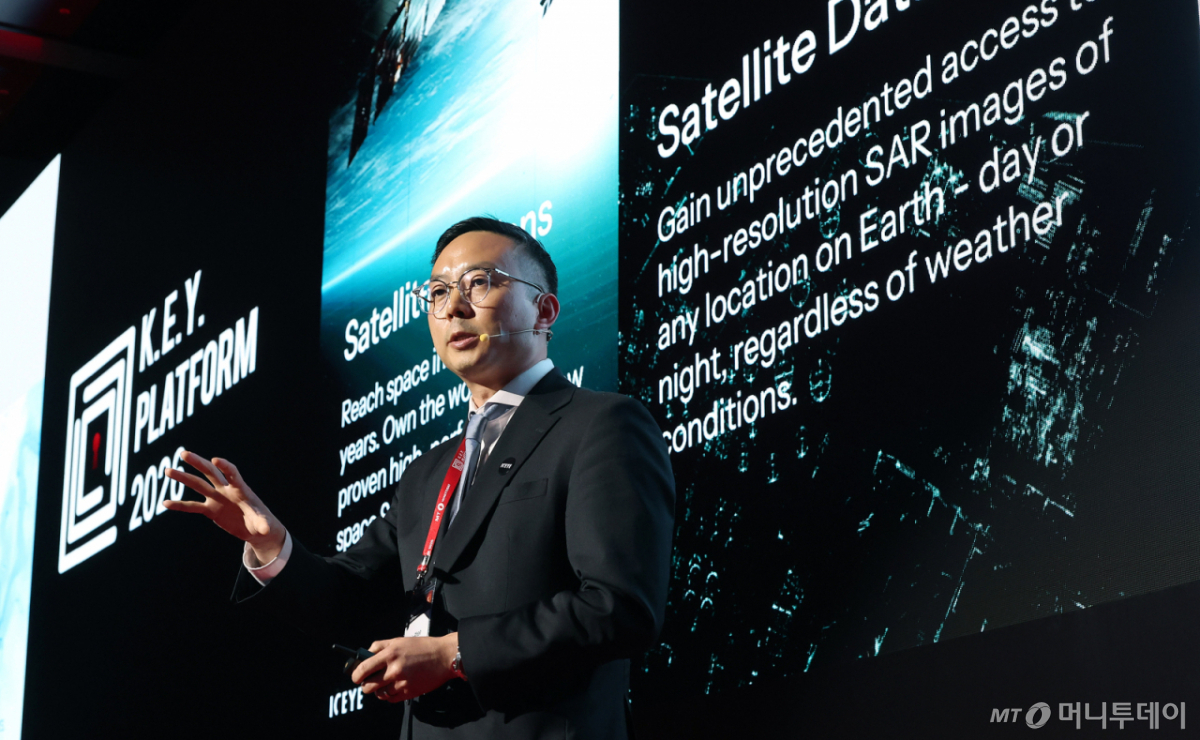
This funding round is a continuation of the Series E round that closed last December. At that time, U.S.-based General Catalyst led the investment, injecting €150 million (about 260 billion won) in new capital and €50 million (about 88 billion won) in secondary capital, totaling €200 million (approximately 350 billion won).
ICEYE's rapid move to secure additional funding coincides with increased defense spending across Europe. With over half of its revenue coming from government and defense sectors, the company is expanding its operations more aggressively.
ICEYE has signed various contracts, including: a joint venture with Germany's LINE Metal worth approximately €1.7 billion (about 3 trillion won) for a space reconnaissance contract; a SAR reconnaissance constellation delivered to the Polish military valued at around €200 million (approximately 350 billion won); and an expanded partnership with Ukraine's Ministry of National Defense.
According to ICEYE's financial results released earlier this year, its annual revenue exceeded €250 million (about 440 billion won), and its order backlog reached approximately €1.5 billion (about 2.6 trillion won). The company expects to maintain a similar growth rate this year as well.
To date, ICEYE has launched a cumulative total of 62 satellites. Its goal is to establish a weekly satellite production system by the end of this year to increase capacity in Yangsan. The funds raised in this round will be allocated to: expanding the SAR constellation; R&D for next-generation sensing technology; upgrading data and analysis platforms for government and institutional investors; and expanding into defense system integration.
Industry insiders view this round as likely being ICEYE's final capital raise before an IPO (initial public offering). An industry source stated, "ICEYE, which started as a polar monitoring startup, has now established itself as one of Europe's leading IPO candidates in the defense technology sector after 12 years."
Taiwan Enters Global Startup Ecosystem 'Top 20' for First Time… South Korea and Japan Chase Behind
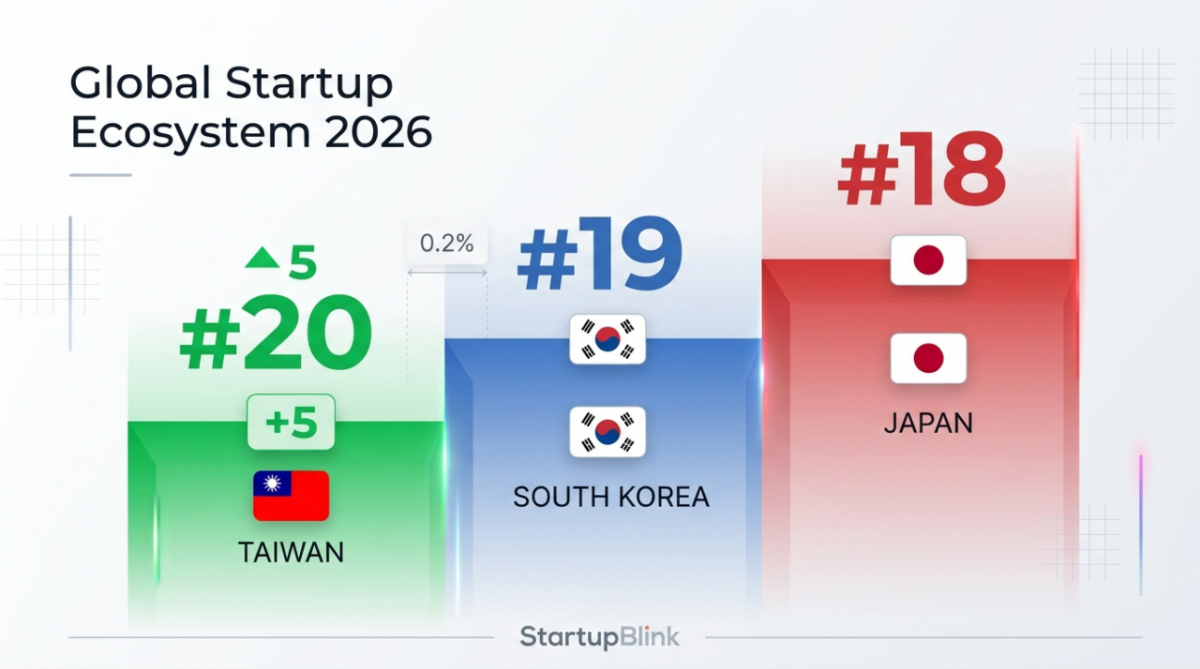
Taiwan has entered the global startup ecosystem rankings in the 'Top 20' for the first time in history. Along with Japan and South Korea, Taiwan now fills three spots in the global Top 20. Evaluations suggest that beyond its status as a semiconductor powerhouse, Taiwan is actively transforming into a 'startup hub.'
In the recently released '2026 Global Startup Ecosystem Index' by Israel-based global startup research institutional investor StartupBlink, Taiwan ranked 20th globally. This marks a five-position jump from last year's 25th place, achieving its highest-ever ranking.
The survey covered 120 countries and over 1,500 cities worldwide. Evaluation criteria included the quantity and quality of startups, investment flows, and support infrastructure. The Top 4 positions were held by: the United States, the United Kingdom, Israel, and Singapore.
According to this compilation, three East Asian countries are among the global Top 20: Japan (18th), South Korea (19th), and Taiwan (20th). China, which previously held a higher position, saw its score decline this year and fell out of the Top 20.
Notably, the gap between South Korea and Taiwan has narrowed to its smallest margin ever. A StartupBlink representative stated, "The gap between South Korea and Taiwan has shrunk to just 0.2 percentage points," and added regarding Japan's first-place position: "Its position is becoming increasingly vulnerable, making a (Taiwanese) overtaking fully plausible."
Considering that China also turned to negative growth during the same period, Taiwan is assessed as a market with high expansion potential in East Asia. In fact, Taiwan's annual ecosystem growth rate reached 41.1%, approximately three times the global average of 14.9%.
Taiwan's startup ecosystem was valued at $93.4 billion (approximately 142 trillion won). Its strengths by industry were also clear. Building on a semiconductor foundation represented by TSMC and MediaTek, Taiwan ranked seventh globally in hardware and IoT (Internet of Things) sectors. In the healthtech sector, it placed third in East Asia and fifth in Asia-Pacific.
Analyses suggest that Taiwan's rapid ascent can be attributed to policy effects implemented by the Taiwanese government over several years. A prime example is 'Startup Island TAIWAN,' a national-level startup integrated brand operated by the National Development Council (NDC) under the Executive Yuan of Taiwan.
This brand is overseen by the NDC in terms of policy and budget, while its subordinate institutional investors, such as TTA (Taiwan Tech Arena) and ITRI (Industrial Technology Research Institute), handle operational tasks. With bases in Silicon Valley and Tokyo, they are promoting global acceleration to connect Taiwanese startups with overseas VCs and large corporations.
Additionally, the 'Employment Gold Card' visa system for attracting foreign talent and the 'New AI 10 Major Infrastructure Promotion Plan' launched last year are cited as key drivers. Furthermore, offline infrastructure such as 'Startup Terrace,' Taiwan's largest international campus, is densely distributed.
An industry insider from Korea stated, "If Taiwan was previously viewed only as a 'semiconductor outsourcing partner,' it is now time to regard it as a full-fledged competitor at the ecosystem level. There is also no excluding the possibility that rankings could be reversed within the next one to two years."
Top-Tier Silicon Valley VCs Invest in Succession… U.S. Fintech 'Mercury' on Verge of Entering Decacorn (Startup Valued Over $10 Billion)

U.S.-based digital banking platform Mercury raised $200 million (approximately 300 billion won) in its Series D round, pushing its corporate valuation to $5.2 billion (about 7.9 trillion won). Compared to the round 14 months ago, its corporate valuation rose by 49%, leading to speculation that entry into decacorn status (corporate valuation of over $10 billion) is not far off.
This investment saw follow-on investments from existing investors including Sequoia Capital, Andreessen Horowitz (a16z), Coatue, CRV, Sapphire Ventures, and Spark Capital—all top-tier Silicon Valley VCs. TCV (Technology Crossover Ventures), a fintech-focused investment firm, joined as a new investor.
TCV is a late-stage fintech investment house that has invested in UK-based Revolut and Brazil's Nubank. It is noteworthy that investors participated in a 49% up-round (follow-on investment with increased valuation) amid a broader trend of down-rounds (follow-on investments after valuation declines) across the fintech sector.
A VC industry source remarked, "When top-tier VCs increase their portfolio valuations by nearly 50% within 14 months and invest, it means they are not merely following along but have begun to seriously consider an IPO scenario."
The foundation of Mercury's credibility with VCs lies in its solid fundamentals. Mercury has recorded GAAP (U.S. accounting standards) net profits and EBITDA (operating profit before depreciation) for four consecutive years. As of the third quarter last year, its annual recurring revenue (ARR) reached $650 million (approximately 980 billion won).
Mercury has secured a diverse customer base, with one out of every three early-stage U.S. startups using Mercury accounts. Recent high-profile AI and SaaS startups such as Superbase, ElevenLabs, Rumble, Linear, Phantom, and Tempo are among Mercury's clients.
Mercury plans to launch 'Mercury Command' in the second half of this year. This product is a financial agent that processes commands such as "Check my cash flow," "Change automatic payment rules," or "Classify transactions" using AI. All actions ultimately require user approval.
Industry analysts suggest that given Mercury's proven profitability from four consecutive years of profits, its robust revenue of $650 million in ARR, its product competitiveness differentiated by an AI agent, and the strong support from top-tier VCs, entering decacorn status (startup valued over $10 billion) in the next round is entirely feasible.
Speculation also points toward a concrete IPO plan following this. In a CNBC interview, Immad Akhund, CEO of Mercury, emphasized his determination for an IPO by stating, "We have no plans to sell the bank. We want to build a strong independent brand and become a publicly listed company."
[MoneyToday Startup Media Platform 'Unicorn Factory']

 in FUTURE


