

[For more diverse corporate information on the startups mentioned in this article, visit the Unicorn Factory big data platform 'Data Lab'.]
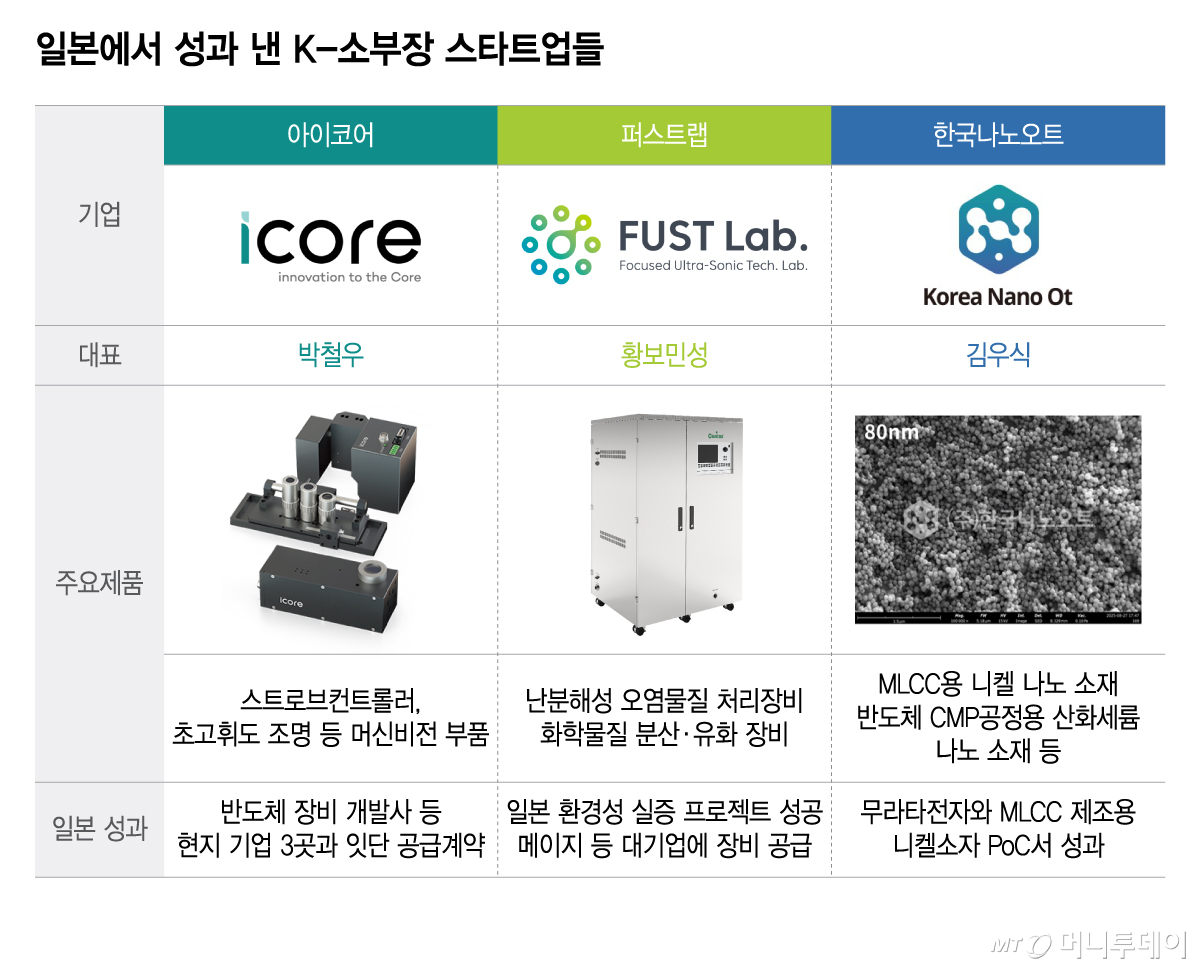
Domestic materials, components and equipment (MCE) startups are achieving results in Japan, a powerhouse in the sector. They are penetrating the market through new approaches and emerging technologies. Analysts also suggest that the surge in popularity of K-content has boosted trust in the quality of 'Made-in-Korea' products, contributing to this trend.
According to industry sources on the 2nd, startup iCore, which develops machine vision components such as autofocus modules, strobe controllers, and ultra-high-brightness lighting, recently established a branch office in Japan. This move follows increased order volumes from Japanese client companies, including semiconductor equipment developers. iCore expects its export revenue to Japan to exceed 1 billion won next year.
Startup FirstLab, which manufactures equipment for treating non-biodegradable pollutants, is also focusing on the Japanese market. After successfully demonstrating the decomposition of PFAS (per- and polyfluoroalkyl substances) by Japan's Ministry of the Environment in collaboration with Japanese equipment maker Hitachi High-Tech, partner Hitachi High-Tech is rushing toward commercialization. FirstLab has not only established a corporation in Japan but also opened an R&D (research and development) center there, signaling its full-scale push into the local market.
Startup Korea Nano Auto, which develops industrial materials, is conducting a PoC (proof of concept) with Japanese MLCC manufacturer Murata for nickel materials. While Japanese companies dominate most of the market for nickel materials, Korea Nano Auto demonstrated higher competitiveness in controlling particle size, shape, and uniformity during the PoC. Korea Nano Auto also recently secured 7.7 billion won in investment funds to prepare for Yangsan in the second half of the year.
Tackling industry challenges with approaches that traditional companies avoid
It is considered unusual for MCE startups to achieve results in Japan. Traditionally, Japan has been a dominant force in the MCE sector. Additionally, Japanese MCE companies have formed tight industrial value chains, making it difficult for new entrants to penetrate the market—a factor often cited as a reason why achieving results is challenging.
The startup industry attributes this breakthrough to new approaches and emerging technologies. For instance, unlike existing companies that advanced machine vision lighting components by utilizing LEDs (light-emitting diodes), iCore proactively introduced lasers to solve industry-wide challenges. Similarly, FirstLab applies ultrasonic technology for pollutant decomposition, while Korea Nano Auto employs underwater plasma synthesis technology for material processing—both representing comparable cases.
A representative from FirstLab stated, "Many Japanese MCE companies stick to existing methods and gradually refine them to improve their products. In contrast, domestic startups have quickly resolved chronic problems that the market could not solve through original technologies, catching the attention of Japanese firms."
The improved trust in Korean products driven by K-content also played a role. A representative from iCore remarked, "Although our fields differ, thanks to K-content, 'Korea Premium' has emerged for Korean manufacturing companies as well. This likely influenced customers' choices." The representative added, "To sustain the Japanese achievements of MCE startups that are just beginning their journey, we need continued interest and investment from the government and industry."
[MoneyToday Startup Media Platform Unicorn Factory]

 in FUTURE
