

[For more diverse corporate information on the startups featured in this article, please visit the Unicorn Factory big data platform 'Data Lab'.]
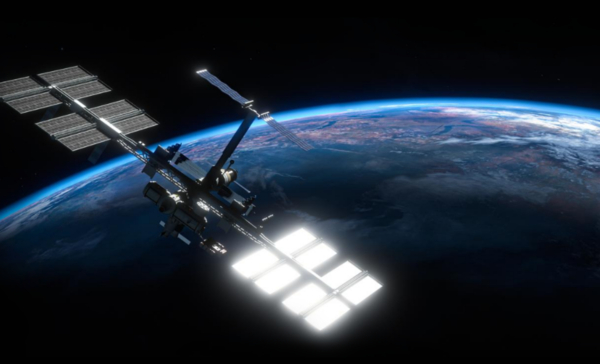
The number of artificial satellites launched worldwide last year is estimated at 4,526. This represents a 58% increase compared to the previous year. If this pace continues, it is predicted that the number of satellites in orbit around Earth will reach 100,000 by 2030. As the number of satellites increases sharply, the market for 'space solar cells,' which serve as the core power source for satellites, is also experiencing explosive growth.
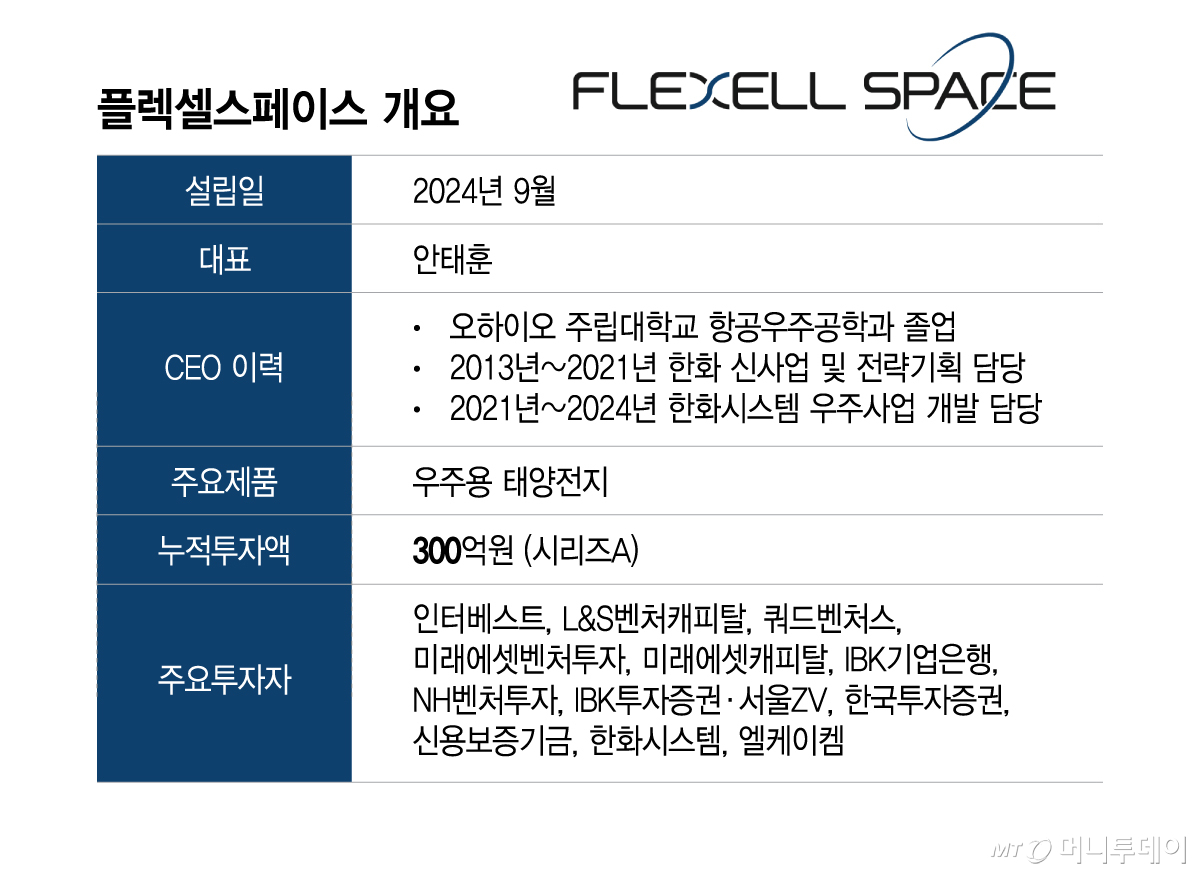
FlexSpace is a startup challenging the market with next-generation space solar cells. The company has drawn attention in the market by using materials different from existing space solar cells, such as inorganic perovskite and CIGS (copper, indium, gallium, selenium), resulting in solar cells that are 30% more efficient in power generation and lower in price.
FlexSpace recently raised 25 billion won in Series A funding to establish a mass production system. This round was led by Investment & Securities, with existing investors L&S Venture Capital and Quad Ventures making follow-on investments. New investors included Mirae Asset Venture Investment, Mirae Asset Capital, IBK Industrial Bank of Korea, NH Venture Investment, IBK Investment & Securities·SeoulZV, Korea Investment & Securities, and the Korea Credit Guarantee Fund.
Investors: "A Rapidly Growing Market… Opportunity Through Unique Technology"
Investors focused on the growth of the space solar cell market and FlexSpace's technological capabilities. Lee Chang-sun, Director at Quad Ventures, who has invested in FlexSpace consecutively, stated, "Not only is the number of satellites increasing, but the amount of power they use is also rising, causing a surge in demand for solar cells." He added, "On the other hand, supply cannot keep up, resulting in serious bottlenecks."
The supply shortage is difficult to resolve in the short term due to the manufacturing methods of existing space solar cells. Currently, space solar cells primarily use high-efficiency cells based on gallium arsenide (GaAs). It was explained that the manufacturing process is complex, making it difficult to increase production volume, and the number of companies capable of producing them is limited.
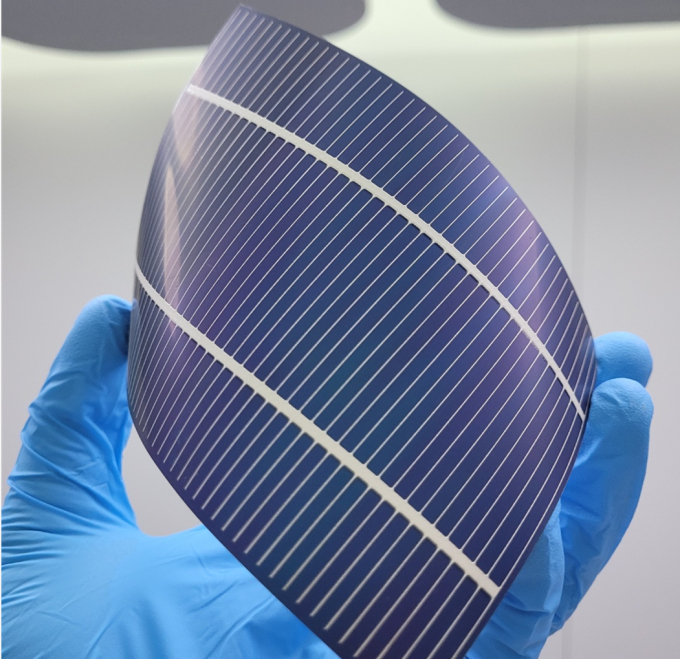
FlexSpace changed its approach by using perovskite and CIGS materials instead of gallium arsenide. The company employs a 'tandem' structure where inexpensive CIGS is placed at the bottom and high-efficiency perovskite is layered on top. As a result, FlexSpace's solar cells are more than 60% cheaper than existing products and have a power generation efficiency that is 28 to 30 percent higher. Their lightweight weight and flexible cells are also strengths.
Director Lee Chang-sun said, "While next-generation satellite solar cells with various materials and designs are being developed, FlexSpace's products are highly competitive in terms of radiation resistance, heat resistance, and power generation efficiency." He added, "The company demonstrates high technological capability in its tandem design, which stacks two materials to maximize efficiency."
An investment reviewer at Interbest, who participated in the investment, stated, "It is unique as a solar cell technology utilizing inorganic perovskite suitable for the space environment." He added, "The company has a strength in proactively commercializing this technology and achieving results."
"Solid Industrial Network… Rapid Commercialization"
Domestic research infrastructure is also a positive factor supporting FlexSpace's technological growth. Director Lee stated, "Korea possesses world-class perovskite technology and a research ecosystem." He added, "It is a very favorable environment for continuous technological advancement and securing top talent."
Finally, investors cited the achievement of 'space heritage,' a key metric for space companies, and networks within the industry as strengths. An Interbest reviewer said, "A strength is that FlexSpace has already built space heritage by having its solar cells used on a co-passenger satellite during the fourth launch of Nuriho." He added, "Various verifications are scheduled in the future, including at the International Space Station (ISS)."
Director Lee Chang-sun also stated, "FlexSpace started as an internal venture of Hanwha Systems, so it has a solid global space company network built up from its past at Hanwha Systems." He added, "Based on this, they are conducting pilot tests with global companies such as Airbus and Terran Orbital, and once mass production begins, revenue can be generated quickly."
[MoneyToday Startup Media Platform Unicorn Factory]

 in FUTURE


