

[For more diverse corporate information on startups, visit the Unicorn Factory big data platform 'Data Lab'.]
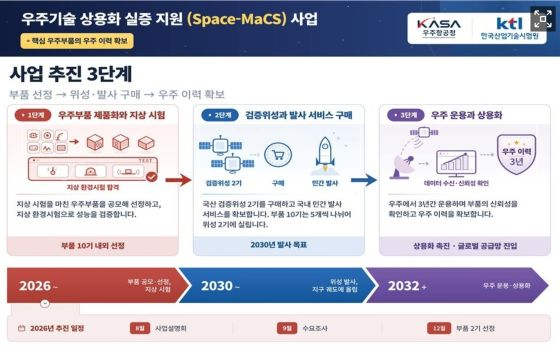
A national project is set to fully launch, verifying space components developed by domestic companies by mounting them on a domestic verification satellite and private launch vehicles to prove their performance in the actual space environment. It is expected to provide new breakthroughs for domestic space companies that have faced limitations in entering overseas markets due to the lack of operational records in space, commonly referred to as 'flight heritage'.
The Korea Aerospace Administration announced on the 3rd that it will invest a total of 49.5 billion won by 2030 to promote the 'Space-MaCS' (Space Technology Commercialization Demonstration Support) project.
This project involves mounting core space components developed by domestic companies onto verification satellites and launching them into low Earth orbit using domestic private launch vehicles to verify their performance and reliability in the actual space environment.
According to the Korea Aerospace Administration, domestic space companies have long struggled with commercialization and entry into overseas markets despite possessing excellent technological capabilities due to insufficient operational records in space. Since flight heritage serves as a key criterion for component adoption in the global space industry, the Administration expects this project to serve as an opportunity to enhance the competitiveness of domestic companies.
The Administration plans to build a demonstration platform that supports the entire process from satellite design and manufacturing to system integration, launch support, and mission operations. After launch, the satellites will be operated for approximately three years to verify the performance and reliability of mounted components and secure core data.
The project will be promoted in three major areas: △productization and verification of payloads, △acquisition of verification satellites, and △purchase of private launch services. First, 10 domestic satellite payloads with a Technology Readiness Level (TRL) of stage 6 or higher, which have completed ground-based environmental simulations similar to space, will be selected to support their productization and additional ground verification.
Next, the Administration plans to purchase two verification satellites and system integration services from domestic companies and distribute five payloads each onto the two satellites to verify their performance in the actual space environment.
By 2030, two verification satellites will be launched into low Earth orbit using small-to-medium launch services from domestic private launch companies. A Korea Aerospace Administration official stated, "By directly purchasing launch services, the government will create an initial market for domestic private launch vehicle companies and simultaneously support the accumulation of launch experience and strengthening of industrial competitiveness."
The Administration plans to hold business explanation sessions this month targeting satellite payload developers, verification platform providers, and private launch vehicle companies, followed by a demand survey. After evaluation, two payloads will be selected as priorities this year, with the remaining eight to be selected gradually according to the project schedule.
Oh Tae-seok Woo Ju-hang-gong (Commissioner) said, "This is a project that enhances the reliability of domestic space components by directly sending core parts developed by our companies into space for verification," and added, "We expect it to serve as an important opportunity to promote the commercialization of core space technologies and create a virtuous cycle structure for the domestic space industry ecosystem and the space economy."
[MoneyToday startup media platform 'Unicorn Factory']

 in FUTURE
