

[For more diverse corporate information on the startups mentioned in this article, please visit the Unicorn Factory big data platform 'Data Lab'.]
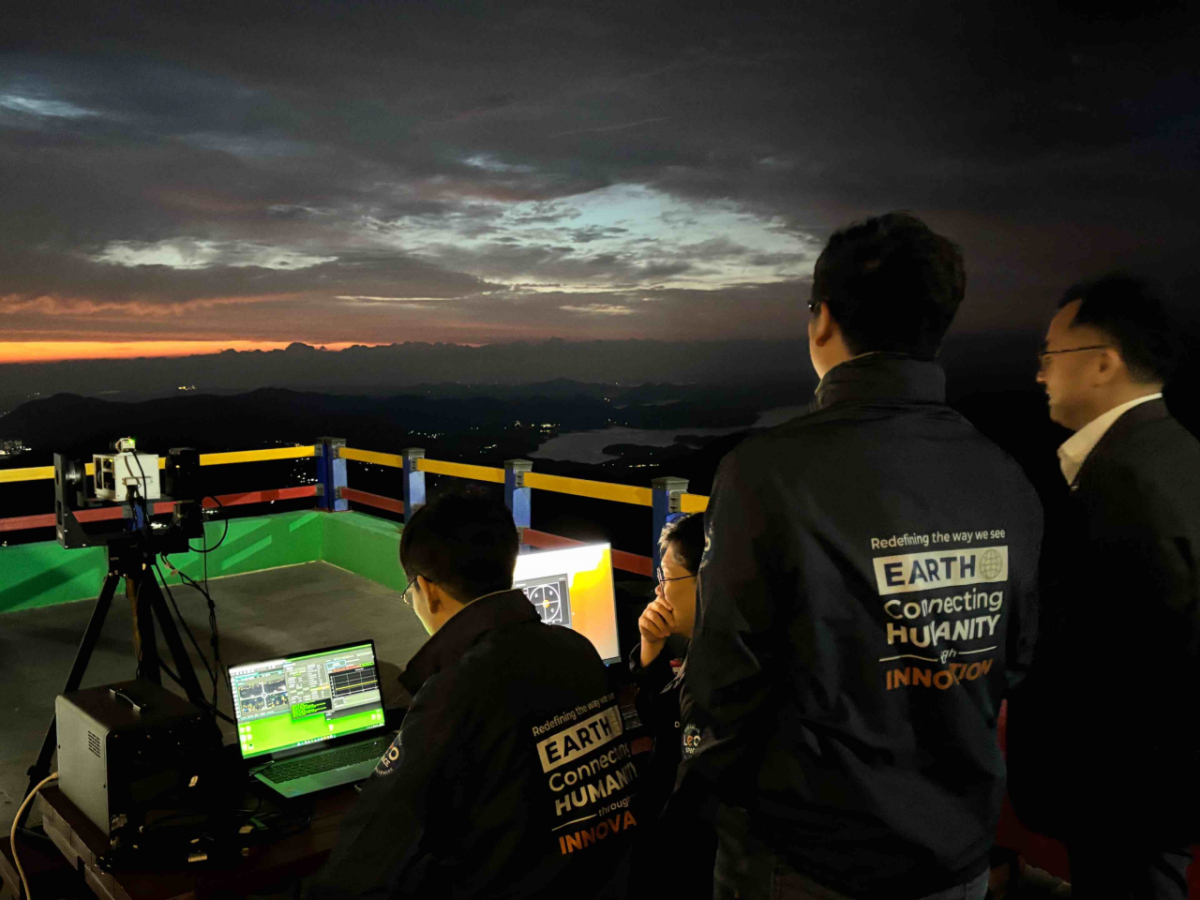
A domestic space startup has succeeded in demonstrating two-way laser optical communication using only a compact satellite-grade optical system, without relying on large ground-based receiving facilities. This achievement marks the beginning of South Korean companies making progress in the field of satellite-mounted optical communication terminals, which have been led by countries such as the United States and Germany.
According to space optical communication startup LeoSpace, on the 30th of last month, they successfully demonstrated two-way optical communication at a speed of 1Gbps (gigabits per second) over a ground distance of approximately 30km using only LCTs (laser communication terminals). The key feature is that communication was achieved solely with a compact 63mm aperture optical system designed for satellite mounting, without any separate large fixed receiving facilities.
Until now, laser optical communication typically involved making the satellite terminal small while placing large ground-based receiving facilities to compensate for aiming accuracy and signal strength. In this demonstration, LeoSpace employed PAT (pointing, acquisition, and tracking) technology that precisely aimed the narrow laser beam and maintained it despite external environmental factors or movement, enabling two-way communication using just two LCTs.
Researcher Jang Seung-won stated, "We confirmed the entire process of the two LCTs acquiring each other's signals, precisely pointing and tracking them, and then transmitting actual data and video." He added, "The significance lies not in the 30km distance itself, but in demonstrating that compact satellite terminals can achieve long-distance optical communication without large ground receiving facilities."
Another key feature is that the demonstration was conducted in an actual atmospheric environment. Laser optical communication is significantly affected by atmospheric conditions such as signal attenuation due to water vapor and fine particles, atmospheric turbulence caused by temperature differences, fog, and wind. During this test, humidity levels at the two LCT installation sites were recorded at 80% and 95%, respectively, with observations of complex atmospheric influences including fog and wind.
[Technology enabling inter-satellite communication… Enhancing satellite utilization]

Laser optical communication is a next-generation communication technology that complements existing radio wave communication. In particular, optical communication between compact LCTs enables large-volume data such as observation images collected by one satellite to be transmitted via other satellites to ground stations, reducing information delivery time and enhancing usability in disaster monitoring, land and ocean observation, and other applications. It can also be applied on the ground for high-speed communication networks between mountainous and island regions where fiber optic cable installation is difficult, between industrial facilities, and for temporary or emergency communication networks in disaster zones.
Founded in 2021, LeoSpace has progressively expanded its communication distance from an initial 3km test in May to the current 30km. The next target is 60km. Based on data secured during this demonstration, LeoSpace plans to refine link design according to long-distance atmospheric conditions and improve initial signal acquisition and tracking performance.
Researcher Jang stated, "In the 60km test, we will more rigorously verify signal variations due to atmospheric conditions and long-term link stability." He added, "Ultimately, we aim to complete compact LCTs applicable to inter-satellite laser communication while simultaneously confirming the possibility of expanding into ground-based optical communication infrastructure."
[MoneyToday startup media platform Unicorn Factory]

 in FUTURE

