

More diverse corporate information on the startups mentioned in this article can be viewed at Unicorn Factory's big data platform, Data Lab.
"Making educational products has never been easier than it is now, but differentiation for edtech companies has never been more difficult than it is now."
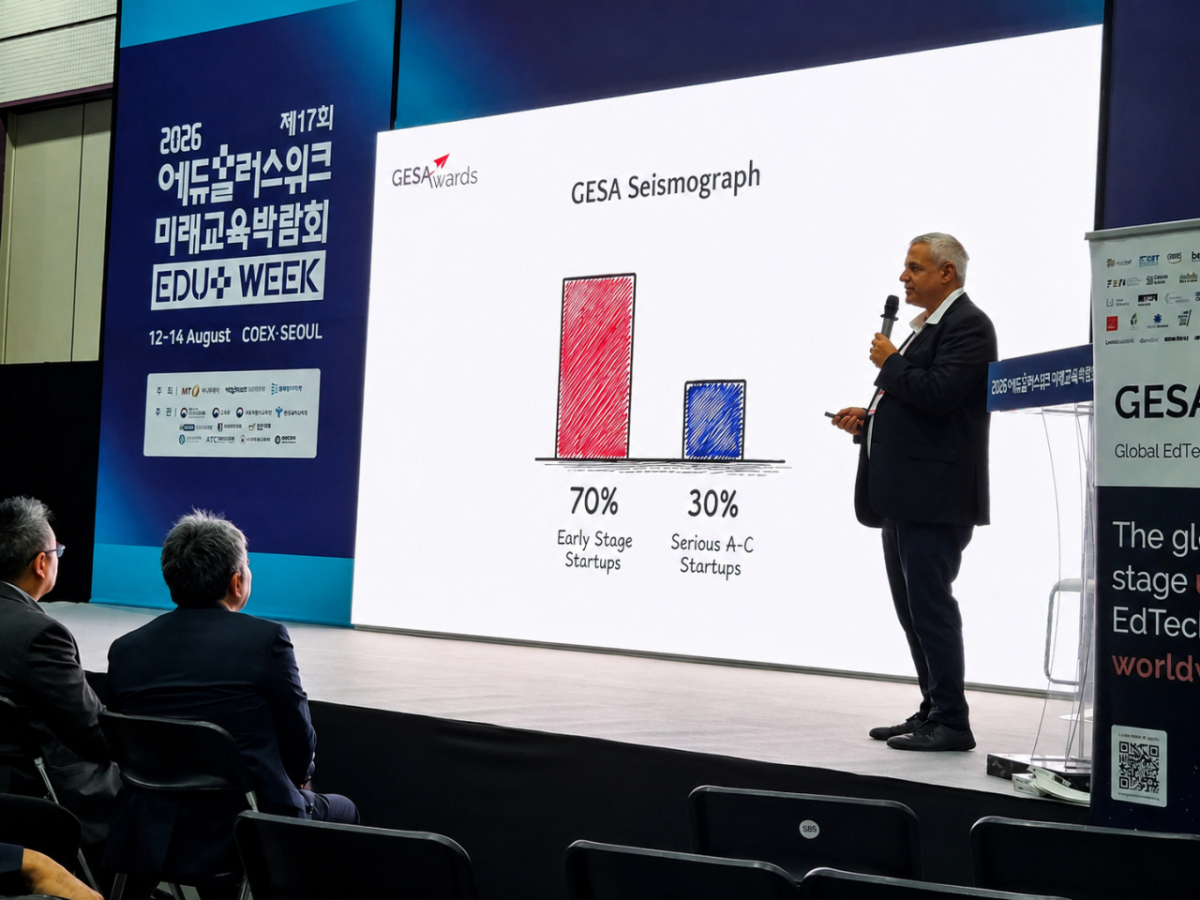
Avi Warshavsky, CEO of MindCET, outlined these challenges facing EdTech startups in the AI era during a keynote speech at the "Global EdTech Startup Awards (GES Awards) Bootcamp," a side event of the 17th 2026 EduPlus Week Future Education Expo held on the 12th at COEX in Seoul.
The spread of generative AI and v-coding (coding using AI) has made it possible to create an MVP (minimum viable product) in just a few hours, whereas it used to take several months; however, experts note that as the barrier to entry for technology development has lowered, differentiation has also become more difficult.
Warszawski CEO likened the current situation, where countless services are flooding in, to a "junk food trap," pointing out that it has become difficult to distinguish what is truly meaningful and effective.
The changing social perception of AI technology was also cited as a challenge that startups must address.
Warszawski CEO said, "Recent data show that surprisingly, the 2030 generation, who were once enthusiastic about new technologies, are now showing lower interest and hope in AI while experiencing higher levels of anxiety and anger."
CEO Warschawski emphasized that in such a situation, edtech startups should not merely integrate AI into existing education or simply digitize education.
He proposed the 'imagination gap' as a new value for startups, stating, "We must question what we take for granted and rethink learning models." He emphasized that it is the role of edtech startups to expand the very ways humans learn and create by leveraging AI.
"Look at teachers, not policies"... Rapidly growing Asia presents new opportunities for edtech

In the subsequent panel talk, growth strategies for EdTech startups and the potential of the Asian market became key topics.
Jung Hoon, CEO of Running Spark, said, "I want to advise ed-tech startups to look toward teachers rather than policies in the future," adding, "Since policies keep changing, companies should focus on creating services that teachers in actual educational settings need, rather than relying on policies or policy funds."
Advice was also given to view the rapidly growing Asian market as a new opportunity.
Alex Ng, executive vice president of EduSpaze, the top edtech accelerator in Singapore, said, "From a macro perspective, the Asian edtech market size reaches $410 billion and is projected to grow at an annual average rate of 16% over the next five years." He added, "While the U.S. already has a very large market, Asia is a rapidly growing market."
He added, "Whether to enter a mature market or one that will grow rapidly depends on the startup's strategy, but even excluding India and China, which account for a significant portion of the Asian market, there is still a sufficiently large market."
Norihisa Wada, a global edutech accelerator from Japan, said, "Both Korea and Japan are facing population decline, so they are opening doors to overseas markets more actively," adding that "the governments of Japan and Korea are also trying to support companies' expansion into overseas markets and cooperation between the two nations."
He added, "Currently, many startups are pursuing global strategies from the outset, such as targeting countries with large young populations."
Meanwhile, the GES Awards Bootcamp held on this day was a networking event where leaders of the global edutech industry and startups discussed key challenges and growth strategies for the sector and explored opportunities for overseas expansion.
[Money Today Startup Media Platform Unicorn Factory]

 in FUTURE

