

The solution to achieving RE100 (supplying 100% of electricity consumption with renewable energy), long considered an 'impossible mission' for domestic manufacturers, is increasingly likely to emerge from 'rice paddies and farmland.' With the recent establishment of a legal basis for 'farming-integrated solar power,' assessments indicate that the renewable energy transition scenarios for high-energy-consuming companies such as Samsung Electronics and SK hynix, which operate production facilities in the Gyeonggi and Chungcheong regions, have entered the realm of reality.
Just 3% of national potential suffices for Samsung's RE100 'OK'
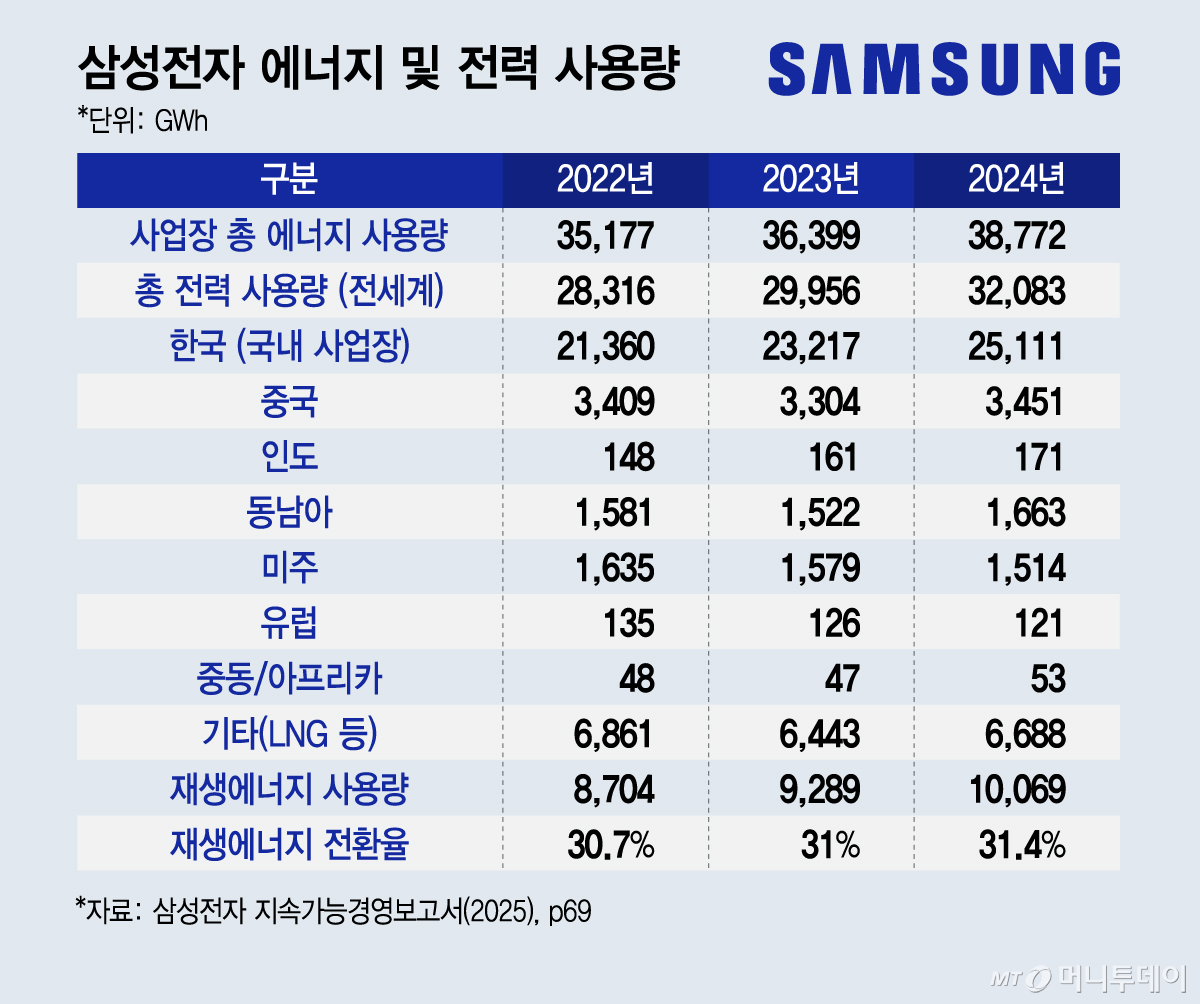
According to a MoneyToday analysis on the 31st, the solar power generation capacity required for Samsung Electronics to replace 100% of the electricity used across all its domestic sites with renewable energy is estimated at approximately 19.3 GW (gigawatts). This figure was derived based on the company's disclosed annual domestic electricity consumption of 25,111 GWh (gigawatt-hours) for 2024 in its previous year's Sustainability Report, using an average daily sunshine duration of 3.6 hours and assuming an annual generation output of approximately 1,300 MWh per 1 MW (megawatt) of installed capacity.
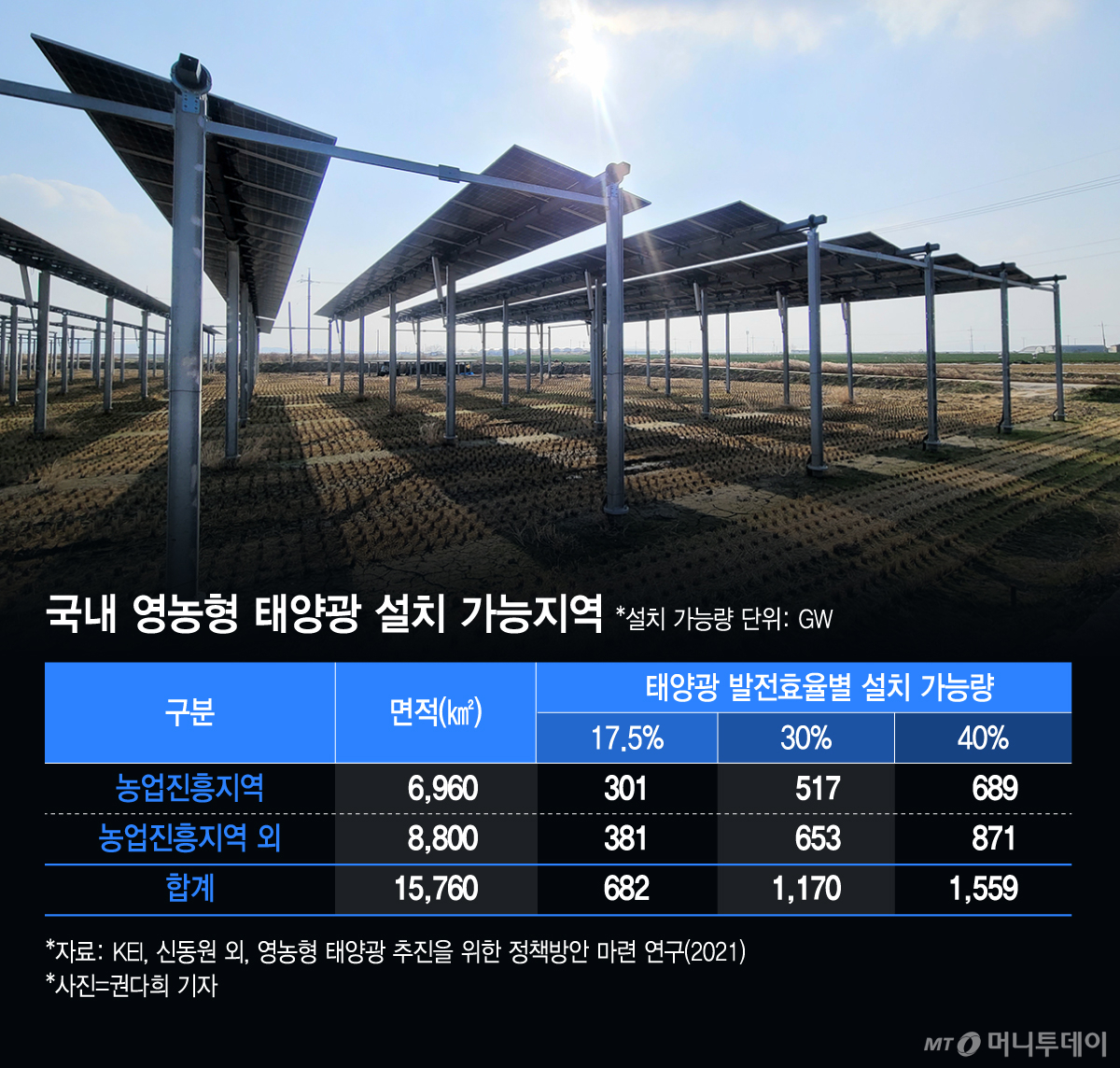
Although Samsung Electronics' domestic electricity consumption is substantial, it is not a large scale relative to the potential for farming-integrated solar power. It represents 2.8% of the total domestic potential for farming-integrated solar power (682 GW), calculated by the Korea Environment Institute (KEI) based on domestic agricultural land area. Even this figure is the maximum, assuming Samsung Electronics procures its entire domestic electricity consumption solely through new solar power. Considering quantities already converted to renewable energy and the share to be covered by future onshore and offshore wind power, the actual scale of farming-integrated solar power required would be smaller.
Farming-integrated solar power involves installing panels over agricultural land to conduct both farming and power generation simultaneously. It has already been commercialized in Japan, Europe, and the United States. Although crop yields may decrease slightly (by approximately 10% to 30% for rice cultivation), it provides additional income to farmers and allows for renewable energy expansion without damaging farmland, making it a preferred option that satisfies the interests of both rural areas and energy consumers. In South Korea, the relevant law passed the National Assembly on the 7th of last month, establishing an institutional foundation.
'Local production, local consumption' enables renewable energy supply before transmission grid construction
In particular, if even a small portion of the domestic potential for farming-integrated solar power is realized as generation facilities and companies purchase the electricity produced there (through Power Purchase Agreements, or PPAs), benefits could accrue to farmers, corporations, and the nation. This means farmers gain solar revenue, companies secure renewable energy, and the state achieves accelerated NDC (Nationally Determined Contribution) implementation and strengthened energy security.
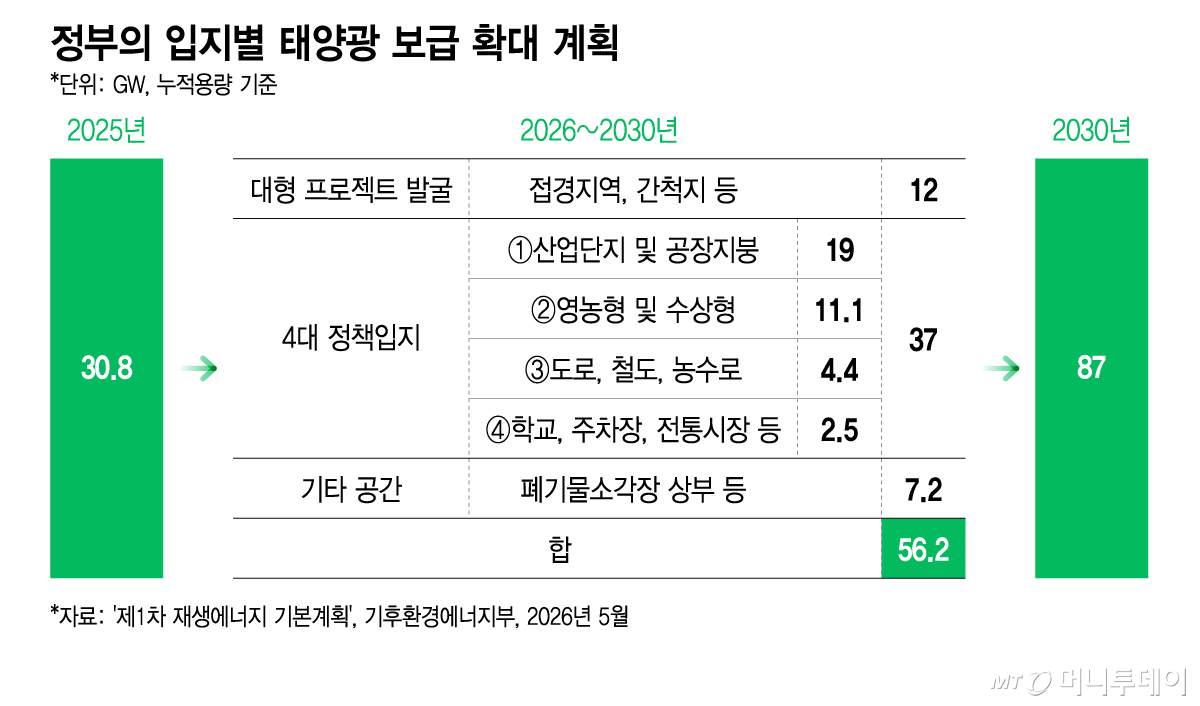
The government is also paying attention to the potential of farming-integrated solar power. In its 'First Basic Plan for Renewable Energy,' released on the 19th of last month, it announced that out of an additional 56.2 GW of solar capacity to be secured by 2030, 11.1 GW would be supplied through farming-integrated and floating solar power. It is being highlighted as a realistic alternative because utilizing only farmland near the Gyeonggi Province, where key production hubs for high-energy-consuming companies like Samsung Electronics are concentrated, could significantly resolve electricity supply issues (as reported by MoneyToday on February 3: 'Gigawatt-scale' solar power generation possible in metropolitan area farmland).
Most importantly, if energy 'local production, local consumption' becomes possible—supplying clean electricity generated from nearby farmland to semiconductor lines—renewable energy supply and consumption can occur without the construction of long-distance transmission lines, which require relatively significant cost and time. Furthermore, if infrastructure investments such as Energy Storage Systems (ESS) and distribution facilities are carried out concurrently in a timely manner, it will provide a substantive breakthrough for achieving cost-efficient renewable energy supply.
Professor Jung Jae-hak of the Department of Chemical Engineering at Yeungnam University, an authority on domestic farming-integrated solar power, emphasized, "Considering the overwhelming potential of farming-integrated solar power, achieving RE100 for domestic companies including Samsung Electronics is arithmetically fully feasible," adding that "ultimately, the key lies in time and will." He further suggested, "If investments in ESS and other areas proceed concurrently, a model where rural areas and companies coexist can be realized."

 in INDUSTRY


