

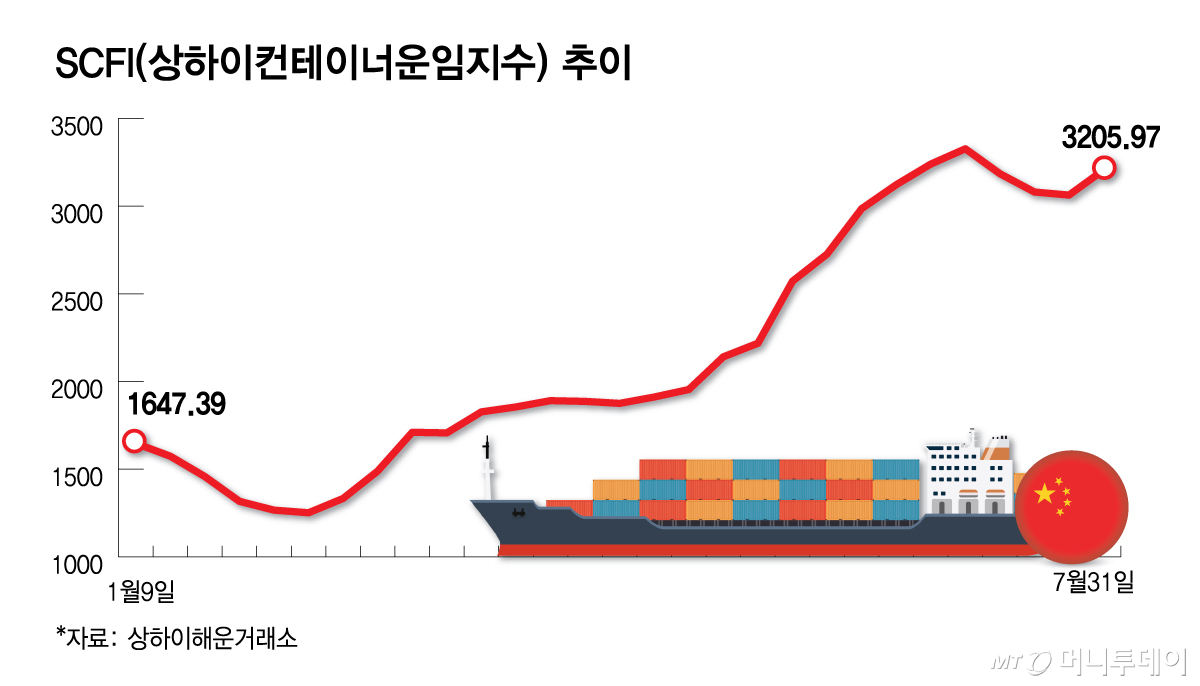
Although container shipping rates have risen to levels approaching the peak during the 2024 Red Sea crisis, analysts say there is limited room for further increases. The anticipated phase of oversupply following large-scale orders after the COVID-19 pandemic has been repeatedly delayed due to conflicts in the Middle East and other factors, but growing expectations suggest that by next year, these offsetting forces will disappear.
According to industry sources on the 4th, the Shanghai Containerized Freight Index (SCFI), which reflects global container market conditions, recorded 3205.97 on the last day of last month. The SCFI has continued its upward trend since the outbreak of war between the United States and Iran at the end of February. Compared to the level of 1333.11 at the time the war began, this represents a sharp surge of 140.5%. While it has not reached the peak of over 5000 seen during the COVID-19 pandemic, it has climbed close to the high point of 3700 recorded during the Red Sea crisis.
The decisive factor behind the sharp rise in rates is fuel costs. According to British shipping analyst MSI, average bunker fuel prices for container ships in the second quarter jumped by 90% compared to the previous period, prompting shipping lines to impose urgent surcharges and pushing up freight rates. Detours also played a role. As shipping lines slowed their vessels to save on soaring fuel costs, more ships were needed to transport the same cargo, resulting in an effective reduction of actual vessel capacity (ship tonnage) supply by 2.5% to 3.0%.
However, these conditions are unlikely to persist for long. As tensions between the United States and Iran move toward resolution through negotiations, the possibility of normalizing traffic through the Strait of Hormuz is increasing. Once traffic resumes normally, vessel capacity absorbed by detours will return to the market, and the basis for surcharges will weaken due to falling oil prices.
Freight rates on major shipping routes are also expected to drop by roughly half. MSI forecasts that European route rates will fall from $2040 per TEU (one 20-foot container) this year to $1464 next year and further down to $961 in 2029. North American route rates are projected to decline from $2831 per FEU (one 40-foot container) this year to $1934 by 2029.
The gradual arrival of ships with orders already placed also poses a burden. Ship deliveries are expected to surge from 1.6 million TEUs this year to 2.88 million TEUs in 2027 and 4.93 million TEUs in 2028. The growth rate of the ship fleet is projected to rise from 4.6% this year to 10.9% by 2028. In contrast, global container cargo volume growth this year is expected to be only 1.7%. Although it is forecast to recover to 4.4% in 2027 and 3.9% in 2028, these figures will still fall significantly short of the ship fleet growth rate over the same period.
Industry experts believe that the strong market driven by supply constraints will continue for some time, but once Red Sea risks ease and vessel capacity supply normalizes, a gradual downturn is expected to begin next year. One industry official stated, "Freight rates in the second half depend on the situation in the Strait of Hormuz and whether an agreement is reached between the United States and Iran; looking further ahead, it will be difficult to avoid a downward trend."

 in INDUSTRY
