

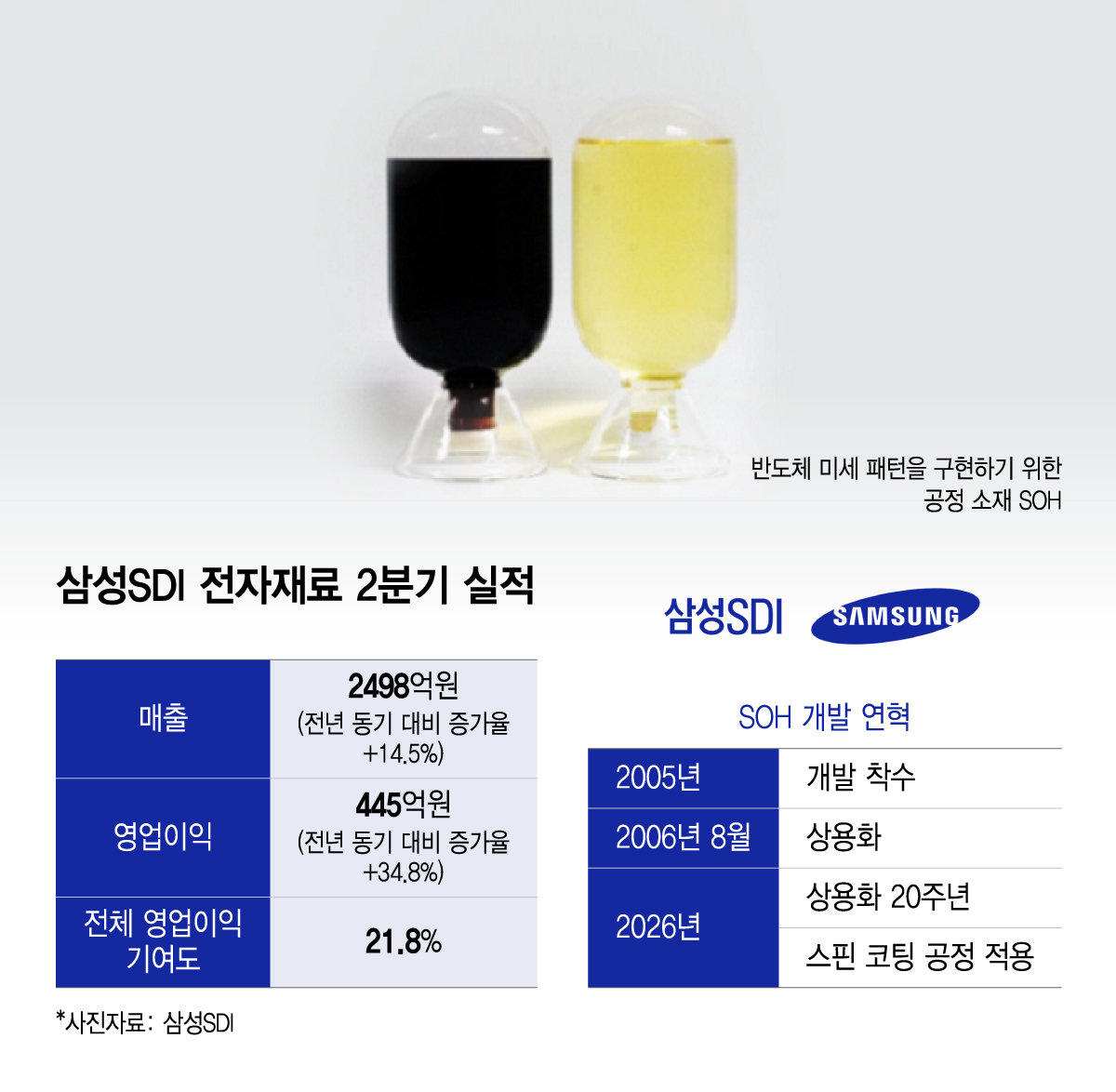
SamsungSDI has launched efforts to capture the AI semiconductor market with a customer-customized portfolio of its core material for semiconductor etching processes, "Spin-On Hardmask (SOH)," which it has accumulated over 20 years. With the spread of artificial intelligence (AI) semiconductors driving demand for ultra-fine process technologies, the semiconductor process materials market is also expected to continue its growth trend.
According to industry sources on the 4th, SamsungSDI is building an SOH product portfolio to respond to advanced semiconductor processes and accelerating its push into next-generation markets. The company has developed SOH with high etch resistance to prevent pattern collapse or warping, high film strength, high thickness formability enabling deep pattern formation, and excellent planarization performance, providing customer-customized solutions.
SOH is a coating material used in the etching process that forms semiconductor circuits. During the etching process, fine circuit patterns formed by photoresist (PR) are prone to collapse; SOH serves as a protective film with high etch resistance. It helps prevent damage to micro-patterns, enabling the realization of deep and intricate circuits.
SamsungSDI's SOH is characterized by replacing the conventional chemical vapor deposition (CVD) process with a "spin coating" process. CVD involves injecting gas onto a wafer to form a film, making equipment and processes complex and time-consuming. In contrast, spin coating sprays liquid material onto a wafer and then rapidly spins it to spread the material thinly and evenly. This simplifies the process, contributing to improved productivity and efficiency while reducing defect rates.
This technological competitiveness has been achieved based on 20 years of accumulated research and development experience. SamsungSDI began developing SOH in 2005 and successfully commercialized it just one year and five months later in August 2006. At the time, it secured competitiveness by localizing semiconductor process materials that had previously relied on overseas suppliers. Since then, it has continued production at its Gumi plant in North Gyeongsang Province, establishing SOH as a high-value-added product in the semiconductor materials business.
Most importantly, demand for SOH is expected to expand amid favorable market conditions for AI semiconductors. As competition in semiconductor technology intensifies due to the spread of AI, autonomous driving, and high-performance computing (HPC), the realization of ultra-fine and multi-layered circuits has emerged as a key focus across the industry. SOH, which supports precise and stable circuit pattern formation, is gaining attention as an essential core material for critical semiconductor processes.
SamsungSDI's electronic materials business is also continuing its growth trend driven by expanding demand. In the second quarter of this year, SamsungSDI reported consolidated sales of 3.7688 trillion won and operating profit of 203.8 billion won. Among these, the electronic materials segment recorded sales of 249.8 billion won, a 14.5% increase from the same period last year, while operating profit reached 44.5 billion won, up 34.8%. Its contribution to total operating profit stood at 21.8%.
Kim Ik-su, head of the Strategic Marketing Team in SamsungSDI's Electronic Materials Division, stated during the second-quarter earnings conference call: "Recent semiconductor companies are continuing investments to expand capacity and are focusing on establishing an early production system, projecting high growth in the medium to long term." He added, "To ensure sustained sales expansion and profitability, we are concentrating not only on expanding DRAM EUV materials, patterning materials for foundries, and packaging materials but also on diversifying overseas customers, including recent new entries by global semiconductor companies into packaging materials."

 in INDUSTRY
