

With AI (artificial intelligence) robot parts included in the scope of "Domestic Production Tax Credit," a government incentive program offering various benefits, Hyundai Motor Group's project to build a "Robot Manufacturing and Parts Cluster" in Saemangeum, North Jeolla Special Self-Governing Province, is expected to gain further momentum.
According to government and industry sources on the 4th, the Ministry of Economy and Finance plans to introduce the Domestic Production Tax Credit, which reduces income tax and corporate tax in proportion to production volume for items where domestic production capacity is weak. The government intends to propose an amendment to the Tax Act (Special Taxation Restriction Act) containing these provisions. If the bill passes the National Assembly this year, the system will operate for 10 years from next year through 2036.
The Ministry of Economy and Finance selected solar power, wind power, secondary batteries, semiconductors, key materials, and AI robot parts as targets for the Domestic Production Tax Credit. The goal is to reduce tax burdens on companies producing and selling these products domestically, thereby easing business costs and helping secure cost competitiveness. Accordingly, the "Robot Manufacturing and Parts Cluster," one of the core facilities of the "Saemangeum AI Valley" that Hyundai Motor Group plans to build with a total investment of 9 trillion won, is expected to be among the beneficiaries.
In fact, Hyundai Motor Group will invest 400 billion won to establish a Robot Manufacturing and Parts Cluster by 2029, consisting of: △a finished robot manufacturing plant for major robots; △a foundry factory that outsources production of small and medium-sized enterprise (SME) products lacking manufacturing know-how; and △a parts complex that manufactures and supplies components required for robots. While the group has indicated an annual production capacity of 30,000 units for the finished robot manufacturing plant, it has not disclosed which specific products will be produced.
However, industry observers believe that since Hyundai Motor Group is highly likely to produce the humanoid (human-shaped) robot "Atlas" in the United States, Saemangeum will instead host mobile robot platforms like "Mobed," wearable robots such as "X Shoulder," and other similar products. Ultimately, the direct beneficiaries of the Domestic Production Tax Credit are expected to include major components of Mobed and various motors and sensors produced at the site by Hyundai Motor Group's key affiliates and partner companies.
The government's decision to offer preferential treatment for tax credit calculations when production occurs in non-metropolitan areas is also a positive factor for the Saemangeum project. The Ministry of Economy and Finance has proposed the following formula for calculating the tax credit amount: "Production Volume × Base Credit Amount × Regional Production Coefficient." Under this system, regional coefficients are set as follows: △1.0 for the capital region; △1.1 for non-capital metropolitan areas; △1.3 for other non-capital regions; and △1.5 for other non-capital preferential zones. This structure ensures that more tax benefits flow to production in local areas. Specific regional classifications will be finalized when the Special Taxation Restriction Act enforcement decree is revised next year. However, given the government's strong support for the Saemangeum project, it is highly likely that the highest coefficient of 1.5 will be applied.
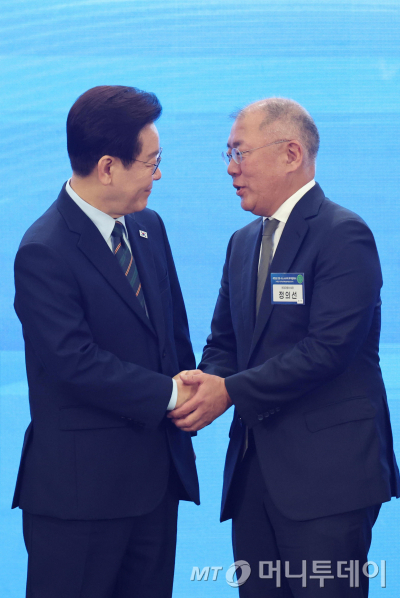
The Saemangeum AI Valley is regarded as the first stage to realize Chairman Chung Eui-sun's "Physical AI Vision." Jeong (Chairman) recently stated at the "San Francisco AI Summit" held in the United States: "The physical AI pursued by our group begins with individual device intelligence such as automobiles and robots, progresses through intelligentization of specific spaces like AI factories, and ultimately achieves integrated intelligence at the city level where entire urban infrastructure is organically connected and operated."

 in INDUSTRY
