

A forecast indicates that South Korea will maintain its leadership in the AI (artificial intelligence) memory semiconductor (hereinafter referred to as "memory") market over the next five years. Analysts say the "rules of the game" are changing, centered around Samsung Electronics and SK Hynix, which have established themselves as the "super-buyers" in the memory supply chain.
On the 4th (local time), Yole Group, a market research firm, stated at the world's largest memory and storage conference, "FMS (Future of Memory and Storage) 2026," held in California, USA, that South Korea will retain its status as the leading memory power by 2031. The group cited as key evidence the plans by the South Korean government, Samsung Electronics, and SK Hynix to double their memory wafer (thin discs used to manufacture semiconductor chips) production capacity over the next five years.
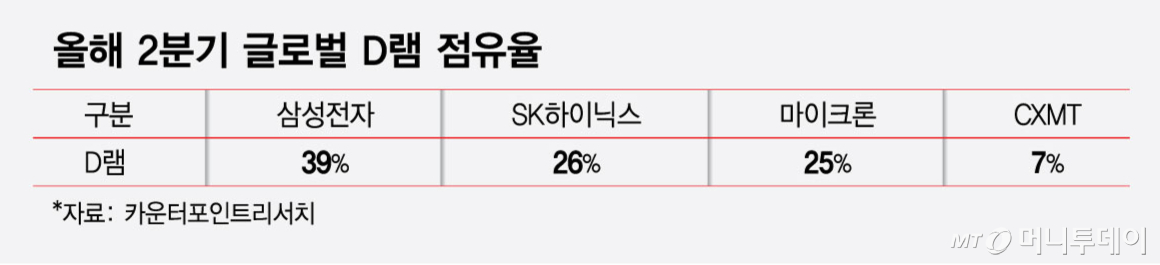
Yole Group forecasts that the global DRAM market size will surpass $100 billion (143 trillion won) for the first time in the second quarter of this year. The core driver of growth is AI infrastructure. This reflects the growing importance of securing memory, including HBM (high-bandwidth memory), as a decisive factor in the competitiveness of AI companies.
In fact, major AI companies are paying prices more than three times higher than those from a year ago to secure memory. To ensure stable supply, NVIDIA, AMD, Google, Amazon, and others are signing long-term agreements (LTAs) of around five years with Samsung Electronics and SK Hynix, including provisions for advance payments and price adjustments.
Gavin Baker, Chief Investment Officer (CIO) of Artadees, a well-known technology stock investor, interpreted LTAs from the perspective of game theory, stating that the bargaining power of memory manufacturers has significantly strengthened. He emphasized, "Any company that breaks an LTA would be effectively excluded from the market moving forward." This means that if a memory manufacturer cancels an agreement with a company, it can redirect that company's supply to competitors, imposing de facto sanctions. In the past, when contracts were limited to a few key customers like Apple, responses to contract breaches were restricted, but now the market structure has changed.
Lisa Su, CEO of AMD, also repeatedly highlighted the importance of securing HBM during today's earnings announcement. AMD is positioning its strategy to lower total cost of ownership (TCO) by increasing HBM capacity by 50% compared to NVIDIA's competing products in next-generation AI systems as a key strength. She stated, "We have closely collaborated with memory partners for years to prepare for business growth."
The financial market is also reacting. Six U.S. financial institutions have issued "buy" or "increase weight" opinions on SK Hynix ADRs (American Depositary Receipts). On this day, SK Hynix rose 8.17% in the U.S. market (based on local time ADRs) and 5.77% in the domestic stock market. Samsung Electronics also recorded a gain of 2.50%.

 in INDUSTRY
