

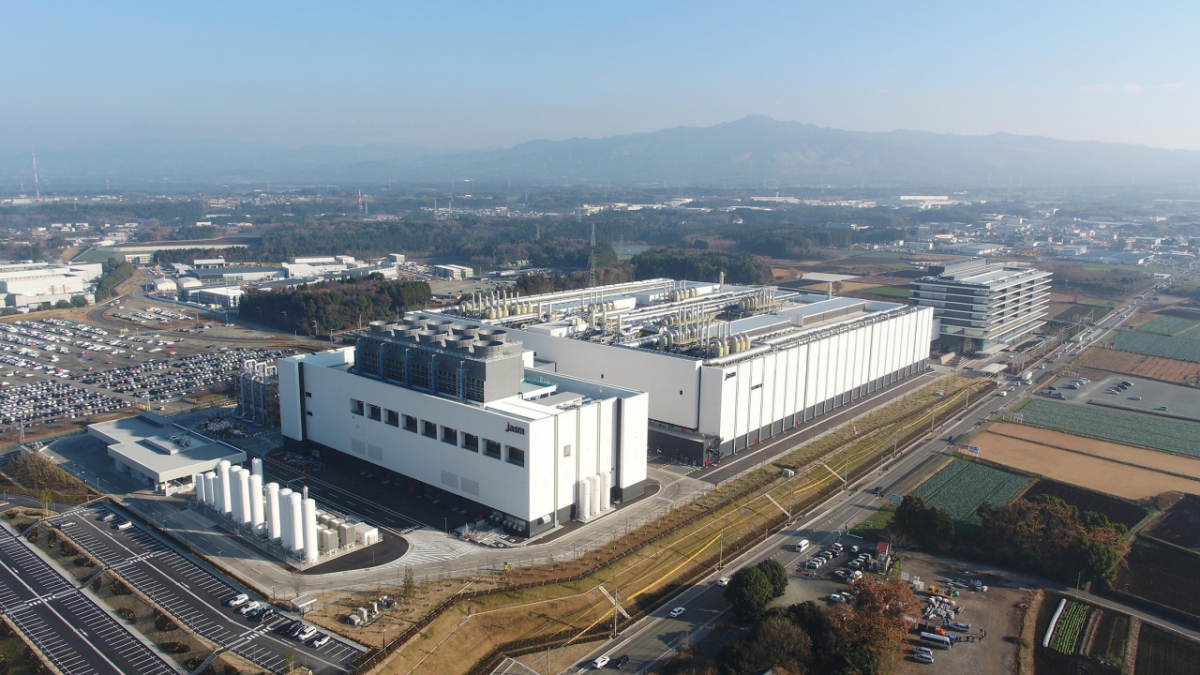
"We hope execution will be as swift as that of TSMC’s Kumamoto plant in Japan."
President Lee Jae-myung cited TSMC’s Kumamoto factory in Japan as a model when he urged on the 10th to accelerate the establishment of a semiconductor cluster in the Honam region. The TSMC Kumamoto plant, which took about three years from the announcement of its construction plan to Yangsan, was the result of an “ultra-high-speed sprint” where the government, local governments, and companies concentrated their resources.
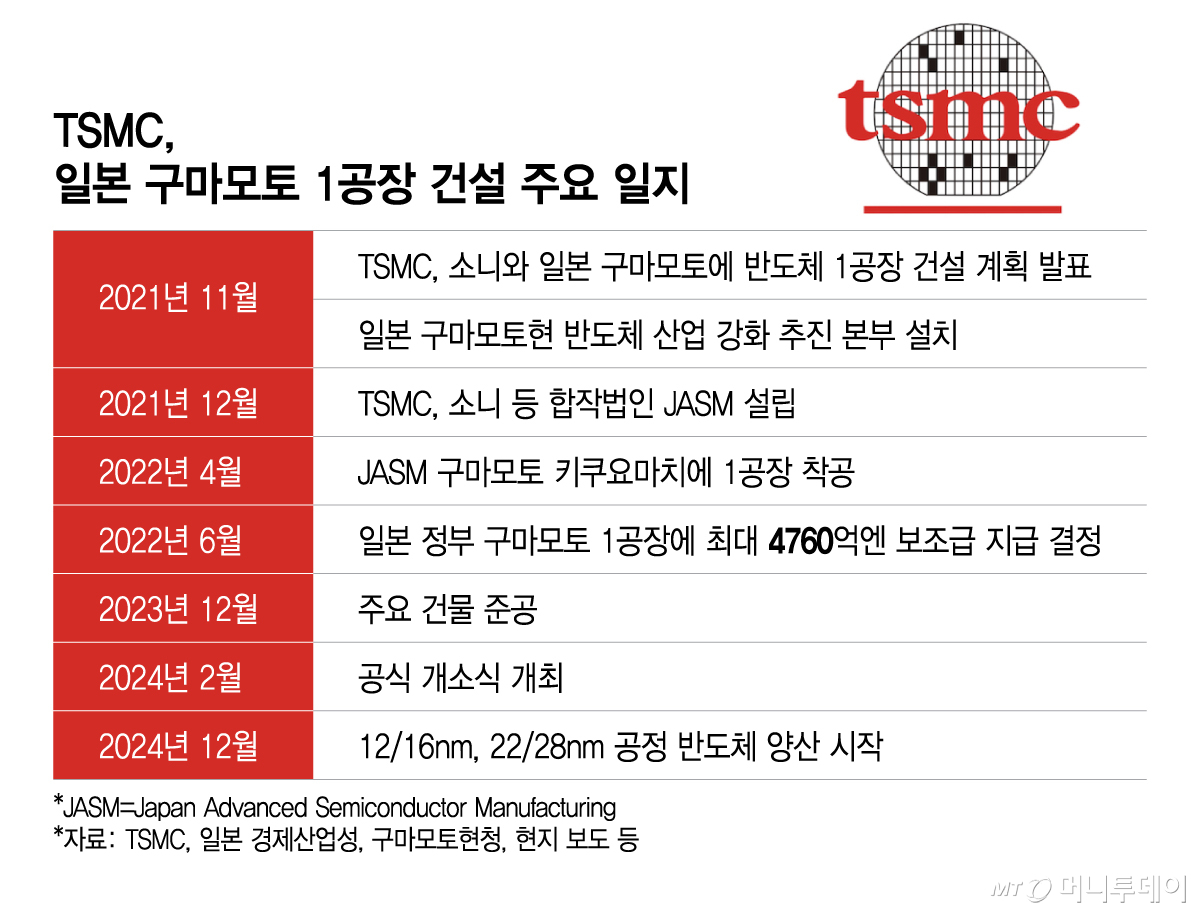
TSMC officially announced in November 2021 that it would build a factory in Kumamoto, Japan, together with Sony by establishing a subsidiary, JASM (Japan Advanced Semiconductor Manufacturing). Construction began just five months later, in April 2022, and an official opening ceremony was held in February 2024. It took 22 months from groundbreaking to the opening ceremony.
The pace was fast from the early stages of construction. About six months after breaking ground, in October 2022, when most of the foundation work was completed, JASM itself evaluated that “it is progressing at an unprecedented speed.” Afterward, through the import and installation of manufacturing equipment and commissioning tests, TSMC began producing 12/16-nanometer (nm) and 22/28-nanometer process semiconductors in Yangsan in December 2024. This was about three years after the investment announcement.
In fact, preparations for the factory construction had begun even before the official announcement. The Japanese government began negotiations early to attract TSMC, and it is reported that in early 2021, TSMC conveyed its intention to build a factory in Japan on the condition of a joint venture with Sony. According to local Japanese reports, Sony began preparing the factory site starting in September 2021. At the time, nearby residents believed that a new Sony factory was being built there.
Completing the project from announcement to Yangsan in about three years is an unusually fast pace even for the semiconductor industry. Samsung Electronics explained during its second-quarter earnings announcement that “it takes more than three and a half years of lead time from the construction of a new fab to wafer production.” In the case of the General Industrial Complex in Yongin, Gyeonggi-do’s semiconductor cluster, an industrial complex plan was approved in 2019, and the first cleanroom is scheduled to begin operations next February.
A “city of lights” due to 24-hour construction… Education and talent acquisition also proceeded simultaneously
The speed of the Kumamoto plant was backed by public-private cooperation. The Japanese government and local governments supported TSMC’s attraction and factory construction as a national and regional project. Immediately after TSMC’s investment announcement, Kumamoto Prefecture established an “Industrial Cluster Strengthening Headquarters” named Ji Sa-reul (Head). Tasks that could affect factory construction and operations—such as transportation, manpower, water supply, and the environment—were divided among departments and addressed simultaneously.
The Japanese government also injected massive financial resources. The Ministry of Economy, Trade and Industry decided to provide subsidies of up to 476 billion yen (4.2364 trillion won) two months after breaking ground. This was justified by the need to secure a domestic advanced logic semiconductor production base.
The private sector also mobilized all its capabilities. The construction company responsible for the project gathered construction materials and personnel from across the country, operating on a three-shift, 24-hour system. Lights never went out at night, so much so that locals called it a “city of lights.” Sony’s experience in semiconductor development and production, including image sensors, also proved highly beneficial.
In particular, Kumamoto Prefecture’s response deserves attention. The prefecture simultaneously prepared infrastructure such as electricity, water supply, and transportation needed for the semiconductor factory, along with permits and approvals. In addition, to ensure stable settlement of Taiwanese personnel, it also prepared living support measures including education for foreign children, multilingual medical information provision, and the addition of Taipei flight routes.
Securing semiconductor personnel was also prepared from the construction phase. A collaborative system involving companies, universities, and technical colleges was established, and semiconductor education curricula were expanded. JASM technicians directly visited local schools to conduct classes. Classes and field trip programs were also operated for elementary school students to raise awareness of the semiconductor industry.
Kumamoto second factory construction delayed… Burden of simultaneous large-scale projects in Korea
The unprecedented construction speed of the Kumamoto plant was the result of aligning the interests of companies, the central government, and local governments, leading to concentrated resources. In addition, Kyushu’s industrial base, where semiconductor materials, components, and equipment (MCE) companies are densely clustered, played an important role. Since the 1960s, Kyushu has been known as the “Silicon Island” due to the successive establishment of semiconductor factories there. One-third of Japan’s semiconductor companies are located in the region.
However, there are conditions that make it difficult to directly apply the Kumamoto case to Korea. First, the 12th/16-nanometer and 22/28-nanometer processes produced at the first factory are already processes for which sufficient Yangsan experience has been accumulated. Cutting-edge processes require higher difficulty not only in factory construction but also in securing and installing advanced manufacturing equipment and stabilizing production processes.
Another consideration is that large-scale resources could be concentrated on the Kumamoto plant. In Korea, where large-scale projects such as the Yongin semiconductor cluster and the Pyeongtaek semiconductor campus are being carried out simultaneously, resources may be dispersed not only in construction personnel and equipment but also in securing manufacturing equipment.
Not all projects in Japan are progressing quickly either. TSMC’s Kumamoto second factory was originally scheduled to break ground at the end of 2024, but actual construction began in October 2025. Traffic congestion around the site and complaints from residents affected the groundbreaking schedule.
An industry official said, “TSMC’s Kumamoto plant is a rare case even globally,” adding, “It was important that various matters required for construction were advanced simultaneously at speed and that there was an abundance of personnel for factory construction.”

 in INDUSTRY

