

Recycling scrapped cars recovered 8 tons of plastic… "Costs must be reduced by 75%"
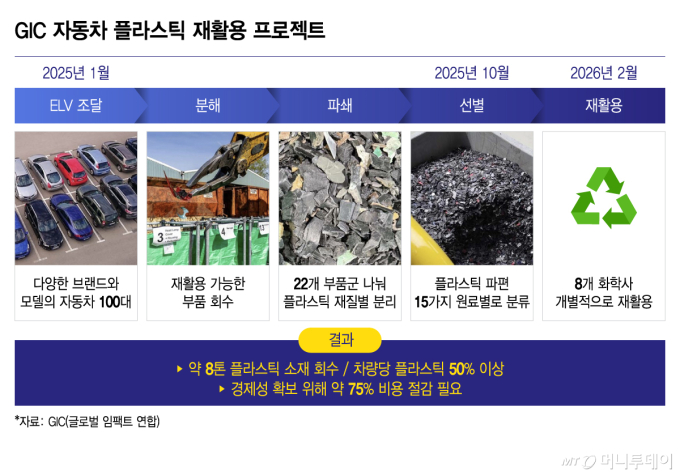
A consortium called GIC (Global Impact Consortium), which includes leading global chemical companies such as BASF, LG Chem, Mitsubishi Chemical, SABIC, and Suez, has conducted an interesting project over the past year. It was an experiment to determine how much plastic used in automobiles can be recycled. Competitors joined hands to commercialize the massive amounts of automotive waste plastics discarded annually.
A total of 100 scrapped cars from various brands and models were used in this project. GIC recovered a total of 8 tons of plastic materials from components such as bumpers, seats, and headlamps of these vehicles. This accounts for about half of all the plastics per vehicle. The recovered plastics are expected to be reborn into approximately 15 types of raw materials, including PE (polyethylene) and PP (polypropylene), through chemical recycling.
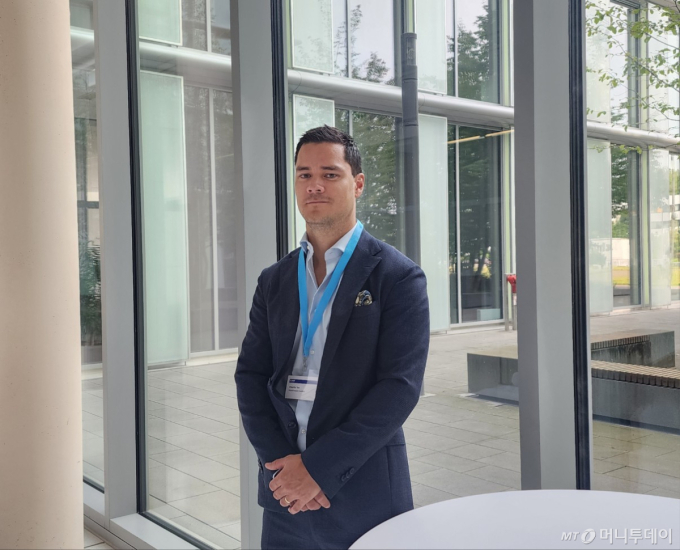
Based on these results, GIC evaluated that the technical foundation for recycling automotive plastics is already fully in place. Charlie Tan, CEO of GIC, stated, "The most encouraging result is that the technology level is far ahead of what many people think," and emphasized, "This proves that a 'closed loop' is possible, where plastics recovered from scrapped cars can be reused as materials for new vehicles." The issue lies in cost. It has been reported that to secure the economic viability of recycling automotive plastics, costs must be reduced by more than 75% compared to current levels.
However, GIC maintains that the cost issue can also be resolved. This is because if a recycling plastic ecosystem reaches a certain level and inter-industry cooperation expands, costs can be sufficiently lowered. For instance, vehicle manufacturers could design cars to facilitate easy recovery of plastics from scrapped vehicles, and expanding automation in dismantling and sorting processes could reduce labor costs. Securing recycling volumes stably to achieve economies of scale could also help improve processing efficiency. GIC explains that sufficient demand for the recycling market must also be supported. If companies gain confidence that a stable market exists for recycled materials, they will actively invest in the infrastructure needed for cost reduction.
Choi Nok-young, a leader at BASF who participated in the project, agreed with this view. Leader Choi said, "What I felt was the biggest obstacle was the lack of experience among companies needed to form a circular ecosystem collaborating with each other," and added, "Cooperation is essential to build a new ecosystem." BASF is researching various recycling technologies such as gasification, depolymerization, and solvent-based recycling with relevant partner companies. It is also broadening its understanding of sorting and classification technologies suitable for existing and future automotive waste.
Based on the technical validation results conducted over the past year, GIC began commercial verification in April. Global automakers such as Valeo and Jaguar Land Rover have also newly joined this project. Over the next year, GIC plans to identify what changes are needed among partners across the entire value chain for large-scale commercialization, develop relevant material specifications, and prepare concrete roadmaps that companies can actually utilize.
CEO Tan stated, "I believe both industry and government must play important roles," and suggested, "The best results will come when the government provides a clear framework and the industry cooperates to solve practical problems."

Resource waste and inability to export… Battle for securing plastics and steel through car recycling
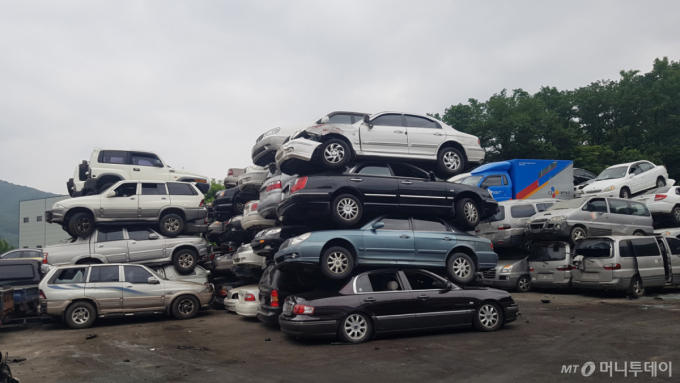
Scrapped cars, composed of steel, aluminum, various plastics, and chemical products, are themselves a treasure trove of resources. The problem is that resource recovery through scrapped cars has not been properly carried out so far. It is understood that annually, 800,000 tons of scrapped car plastics in Europe alone are classified as waste and incinerated or landfilled.
Against this reality, moves to mandate recycling rates are being observed. The EU (European Union) has stipulated that from 2032 onwards, 15% of the plastics used in new cars must be made from recycled raw materials. After 2036, this ratio will surge to 25%. At least 20% of this must be met with plastics derived from vehicle parts removed during scrapping or end-of-life stages.
For South Korea, a resource-scarce nation that is also an automobile exporter, there is no choice but to turn its attention to scrapped car Lisa Ecycle (recycling). If the re-resourceization of scrapped cars is not properly implemented, it will not only waste massive amounts of resources but also make it difficult to sell automobiles in overseas markets. In particular, recycling material regulations in Europe and other regions are interpreted as trade barriers aimed at China. Considering the reality of Korean manufacturing strengthening its role in a de-China value chain, this is undoubtedly a path that must be taken.
Since the Lee Jae-myung government took office, the Ministry of Climate, Energy and Environment has been pushing hard on scrapped car Lisa Ecycle. The Ministry of Climate, Energy and Environment identified scrapped cars as one of the four key items of the 'K-Circular Economy Re-born Project'. Through this, it aims to build an ecosystem involving "scrap yards–preprocessing companies–material companies–parts companies–automakers." According to the government, automakers including Hyundai Motor are building cooperation networks with over 120 major scrap yards nationwide and conducting demonstrations to recover plastics and other materials for reuse in automobile manufacturing.
The key challenge is building a value chain that proceeds from "scrap car procurement→dismantling→shredding→sorting→raw material recovery→new vehicle input." The goal is to increase the resource recovery rate of scrapped cars while simultaneously meeting overseas regulations to ensure no disruptions in automobile exports. The use of automated separation robots for scrapped cars is also being discussed. A representative from the Ministry of Climate, Energy and Environment said, "There are differing interests between the scrap car industry and automakers, so coordination is necessary," and added, "We plan to concretize cooperation measures around the second half of this year."

 in INDUSTRY


