

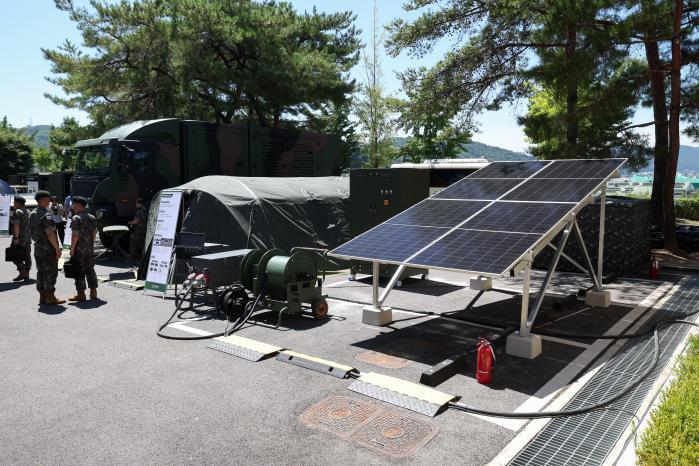
The 'microgrid,' which operates military facilities using self-generated and stored electricity even when external power supply is cut, will be introduced to the army for the first time. The goal is to switch to independent operation within 0.1 seconds in an emergency and supply power to critical facilities for more than 72 hours.
The army announced on the 13th that it will build fixed and mobile microgrids at So Jae (SVP) base in Jangseong County, South Jeolla Province, in collaboration with the Korea Energy Agency by the end of this year, investing a total of 20 billion won. This small-scale independent power grid connects solar power generation facilities, energy storage systems (ESS), and diesel generators into a single platform to supply electricity even when disconnected from the external power grid. A consortium of Hanwha Aerospace and KEPCO will participate in the project.
The army microgrid focuses on ensuring operational continuity during wartime. Many combat units operate away from their garrison locations during wartime, and the demand for power at the battlefield is increasing due to the introduction of advanced equipment such as drones and unmanned systems. During peacetime, it reduces electricity bills and greenhouse gas emissions by utilizing solar power and ESS. The Korea Energy Agency estimates that this will reduce annual electricity costs by about 1.1 billion won and greenhouse gas emissions by 1,756 tCO2eq (carbon dioxide equivalent tons).
The army plans to establish 'ARMY-GRID,' the standard model for military microgrids, based on pilot tests conducted at Sangmu University, which is responsible for military education and training. In connection with MoneyToday's 'Smart Energy Plus (SEP)' event, held from the 28th to 30 at COEX in Seoul, the army will host the '3rd Army Energy Policy Forum' on the first day of the event, the 28th, and is scheduled to introduce next-generation military energy policies, including the microgrid Gi Sul-gwa (SVP) base pilot project.

 in INDUSTRY
