

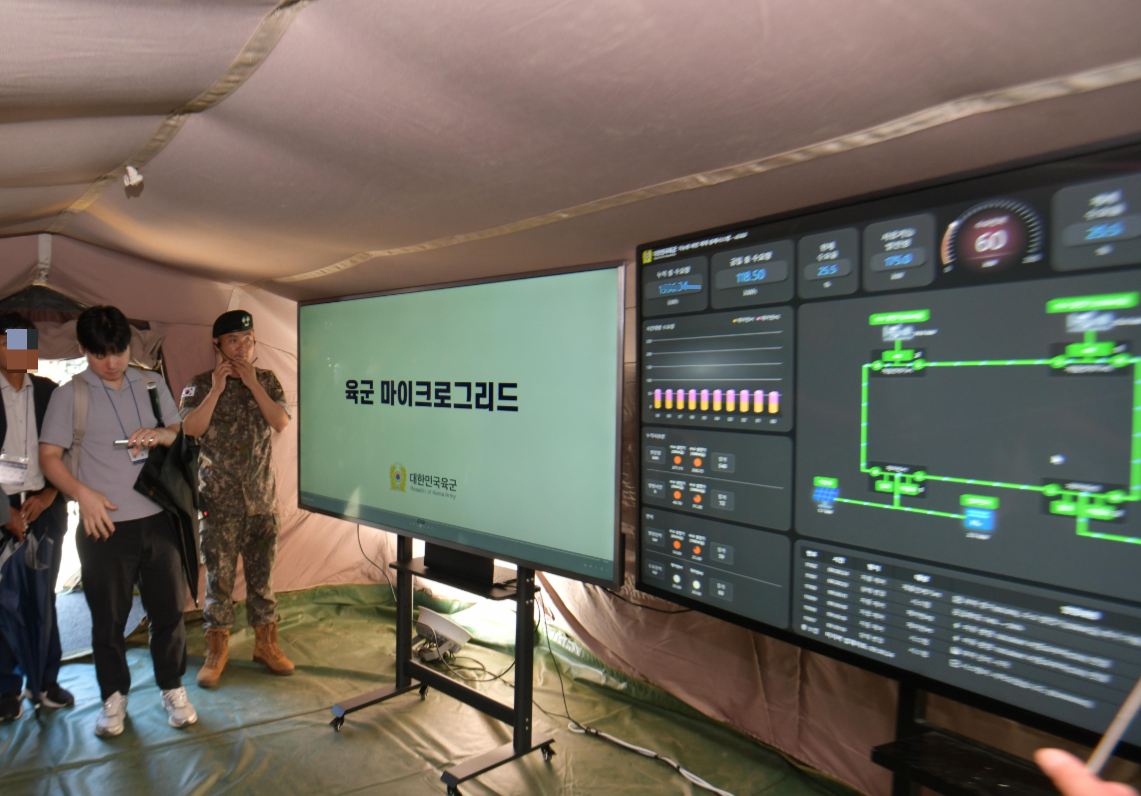
Entering a field temporary command post inside the Army Comprehensive Supply Depot in Sejong City on the 7th, the words "Army Microgrid" appeared on one monitor. On a large screen right next to it, the Energy Management System (EMS) displayed real-time operational status of each facility and power flow as green lines and numerical values.
This screen shows at a glance the process of producing, storing, and supplying electricity by connecting mobile solar power generation facilities, vehicle-mounted energy storage systems (ESS), and diesel generators deployed outside the command post into a single mobile distribution system.
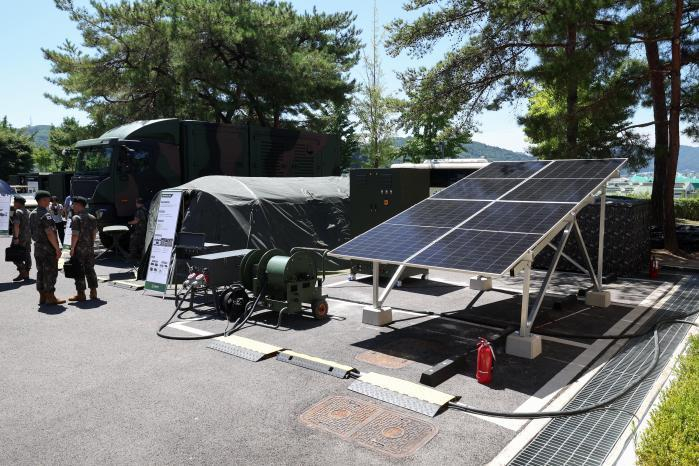
Combination of Solar, ESS, and Diesel...Power Grids Also Move to Operational Areas
A microgrid is a small-scale power grid that connects distributed energy sources within a specific area to produce, store, and consume electricity. During peacetime, it operates while connected to the external power grid, but can switch to an independent power grid in the event of a blackout or disaster.
It is not a system that supplies power solely through solar energy. Electricity generated by solar panels during the day is stored in ESS for use when needed; if generation or stored power is insufficient, diesel generators supplement it. This HYBE-led approach operates multiple power sources redundantly so that even if one source fails, electricity supply continues.
The reason mobile microgrids are essential to the Army is the growing need to quickly reinstall power supply systems in operational areas far from fixed power grids. In fact, during wartime, many units must leave their existing garrisons to carry out missions, while equipment requiring electricity such as drones, unmanned systems, and surveillance devices continues to increase.
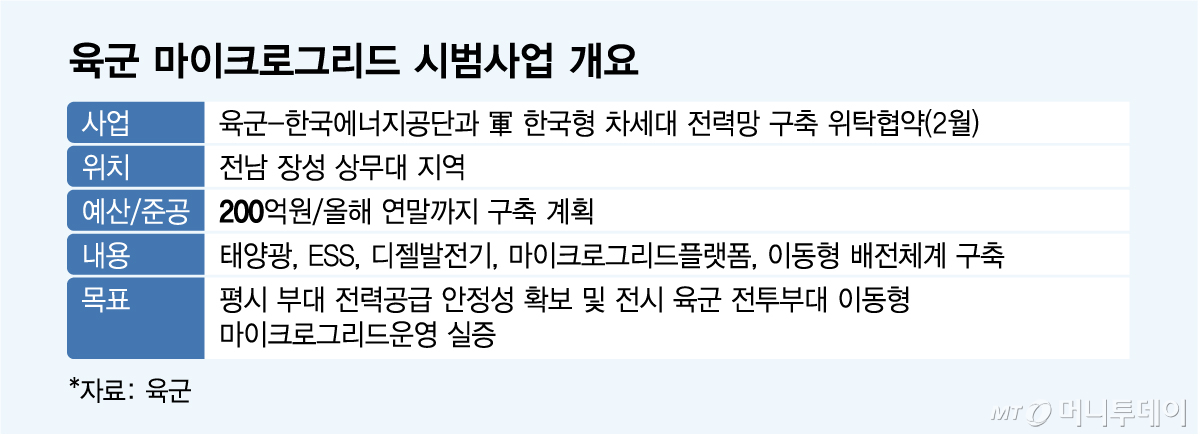
Army Adopts Mobile and Fixed Microgrids
The mobile facilities demonstrated by the Army today will be fully validated at Jang Seong (SVP) units in Jeollanam-do, where the first-ever Army microgrid is being built for military education and training facilities. The mobile equipment includes two 15-kilowatt (kW) solar power generation units, two 110-kilowatt-hour (kWh) vehicle-mounted ESS units, two 100kW vehicle-mounted diesel generators, and a 200kW distribution system. The Army aims to operate this equipment even in difficult terrain and deploy it within 100 minutes after arriving at the site.
At Sangmu Base, alongside mobile facilities, fixed facilities will also be installed, including 3.015 megawatts (MW) of solar power, 9.76 megawatt-hours (MWh) of ESS, and 4 MW of diesel generators. The fixed microgrid connects to the KEPCO grid during peacetime to regulate solar generation and charge/discharge cycles of the ESS.
When external power is cut off, it switches to independent operation within 0.1 seconds and selectively supplies power based on the importance of each facility, ensuring core facilities operate for more than 72 hours. At garrisons, fixed facilities are used; when units move, vehicle-mounted ESS and generation/distribution equipment are transported to operational areas to reconstruct the power grid.
The U.S. Army has completed a base-type microgrid operating core facilities with solar panels and batteries at Fort Hunter Liggett in California in 2024, among other developments. Military microgrids abroad are also evolving into base-type and field-type systems. The current pilot project being validated at Sangmu Base integrates both mobile and fixed microgrid facilities on a single platform for unified operation. The Army explained that it has "maximized the flexibility and responsiveness of defense power grids."
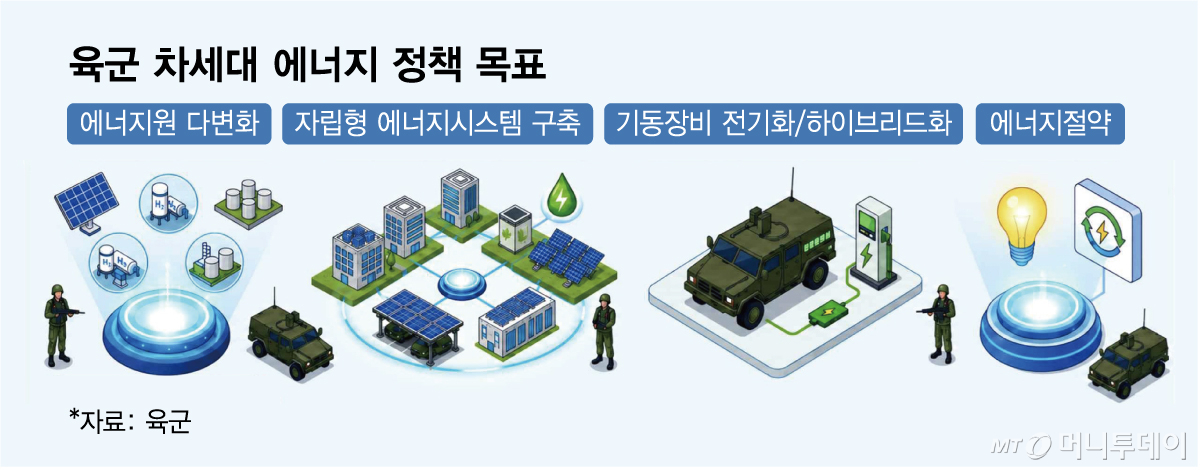
Expanding Power Sources with Hydrogen
The validation at Sangmu Base is the first step in the Army's next-generation energy policy. The Army is diversifying power sources, enhancing the energy self-sufficiency of units, promoting electrification and HYBE-led operations for mobile equipment, and advancing energy conservation.
Accordingly, the Army plans to expand solar power generation in the short term within the microgrid project, connect hydrogen fuel cells and hydrogen-powered vehicles in the medium term, and is conducting core technology research on utilizing ultra-small modular reactors (MMR) as a power source for microgrids in the long term. The Army intends to expand models validated at Sangmu Base to other units.
The Sangmu Base microgrid is also linked to the "Defense RE100 (100% Renewable Electricity Use)" pilot project. Defense RE100 is a project that expands solar power generation for military units in line with the government's energy transition plan. It has two objectives: enhancing independent power supply capabilities during wartime and expanding renewable energy use and energy conservation during peacetime.
Army Logistics Staff Director (Brigadier General) Ha Heon-cheol emphasized, "Securing stable and sustainable power in present-day Daejeon is emerging as a key factor for victory in war," adding, "We will develop an energy supply system that can sustain missions under any circumstances by building an independent power system based on distributed energy."
Meanwhile, the Army's technology and policies of this nature will be introduced in more detail during the "3rd Army Energy Policy Forum" held from the 28th to 30 at Seoul COEX, organized by MoneyToday under the "Smart Energy Plus (SEP)" event. The forum will showcase the validation project for Gi Sul-gwa (SVP) units of fixed and mobile microgrids, Defense RE100, and directions for applying next-generation energy sources such as hydrogen to the military.

 in INDUSTRY


