

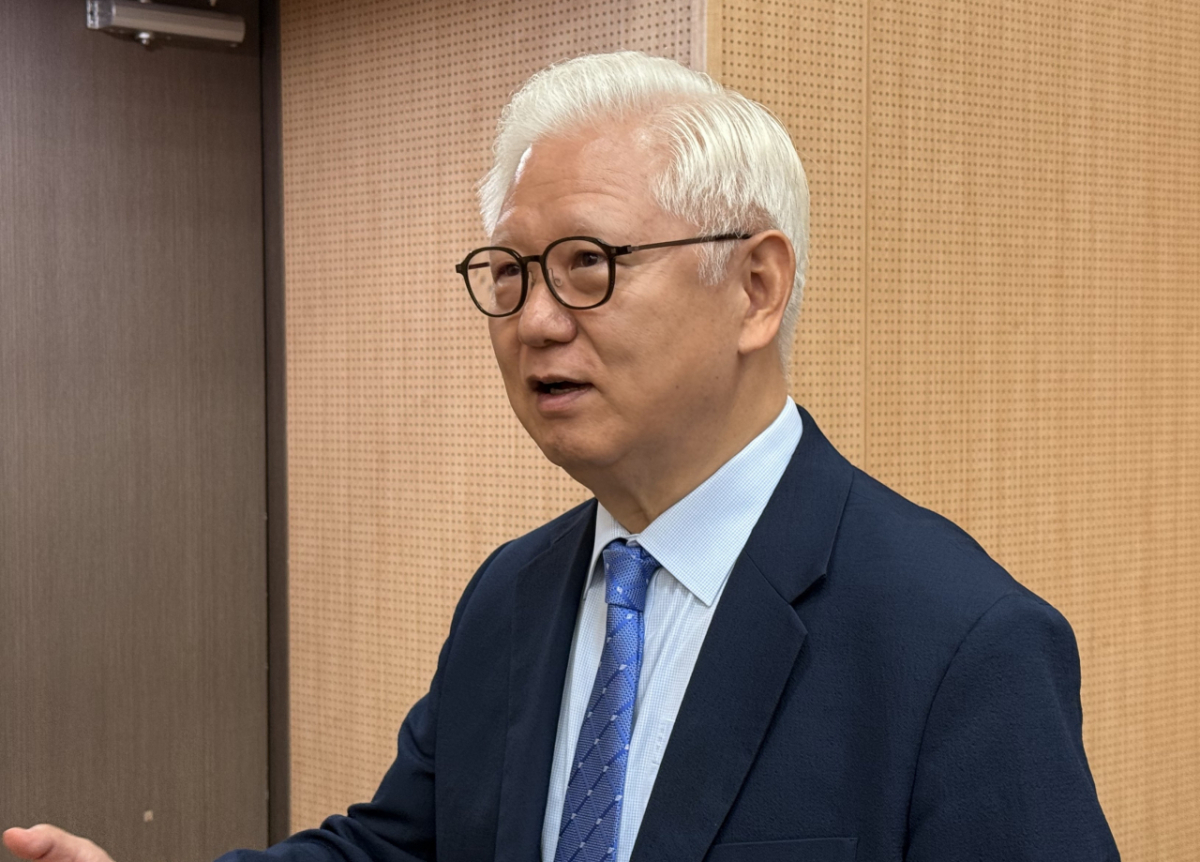
"In hydrogen projects, the government's most important role is not to provide subsidies for individual ventures. What matters is creating a market and trust that enable private sector actors to look ahead and invest."
On the 13th, Director Lee Kwan-young of the Clean Hydrogen Storage and Utilization Strategy Research Unit at Korea Institute of Science and Technology (KIST) met with Money Today at the 'Joint Policy Forum of Major Academic Societies on Energy, Electricity, and Hydrogen' held at the Science and Technology Convention Center in Yeoksam-dong, Seoul, offering this suggestion regarding the government's role in propelling South Korea to become a hydrogen leader nation.
The director stated, "First, the government must present a consistent long-term roadmap outlining how hydrogen will be utilized in power generation, industry, and storage sectors beyond 2030 and 2040." He added, "Since the hydrogen industry requires large-scale upfront investment, if policies repeatedly expand and contract over short periods, private investment will inevitably shrink."
Especially regarding hydrogen R&D (research and development) policy, he emphasized the need to shift the focus from 'basic technology' to a systematic approach leading to 'demonstration and commercialization.' Director Lee noted, "Even with excellent papers and patents, it is difficult to enter overseas markets without demonstration records at MW (megawatt) or GW (gigawatt) levels." He stressed that support must follow the path from basic technology → scale-up → large-scale demonstration → certification → first commercial facilities → exports. He further remarked, "Since private entities cannot bear all risks for initial commercial facilities, the government needs to share a portion of those risks."
He also argued that a 'package strategy' is essential for exporting hydrogen as an industrial product. Director Lee stated, "South Korea is not like the Middle East or Australia, where cheap hydrogen can be produced in large quantities for export. Instead, we possess world-class manufacturing capabilities necessary to industrialize the entire hydrogen value chain—including shipbuilding, EPC (engineering, procurement, and construction), petrochemicals, fuel cells, power equipment, materials and components, and large-scale manufacturing." He continued, "As clean hydrogen and ammonia projects expand in the Middle East, Australia, the United States, and elsewhere, Korean companies will be able to participate not only in electrolyzer systems, storage tanks, hydrogen carriers, ammonia/LOHC (liquid organic hydrogen carrier) technologies, power generation facilities, fuel cells, but also industrial hydrogen utilization equipment. We must move beyond exporting individual components and develop a package industry that integrates production, transportation, storage, and utilization."
The director further advised, "In this process, the government's 'three mega-projects' are extremely important because overseas clients seek to verify actual operational performance and economic viability before purchasing new technologies. Domestic AI data centers, semiconductor clusters, industrial complexes, and renewable energy zones should be utilized as large-scale demonstration and reference sites for Korean hydrogen technologies."

 in INDUSTRY
